Table of Contents
- What Is POS 22 in Medical Billing? The Official CMS Definition for 2026
- POS 22 vs. POS 11, POS 19, and POS 21: The Complete Comparison for Healthcare Providers
- How Split Billing Works for POS 22: CMS-1500 and UB-04 Explained
- POS 22 Reimbursement: Facility Rate, Non-Facility Rate, and What Providers Are Actually Paid
- How Medicare, Medicaid, and Commercial Payers Handle POS 22 Billing
- Which CPT Codes Can Be Billed with POS 22? The Complete Compatibility Guide
- CO-22 Denial Code in Medical Billing: What It Means and How to Fix It
- Does POS 22 Require Prior Authorization? What Healthcare Providers Must Verify by Payer
- How to Determine the Correct POS Code: A Step-by-Step Decision Framework for Providers
- 2026 CMS Updates: The Consolidated Appropriations Act and What It Means for POS 22 Billing
- POS 22 Billing Compliance Checklist: 14 Verification Points Before Every Claim
- How Claimmax RCM Manages POS 22 Billing for Healthcare Providers
- Frequently Asked Questions: POS 22 in Medical Billing
POS 22 in medical billing is the official CMS designation for On Campus-Outpatient Hospital. It identifies that a patient received care within the hospital’s main campus in an outpatient department without being formally admitted. This code goes in Item 24B of the CMS-1500 form for each service line, and it directly determines whether the physician gets paid at the facility rate or the non-facility rate under the Medicare Physician Fee Schedule. That single field controls reimbursement level, compliance exposure, and claim outcome.
The stakes around place of service 22 are higher in 2026 than they’ve ever been. The Consolidated Appropriations Act of 2026 (Public Law 119-75) raised the compliance bar for on-campus versus off-campus classification across the board. Here’s what most providers don’t realize: the OIG doesn’t treat an incorrect POS 22 designation as a paperwork mistake. It’s classified as a payment integrity violation. Billing POS 22 when POS 19 applies, or using POS 11 when POS 22 is required, can flip a claim from paid to denied, or from routine to audited.
This guide covers everything that matters for POS 22 billing in 2026. You’ll find the official CMS definition, facility versus non-facility rate mechanics, CPT code compatibility, CO-22 denial resolution, and a 14-point pre-submission compliance checklist. Claimmax RCM’s full-service revenue cycle management team works with providers across all of these areas daily. The starting point for every POS 22 billing decision is the official CMS definition, and understanding exactly what it requires in 2026.
2026 Policy Alert
The Consolidated Appropriations Act, 2026 (Public Law 119-75), signed February 3, 2026, introduces new Medicare compliance requirements for off-campus outpatient departments effective January 1, 2028. Healthcare providers must now distinguish between POS 22 (on-campus) and POS 19 (off-campus) with greater precision than ever before. See Section 10 for the complete 2026 legislative update.
What Is POS 22 in Medical Billing? The Official CMS Definition for 2026
Most billing staff know POS 22 means “outpatient hospital.” That’s a start, but it’s not the full picture. The complete definition matters because CMS applies it strictly, and the details are what determine whether your claim is coded correctly.
According to the CMS Place of Service Code Set, POS 22 is defined as:
“A portion of a hospital’s main campus which provides diagnostic, therapeutic (both surgical and nonsurgical), and rehabilitation services to sick or injured persons who do not require hospitalization or institutionalization.”
This definition has been in effect since January 1, 2016, as documented in CMS Transmittal 3315, Change Request 9231. It hasn’t changed since then, but how CMS enforces it has become more rigorous, especially with the 2026 legislative updates now in play.
In plain terms, POS 22 applies when a patient visits a hospital-owned outpatient department, gets a CT scan, an infusion, wound care, or a physical therapy session, and goes home the same day without a formal admission order. The key word is “campus.” The facility has to be on the hospital’s main campus to qualify for this code.
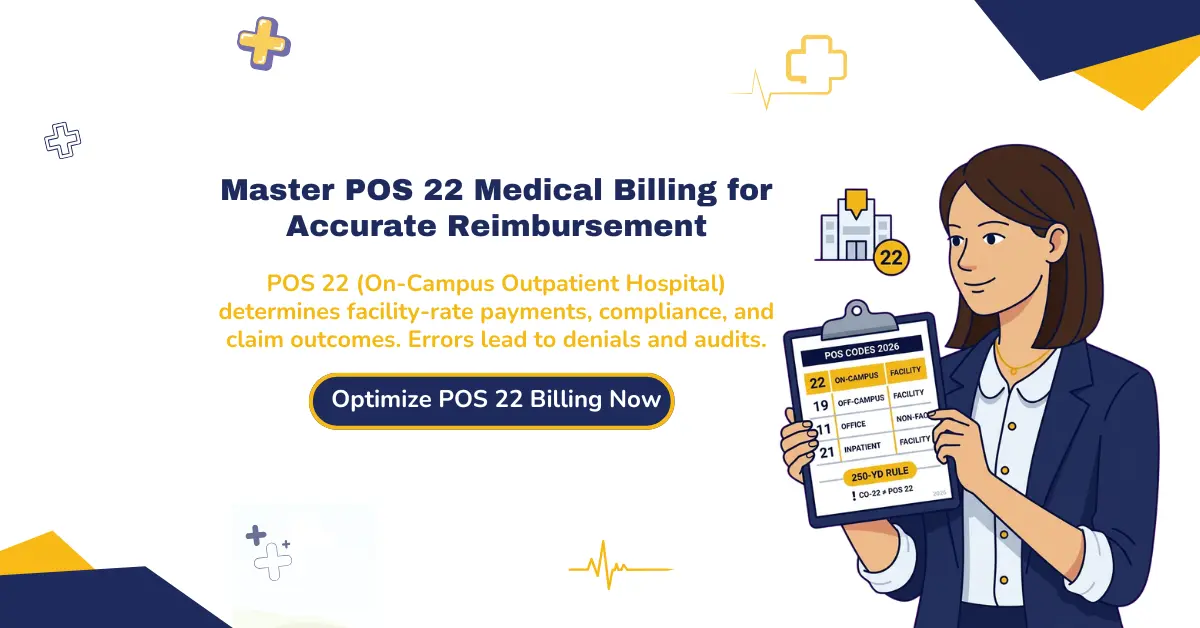
The 250-Yard Rule: What “On-Campus” Means Under CMS Guidelines
CMS doesn’t leave “campus” open to interpretation. The regulatory definition comes from the provider-based rules in 42 CFR 413.65. The campus includes the area immediately adjacent to the main hospital buildings, plus any other structures and areas within 250 yards of those buildings. CMS Regional Offices can also make case-by-case determinations for additional areas.
The practical dividing line works like this:
The 250-Yard Rule
Hospital-owned outpatient facility within 250 yards of the main campus = POS 22 (On-Campus).
Hospital-owned outpatient facility beyond 250 yards = POS 19 (Off-Campus).
Source: CMS provider-based rules, 42 CFR 413.65.
That distance isn’t a guideline. It’s the regulatory boundary. When a hospital opens a satellite clinic three blocks away, that location doesn’t qualify for POS 22, regardless of who owns it. Providers who haven’t measured and documented their facility distances are taking on compliance risk they probably don’t know about.
Where POS 22 Is Reported: Item 24B on the CMS-1500 Form
CMS requires the POS code in Item 24B of the CMS-1500 form, or in the electronic equivalent within the 837P transaction set, for each individual service line. It’s not a header-level field. Every procedure line needs its own POS designation.
POS codes are required fields. A claim submitted without a valid POS code gets returned as unprocessable, typically with CARC 16. Don’t expect the payer to call and ask what you meant.
POS 22 applies only to professional claims submitted by the physician. The hospital’s facility charges for the same encounter are submitted separately on the UB-04 form using OPPS coding. These are two distinct claims for a single patient encounter, and understanding that split is where most of the billing complexity begins.
Understanding what POS 22 means is the first step. The more consequential question, the one that determines reimbursement, compliance, and audit risk, is knowing exactly when to use it.
POS 22 vs. POS 11, POS 19, and POS 21: The Complete Comparison for Healthcare Providers
POS 11, POS 19, POS 21, and POS 22 are the four most commonly confused codes in hospital outpatient billing. Selecting among them isn’t a judgment call. Each code has specific CMS criteria, and billing outside those criteria isn’t a preference issue. It’s an incorrect claim submission with real financial and compliance consequences.
POS Code Comparison: Key Billing Differences
| Feature | POS 11 Office | POS 19 Off-Campus Outpatient | POS 22 On-Campus Outpatient | POS 21 Inpatient Hospital |
| CMS Descriptor | Office | Off Campus-Outpatient Hospital | On Campus-Outpatient Hospital | Inpatient Hospital |
| Patient Status | Not admitted | Not admitted | Not admitted | Formally admitted |
| Ownership | Physician-owned | Hospital-owned | Hospital-owned | Hospital-owned |
| Location | Independent facility | Beyond 250 yards of main campus | Within 250 yards of main campus | Within hospital |
| Overnight Stay Required | No | No | No | Yes, minimum 24 hours |
| Rate Type (Medicare) | Non-Facility, higher | Facility, lower | Facility, lower | Facility, lowest for physician |
| Split Billing | No | Yes | Yes | Yes |
| Claim Form (Hospital) | None | UB-04 | UB-04 | UB-04 |
POS 22 vs. POS 11: Why Hospital Ownership Changes Everything
Here’s the thing most providers get wrong: two clinics can look identical from the waiting room and require completely different POS codes. Physical appearance doesn’t determine the code. Ownership does.
POS 11 applies to services in independently owned physician offices. POS 22 applies when the hospital owns and operates the facility and that location sits on the main campus. A physician renting space in a building across from the hospital uses POS 11. That same physician working in a hospital-owned clinic on campus uses POS 22.
CMS addressed this specifically in the Medicare Claims Processing Manual, Chapter 26. POS 11 can only be used on a hospital campus when the physician maintains separate office space that isn’t a provider-based department under 42 CFR 413.65. That’s a narrow exception, not a general option.
Compliance Note
Billing POS 11 for services in a hospital-owned, on-campus clinic while the hospital simultaneously bills a facility fee may constitute a Stark Law violation under 42 CFR 411.353-411.357. This is a federal compliance risk, not a billing preference.
For a complete breakdown of when POS 11 applies, how it affects reimbursement, and what documentation it requires, see Claimmax RCM’s dedicated resource on POS 11 in medical billing.
POS 22 vs. POS 19: The On-Campus and Off-Campus Distinction
Both POS 19 and POS 22 cover hospital-owned outpatient departments. The only thing that separates them is physical distance from the main campus. CMS created POS 19 through Transmittal 3315 (Change Request 9231), effective January 1, 2016, specifically to track off-campus hospital-based departments for reimbursement purposes.
That distinction matters more now than it did when the codes were created. Starting January 1, 2028, off-campus departments using POS 19 face new NPI and provider-based attestation requirements under the Consolidated Appropriations Act of 2026. A provider that’s been incorrectly billing POS 22 for an off-campus location isn’t just wrong under current CMS rules. That provider is building compounding exposure going into the 2028 implementation deadline.
POS 22 vs. POS 21 and POS 23: When the Setting Changes the Code
POS 21 requires a formal physician admission order and an expected stay of at least 24 hours. The patient isn’t registered as an outpatient. POS 22 never applies to admitted patients. If there’s an admission order, POS 21 is the correct code, full stop.
POS 23 applies when a patient is registered in the hospital emergency department. Per CMS (Medicare Claims Processing Manual, Chapter 26), that registration determines the code, not the physical location of the hospital campus. Procedures performed in an Ambulatory Surgical Center on campus use POS 24. Being on a hospital campus doesn’t make every service a POS 22 service. The patient’s registered setting within that hospital is what determines the specific outpatient code.
Selecting the wrong code across these settings is one of the most common and most preventable sources of claim errors in hospital outpatient billing. Claimmax RCM’s billing team conducts location audits and billing configuration reviews for providers operating across hospital-owned outpatient departments. If you want to know whether your current POS assignments are accurate, our medical billing services are a practical starting point.
How Split Billing Works for POS 22: CMS-1500 and UB-04 Explained
Most billers know POS 22 means hospital outpatient. What they don’t always realize is that every single POS 22 encounter produces two separate insurance claims at the same time. That process is called split billing, and it’s the most operationally misunderstood part of hospital outpatient billing. Two claim forms, two adjudication pathways, and two sets of coding requirements apply to one patient visit.
The Two Claims Every POS 22 Encounter Generates
Claim 1: Professional Fee (Physician)
The physician submits this claim on the CMS-1500 form under the physician’s own NPI and billing address. It covers the cognitive and procedural work: evaluation and management, clinical decision-making, and any procedures the physician personally performed. Medicare adjudicates this claim under the Medicare Physician Fee Schedule at the facility rate. The physician doesn’t bill for the room, the nursing staff, the equipment, or the supplies. Those costs aren’t the physician’s to claim.
Claim 2: Facility Fee (Hospital)
The hospital submits this claim on the UB-04 form under the hospital’s NPI and provider number. It covers everything the physician’s claim doesn’t: the physical space, medical equipment, nursing and support staff, and all supplies consumed during the encounter. Medicare adjudicates the facility fee under the Hospital Outpatient Prospective Payment System (OPPS) using Ambulatory Payment Classification (APC) codes.
Both claims must reference the same date of service, the same patient identification, and compatible procedure codes. A discrepancy between the CMS-1500 and the UB-04 on any of those three points triggers a cross-claim audit flag with the payer. That flag holds both claims pending investigation, not just the one with the error.
What Happens When Split Billing Is Executed Incorrectly
Two errors come up repeatedly in practice, and both create serious problems.
The first is a physician billing POS 11 instead of POS 22 for an on-campus hospital outpatient encounter. When that happens, the physician collects the higher non-facility rate while the hospital simultaneously bills a facility fee for the same visit. Commercial payers and Medicare flag that combination as a payment integrity violation. It isn’t a gray area.
The second error is a data mismatch between the CMS-1500 and the UB-04. If the dates don’t align or the patient identifiers don’t match exactly, the payer may deny both claims pending investigation. In 2026, major commercial payers have deployed AI-driven claim scrubbing systems that automatically cross-reference the physician’s NPI location data against the submitted POS code. Mismatches that might have slipped through five years ago get caught at adjudication now.
The direct financial consequence of POS 22, for both the physician and the facility, is determined by the reimbursement rate structure.
POS 22 Reimbursement: Facility Rate, Non-Facility Rate, and What Providers Are Actually Paid
Reimbursement is where POS 22 decisions become real money. Providers sometimes treat the POS code as a clerical field. It isn’t. Place of service 22 directly controls which fee schedule rate applies, and that rate difference adds up fast across a full billing cycle.
Is POS 22 a Facility or Non-Facility Code? The Definitive Answer
POS 22 is a facility code. Under Medicare and Medicaid billing guidelines, any professional claim submitted with POS 22 is paid at the facility rate, the lower of the two reimbursement tiers under the Medicare Physician Fee Schedule. The facility rate applies because the hospital, not the physician, bears the overhead costs of the outpatient encounter. Those costs are recovered separately through the hospital’s OPPS facility fee claim.
CMS confirms this explicitly: hospital outpatient services billed under POS 19 or POS 22 are paid at the facility rate regardless of where the face-to-face encounter physically occurred within the hospital outpatient department. The location inside the building doesn’t change the rate. The ownership and campus classification do.
How the Facility Rate Compares to the Non-Facility Rate Under Medicare
The rate difference comes down to how Medicare calculates Relative Value Units (RVUs). Every CPT code carries three RVU components: physician work, practice expense, and malpractice. In POS 11 non-facility settings, the physician absorbs all overhead costs, so the practice expense RVU is calculated at the full rate. In POS 22 facility settings, the hospital absorbs those overhead costs through its OPPS claim, so CMS reduces the practice expense RVU accordingly.
Facility vs. Non-Facility Rate: What Changes for the Physician
| Component | POS 11 Non-Facility | POS 22 Facility |
| Physician Work RVU | Full amount | Full amount, unchanged |
| Practice Expense RVU | Full, physician bears overhead | Reduced, hospital bears overhead |
| Malpractice RVU | Full amount | Full amount, unchanged |
| Net Professional Payment | Higher total | 10 to 15% lower typically |
The physician work RVU doesn’t change between settings. What changes is the practice expense component. For the same CPT code, the physician billing POS 22 receives a lower professional fee than the physician billing POS 11. That’s expected, compliant, and by design. The hospital’s separate OPPS facility fee compensates for the overhead the physician isn’t carrying.
The 2026 MPFS Conversion Factor and Its Effect on POS 22 Revenue
The 2026 Medicare Physician Fee Schedule conversion factor is $33.40 for non-qualifying APM participants and $33.57 for qualifying APM participants. CMS also applied a 2.5% efficiency adjustment reduction to work RVUs across approximately 7,700 procedural codes this year.
What that means for POS 22 billing in medical billing is straightforward. Professional payment rates are under incremental downward pressure. When a provider miscodes POS 22 as POS 11 and collects the non-facility rate incorrectly, the overpayment amount per claim is larger relative to where rates currently sit. Payers know this. Payment integrity reviews have intensified specifically because of 2026 rate adjustments. Providers who overcollect through incorrect POS coding face retroactive recoupment demands, and those demands now arrive faster than they did in prior years.
For providers managing POS 22 billing across multiple locations and payer contracts, the rate structure complexity compounds quickly. Claimmax RCM’s revenue cycle management services are built to protect net collections and ensure every POS designation is backed by documentation before the claim goes out.
How Medicare, Medicaid, and Commercial Payers Handle POS 22 Billing
The CMS rules for POS 22 medical billing set the foundation. But Medicare, Medicaid, and commercial payers each apply those rules differently, and assuming they’re the same across the board is where providers run into preventable problems.
Medicare: The Primary Rule-Setter for POS 22 Compliance
Per the Medicare Claims Processing Manual, Chapter 26, when a patient is registered as a hospital outpatient, the physician must report at minimum POS 19 or POS 22 on the professional claim to trigger the facility payment amount under the MPFS. Using POS 11 in that situation produces an incorrect overpayment to the physician. Medicare doesn’t treat that as a coding preference. It’s an improper billing under Medicare’s payment integrity rules.
Medicare’s Recovery Audit Contractors actively review POS coding accuracy. CMS has documented overpayments from practitioners billing the non-facility rate while patients were registered in facility outpatient settings. The HHS Office of Inspector General has published audit findings recommending expanded contractor controls in this specific area.
For infusion billing, the rule is direct: chemotherapy and other infusion services administered in an on-campus hospital outpatient infusion center require POS 22 on the physician’s professional claim. Medicare adjudicates the infusion service through the hospital’s OPPS claim separately. A physician billing infusion services with POS 11 while the hospital bills the OPPS facility fee for the same encounter creates duplicate payment exposure that triggers automatic review.
CMS also requires the hospital department to be properly registered as a provider-based outpatient department under 42 CFR 413.65 before any POS 22 billing from that location is valid. Registration isn’t optional. Claims submitted from unregistered locations carry compliance exposure regardless of how accurate the coding is.
Medicaid: State-by-State Variation and What Providers Must Verify
Medicaid POS 22 policies can’t be generalized. Each state runs its own program with its own requirements, and the variation is substantial. Key differences across state programs include whether provider-based attestation documentation must accompany POS 22 claims, whether specific Medicaid plans require additional modifiers for outpatient hospital services, and whether Medicaid-managed care plans apply different facility rate structures than traditional fee-for-service Medicaid.
Don’t assume your state mirrors Medicare’s approach. Review your specific state’s Medicaid provider manual for POS 22 requirements before submitting claims. If you’re billing across multiple states, each state needs its own verification.
Commercial Payers: Contract-Specific Rules That Require Individual Review
Blue Cross Blue Shield plans, UnitedHealthcare, Aetna, Cigna, Humana: each one applies POS 22 through the lens of its individual provider contract. What varies by contract includes whether the payer differentiates facility from non-facility rates the same way Medicare does, whether site-of-service payment differentials reduce POS 22 professional fee payments, whether the physician’s NPI must be enrolled at the specific hospital outpatient department address on file with the payer, and whether prior authorization is required for specific services at POS 22 locations.
A provider can’t assume commercial payer rules mirror Medicare pos 22 rules. Contract review and payer-specific policy verification are required before billing, not after a denial.
Navigating POS 22 rules across Medicare, Medicaid, and commercial contracts at the same time is exactly the kind of operational complexity that compounds into real revenue loss when it’s not managed consistently. Claimmax RCM handles payer policy verification, claim configuration, and payment reconciliation across all payer types. If POS-related underpayments are sitting in your payment posting workflow, our payment posting service is designed to find and fix them.
Which CPT Codes Can Be Billed with POS 22? The Complete Compatibility Guide
One of the most specific questions billers ask about POS 22 in medical billing is whether a particular CPT code can be submitted with it. There’s no universal answer. Compatibility depends on whether the CPT code is appropriate for an outpatient hospital setting, whether the specific payer allows the combination, and whether the documentation in the chart actually supports it.
E&M Codes (99213 Through 99215) with POS 22: What Billers Need to Know
Evaluation and Management codes 99213, 99214, and 99215 are among the most frequently submitted codes at POS 22 locations. You’ll see them constantly for established patient visits in hospital-owned specialty clinics and primary care offices on campus.
Common E&M Codes at POS 22: Billability Reference
| CPT Code | Description | POS 22 Billable | Key Condition |
| 99213 | Established patient, low complexity | Yes | Documentation must support outpatient hospital setting |
| 99214 | Established patient, moderate complexity | Yes | Most common E&M at POS 22, applies facility rate |
| 99215 | Established patient, high complexity | Yes | High-complexity documentation required |
| 99202 | New patient, low complexity | Yes | Appropriate for new patient encounters in hospital clinic |
| 99205 | New patient, high complexity | Yes | Full documentation of decision-making required |
All five codes are billable with POS 22. The facility rate applies to each one. That means the physician’s reimbursement will be lower than it would be under POS 11 for the same visit, which is expected and correct.
Can 99222 or 99223 Be Billed with POS 22?
CPT 99222 and CPT 99223 are initial hospital inpatient or observation care codes designed for patients who have been formally admitted, which typically requires POS 21, not POS 22. Some payers do accept 99222 or 99223 with POS 22 in specific situations where the patient is registered as a hospital outpatient but the physician provided initial comprehensive care equivalent to inpatient-level evaluation. That’s a narrow exception, not a standard practice.
Action Required: Do not bill 99222 or 99223 with POS 22 without first verifying the specific payer’s policy in writing. Medicare typically requires formal admission for these codes. Submitting them with POS 22 without documented hospital outpatient registration and written payer policy verification creates audit exposure.
Can the GE Modifier Be Used with POS 22?
Yes. The GE modifier can be used with POS 22 in appropriate teaching hospital scenarios. The GE modifier signals that a resident physician provided a service under the Primary Care Exception to Medicare’s teaching physician billing requirements. That exception applies specifically to primary care E&M services, CPT codes 99202 through 99215, when residents provide them in outpatient primary care settings of teaching hospitals.
When residents provide those services in an on-campus hospital outpatient department under the Primary Care Exception, the GE modifier must be appended to the professional claim. Skipping it isn’t a minor oversight. Medicare will deny or downcode the claim without it.
Infusion, Imaging, and Procedure Codes with POS 22
Non-E&M services make up a significant share of POS 22 volume. Here’s a quick reference for codes that come up most often.
Common Non-E&M Codes at POS 22: Billability Reference
| CPT Code | Procedure | POS 22 Billable | Notes |
| 77002 | Fluoroscopic guidance for needle placement | Yes | Radiology, hospital campus imaging department |
| 99153 | Moderate sedation, additional 15 minutes | Yes | Confirm facility has sedation services registered |
| 25609 | Treatment of distal radius fracture | Yes | Orthopedic, hospital outpatient surgical suite |
| G0463 | Hospital outpatient clinic visit | Yes | Medicare-specific, replaces certain E&M codes in hospital outpatient billing |
| 96413 | Chemotherapy administration, IV infusion | Yes | Infusion therapy, separate physician and facility claims required |
For chemotherapy and other infusion therapies administered in an on-campus hospital outpatient infusion center, POS 22 is required on the physician’s professional claim. Medicare adjudicates infusion services through the hospital’s OPPS claim at the facility level. Billing infusion services with POS 11 while the hospital concurrently submits an OPPS infusion facility fee for the same encounter creates a payment integrity conflict. That combination triggers automatic claim review, and it’s one of the patterns RAC auditors look for specifically.
CPT-POS compatibility errors are one of the most common causes of claim rejections in hospital outpatient billing. When those errors age past 90 days, collection becomes difficult and sometimes impossible. Claimmax RCM’s AR Follow-Up team identifies CPT-POS mismatches and resolves them before they reach that point. Learn about our AR follow-up services.
CO-22 Denial Code in Medical Billing: What It Means and How to Fix It
If you searched “CO-22 denial code” and landed here while reading about POS 22 in medical billing, you’re in the right place. But let’s clear something up first, because this confusion costs billing teams real time every week. CO-22 and POS 22 share the number 22. That’s where the similarity ends.
CO-22 vs. POS 22: What Each Code Actually Is
| CO-22 | POS 22 |
| Code Type | Claim Adjustment Reason Code (CARC) |
| Meaning | Another payer may be primarily responsible for this claim |
| Where It Appears | On the Explanation of Benefits (EOB) after adjudication |
These two codes share the number 22. They have no other connection.
What Is the CO-22 Denial Code? The Direct Answer
CO-22 is a Claim Adjustment Reason Code (CARC) meaning: This care may be covered by another payer per coordination of benefits. When a payer posts CO-22 on an EOB, it’s telling you that the payer believes a different insurance carrier should bear primary financial responsibility for the claim. The claim isn’t being denied because of a coding error. It’s being flagged because the payer thinks someone else should pay first.
CO-22 denials show up most often in four situations:
- A patient has Medicare as secondary to an employer group health plan
- A patient carries both commercial insurance and Medicaid
- A spouse’s employer insurance wasn’t disclosed at registration
- The coordination of benefits order in the practice management system wasn’t updated after a coverage change
What usually happens when staff see the CO-22 on the EOB is they try to fix the claim itself. That’s the wrong move. The claim isn’t the problem. The insurance coordination on the account is.
CO-22 Denial Code Solution: A Step-by-Step Resolution Guide
Here’s the resolution process that actually works. Follow the steps in order. Skipping ahead creates more denials.
Step 1: Verify coordination of benefits information at the patient level.
Call the patient directly. Confirm whether any additional insurance coverage exists beyond what’s on file. Ask specifically about a spouse’s employer plan, a Medicare Secondary Payer arrangement, or any Medicaid coverage. Once you’ve confirmed the correct insurance picture, update the coordination of benefits order in your practice management system before you do anything else.
Step 2: Identify the correct primary payer using the MSP questionnaire.
For Medicare patients, pull the Medicare Secondary Payer (MSP) questionnaire the patient completed at the time of service. Medicare’s coordination rules depend on the patient’s employment status, age, disability status, and whether the patient or a spouse is actively working. Review the responses, make a determination, and document it in the account.
Step 3: Refile to the identified primary payer first.
Submit the claim to the correct primary payer with complete patient and insurance information. Don’t refile to the original payer yet. Wait for the primary payer to adjudicate and issue an EOB. Once that EOB comes back, attach it to the secondary claim submission. That sequence matters. Secondary payers require the primary EOB before they’ll process the claim.
Step 4: File a formal appeal if the coordination determination is factually wrong.
Sometimes the CO-22 is incorrect. If the patient genuinely has only one active insurance plan and the payer is flagging a second payer that doesn’t exist, file a written appeal. Include the patient’s insurance verification records, the MSP questionnaire, and any employer letters confirming no secondary coverage. Most payers allow 60 to 180 days from the date of the CO-22 denial to submit an appeal.
Step 5: Audit registration workflows to prevent future CO-22 denials.
CO-22 is largely a front-end problem. Real-time eligibility verification at every patient encounter catches coordination of benefits conflicts before the claim goes out. If CO-22 denials are recurring across your practice, the registration workflow is where the fix belongs.
PR-22 and PI-22 Denial Codes: How They Differ from CO-22
PR-22 and CO-22 carry identical descriptions: “This care may be covered by another payer per coordination of benefits.” The prefix tells you who’s responsible for resolving it.
PR-22 (Patient Responsibility prefix): The payer has designated this as the patient’s problem to fix. The patient needs to contact their other insurer or provide documentation that no secondary coverage exists. When PR-22 appears, contact the patient directly. Guide them through what they need to gather, because most patients won’t know what to do with a PR-22 on their own.
PI-22 (Payer Initiated prefix): The payer made an adjustment based on its own determination that another payer is responsible. This comes up frequently in Medicare Secondary Payer situations where Medicare believes an employer group health plan should be primary. Resolution requires confirming the MSP determination, documenting it, and refiling to the correct primary payer.
All three codes, CO-22, PR-22, and PI-22, require coordination of benefits resolution. None of them requires a POS code correction. A provider who attempts to fix a CO-22 denial by changing the POS code on the claim has misdiagnosed the problem entirely. The POS code on the CMS-1500 has nothing to do with which payer is primary.
Coordination of benefits denials are preventable. When they pile up in the aging report unresolved, they become write-offs. Claimmax RCM’s denial management team catches coordination conflicts at the front end, works through aging CO-22 queues, and builds the workflow changes that keep them from coming back. If this is a recurring problem in your practice, our denial management services are built specifically for this.
While denial codes like CO-22 arise after claim submission, the next category of POS 22 problems occurs before the claim is even submitted, when the prior authorization process isn’t aligned with the service location.
Does POS 22 Require Prior Authorization? What Healthcare Providers Must Verify by Payer
Providers ask this question often, and the confusion is understandable. POS 22 involves a hospital outpatient setting, which triggers an assumption that more approvals must be required. Let’s answer it directly.
The Direct Answer: POS 22 and Prior Authorization Requirements
POS 22 itself does not require prior authorization. Prior authorization requirements are determined by the specific CPT code being performed, the payer, and the patient’s insurance plan, not by the place of service designation alone.
The POS code tells the payer where the service occurred. Prior authorization tells the payer whether the service needed pre-approval before it occurred. These are two separate administrative functions. A POS 22 designation doesn’t exempt any service from prior authorization requirements that would otherwise apply to that CPT code under that payer’s policy.
Prior Authorization by Payer Type: A Reference Guide for POS 22 Services
POS 22 Prior Authorization Requirements by Payer Type
| Payer Type | Prior Auth Required for POS 22 Services | Key Conditions |
| Medicare Traditional | For specific high-cost procedures: advanced imaging, certain surgeries | The hospital outpatient department must be registered as provider-based under 42 CFR 413.65 before any POS 22 billing from that location is valid |
| Medicare Advantage | Frequently required, plan-specific | MA plans often require pre-authorization for procedures that traditional Medicare does not. Verify each MA plan’s current policy independently |
| Medicaid | State-specific: verify the state Medicaid provider manual | Some state Medicaid programs require prior authorization for all facility-based outpatient services regardless of CPT code |
| Commercial Payers | Contract-specific: review individual payer contracts | Most commercial payers require prior authorization for outpatient surgeries, advanced imaging, and infusion services at POS 22 locations |
Providers operating in hospital outpatient departments should build a CPT-specific authorization matrix for each active payer contract. That’s a working reference document mapping which CPT codes require prior authorization at place of service 22 locations under each specific plan. It takes time to build once. It prevents a category of denials that’s entirely avoidable going forward.
What Happens When Prior Authorization Is Missing for a POS 22 Claim
If a required prior authorization wasn’t obtained before a POS 22 service was rendered, the payer denies the claim with CO-15: “Payment adjusted because the submitted authorization number is missing, invalid, or does not apply to the billed services or the provider.” That’s a distinct denial from CO-22 and requires a different resolution path.
Fixing a CO-15 means submitting a retroactive authorization request or filing a formal appeal with clinical documentation supporting medical necessity. Retroactive approval is at the payer’s discretion. In most cases, payers deny retroactive requests for services that should have been authorized in advance.
Missing authorization is one of the most preventable denial types in POS 22 billing. The authorization must exist before the date of service. It must be linked to the specific CPT code and the POS designation. It must be documented in both the patient record and the claim submission. Getting any one of those three elements wrong is enough for a denial.
Claimmax RCM manages the prior authorization process for healthcare providers across all payer types, from submission through approval and documentation, so POS 22 services are authorized before the patient walks in. Our prior authorization service is designed to eliminate this category of preventable denials.
Prior authorization protects the claim before it’s submitted. The next layer of protection is ensuring the claim itself is free from the coding errors that trigger denials at adjudication.
How to Determine the Correct POS Code: A Step-by-Step Decision Framework for Providers
The most preventable source of POS code errors isn’t a knowledge gap. It’s the absence of a decision process at the moment the claim is being built. When billing staff don’t have a structured framework, they default to the most familiar code. That default behavior is the primary driver of POS 22 miscoding across hospital outpatient billing environments.
POS Code Selection Decision Framework
Use this framework at the point of claim creation. Work through each step in order.
Step 1: Was the patient formally admitted to the hospital with a physician admission order?
If yes: use POS 21 (Inpatient Hospital). Stop here. Do not proceed to Step 2.
If no: proceed to Step 2.
Step 2: Is the patient being seen in the hospital emergency department as a registered emergency patient?
If yes: use POS 23 (Emergency Room Hospital). Stop here.
If no: proceed to Step 3.
Step 3: Is the service being performed in an Ambulatory Surgical Center?
If yes: use POS 24 (Ambulatory Surgical Center). Stop here.
If no: proceed to Step 4.
Step 4: Is the facility owned and operated by the hospital, not by the physician or a physician group independently?
If no: use POS 11 (Office). Stop here. For complete POS 11 billing guidance, see Claimmax RCM’s POS 11 in medical billing resource.
If yes: proceed to Step 5.
Step 5: Is the facility located within 250 yards of the main hospital campus buildings, as defined by CMS provider-based rules?
If yes: use POS 22 (On-Campus Outpatient Hospital). This is the correct POS code for your claim.
If no: use POS 19 (Off-Campus Outpatient Hospital). Note the January 1, 2028 compliance requirements for POS 19 locations under the Consolidated Appropriations Act of 2026.
If the distance is uncertain: measure the physical distance and document it before submitting any claims from that location. Contact your RCM team for a location classification audit.
This framework covers the majority of POS coding decisions in hospital outpatient billing environments. Exceptions exist, including telehealth services, skilled nursing facility settings, and rural health clinics, each of which carries its own POS designation. Providers operating across multiple care settings should maintain a written POS assignment matrix organized by location so billing staff don’t have to make this determination from scratch on every claim.
2026 CMS Updates: The Consolidated Appropriations Act and What It Means for POS 22 Billing
2026 is the most legislatively active year for hospital outpatient billing classification since CMS created the POS 19 and POS 22 distinction in 2016. The Consolidated Appropriations Act, 2026 doesn’t redefine POS 22. What it does is raise the compliance stakes around correctly distinguishing on-campus from off-campus designations to a level that didn’t exist before. Providers operating across both POS 22 and POS 19 locations now have a defined implementation deadline and specific obligations attached to it.
The Consolidated Appropriations Act, 2026: What Changed and What Is Coming
The Consolidated Appropriations Act, 2026 (Public Law 119-75), signed into law on February 3, 2026, introduces new Medicare payment conditions for off-campus outpatient departments under Section 6225, effective January 1, 2028.
Three specific conditions apply to off-campus outpatient departments starting on that date:
Condition 1: Services must be billed under a separate National Provider Identifier (NPI) specifically assigned to the off-campus outpatient department, not the hospital’s primary NPI.
Condition 2: The provider must submit an initial provider-based status attestation confirming compliance with 42 CFR 413.65 before billing can commence under the department’s separate NPI.
Condition 3: CMS must establish a formal submission and review process for the attestation through notice-and-comment rulemaking before the January 1, 2028 effective date.
Here’s the direct implication for POS 22 billing: this law doesn’t touch the definition or use of POS 22. What it does is make the on-campus versus off-campus classification decision carry more weight than it ever has. Health systems that have historically billed POS 22 for locations that are actually beyond 250 yards of the main campus now face compounding exposure. Current CMS rules apply to those misclassified locations today. The 2028 implementation requirements add a second layer of compliance risk on top of that.
Medicare Site Neutrality in 2026: The Payment Equalization Trend Affecting POS 22
Medicare site neutrality refers to the policy direction of paying the same rate for equivalent services regardless of whether they’re delivered in a hospital outpatient department or a physician’s office. The rate you receive for a service shouldn’t depend on the building it happened in. That’s the principle CMS has been moving toward for years.
This trend started building momentum with the Bipartisan Budget Act of 2015, Section 603, which established payment parity rules for new off-campus outpatient departments. It didn’t stop there. In 2026, CMS has broadened the categories of services subject to site-neutral payment rates, meaning the facility rate advantage that POS 22 locations have historically held over POS 11 offices is narrowing for specific service types.
For providers billing POS 22 in medical billing, the practical consequence runs in two directions at once. Reimbursement differentials between POS 22 and POS 11 are shrinking on certain CPT codes. Simultaneously, payers are intensifying payment integrity reviews to enforce site-neutral payment rules accurately. That combination means the compliance imperative to use the correct POS designation is increasing at the same time the financial benefit of getting it right is decreasing for some service categories.
What Healthcare Providers Must Do Before January 1, 2028
Four actions need to happen before the deadline. Start on these now, not in 2027.
Action 1: Audit every hospital-owned outpatient location and determine definitively whether it is on-campus, within 250 yards of the main campus as POS 22, or off-campus, beyond 250 yards as POS 19. Don’t rely on historical assumptions. Measure the distance and document it.
Action 2: For all off-campus locations currently billing as POS 19, initiate the provider-based status attestation process under 42 CFR 413.65 and begin obtaining a separate NPI for each affected department. The attestation process takes time. Starting in 2027 won’t be enough.
Action 3: Document the physical distance and ownership status of every outpatient location in a written location classification register. That register needs to be producible in the event of a CMS audit. An undocumented determination is the same as no determination from the auditor’s perspective.
Action 4: Review all active payer contracts for site neutrality provisions that may affect POS 22 reimbursement rates for specific CPT codes beginning in 2026. Some commercial contracts already contain site-neutral payment language that changes what you’re paid, regardless of CMS policy.
POS 22 Billing Compliance Checklist: 14 Verification Points Before Every Claim
POS 22 billing accuracy isn’t a single checkbox at the end of the workflow. Errors enter at scheduling, at documentation, at coding, and at submission. Running through this checklist before every claim goes out catches problems at each of those stages. These 14 verification points represent the complete pre-submission compliance review for POS 22 billing.
- Confirm the service was physically provided within 250 yards of the main hospital campus buildings as defined by CMS provider-based rules.
- Verify that the facility is owned and operated by the hospital, not by the physician or a physician group independently, and that this ownership is documented.
- Confirm the patient was not formally admitted as a hospital inpatient. A formal admission order requires POS 21, not POS 22.
- Verify the patient was not a registered emergency department patient, which requires POS 23.
- Confirm the service was not performed in an Ambulatory Surgical Center, which requires POS 24.
- Verify the outpatient department has active provider-based status registration with CMS under 42 CFR 413.65.
- Apply the facility rate, not the non-facility rate, in the billing system’s fee schedule for this location.
- Confirm the CMS-1500 professional claim and the UB-04 facility claim share the same date of service, patient identifier, and compatible procedure codes.
- Verify that required prior authorization for the CPT code being billed has been obtained and the authorization number is documented on the claim.
- Confirm the CPT code being billed is appropriate for an outpatient hospital setting and is not restricted to inpatient-only use by the payer.
- Verify payer-specific POS 22 requirements, particularly for Medicare Advantage, Medicaid, and commercial contracts, before submission.
- Confirm that clinical documentation explicitly references the care setting in a way that supports the POS 22 designation.
- Apply the GE modifier if a resident is providing primary care E&M services in a teaching hospital outpatient department under the Primary Care Exception.
- For off-campus locations currently using POS 19, confirm that separate NPI and provider-based attestation planning is underway to meet the January 1, 2028 deadline under the Consolidated Appropriations Act, 2026.
Running this checklist before submission doesn’t add significant time to the workflow. Catching a denial management problem before the claim goes out takes minutes. Resolving it after adjudication, through appeals and refiling, takes weeks and doesn’t always succeed.
How Claimmax RCM Manages POS 22 Billing for Healthcare Providers
POS 22 billing errors, from incorrect location classification to CPT-POS mismatches to unresolved CO-22 denials, sit among the most consequential and most preventable revenue leaks in hospital outpatient billing. Providers who consistently receive accurate, timely reimbursement for POS 22 medical billing aren’t doing anything extraordinary. They’ve structured their revenue cycle management to address every point in the POS 22 workflow, not just claim submission.
Credentialing comes first. Before a single POS 22 claim can go out, the provider must be properly credentialed and the outpatient department must have active provider-based status with the payer. Claimmax RCM manages the enrollment and attestation process through our credentialing services, so that POS 22 billing from every location is authorized before the first claim is ever submitted.
POS designation management runs at the encounter level. For providers whose outpatient practice includes both in-person hospital outpatient encounters requiring POS 22 and telehealth services requiring POS 02 or POS 10, cross-coding is a real operational risk. Claimmax RCM manages POS designation at the individual encounter level through our telehealth medical billing services, so in-person and virtual services are never mixed up in the billing system.
The full cycle is covered. Claimmax RCM manages POS 22 billing for healthcare providers across all payer types, from credentialing and prior authorization through claim submission, payment posting, AR Follow-Up, and denial management. Every stage in the workflow has a process behind it.
Providers whose outpatient practice includes both in-person hospital outpatient encounters and telehealth services must ensure each encounter type receives the correct POS designation, a function Claimmax RCM manages at the encounter level.
If you want a team to review your current POS coding practices, identify compliance exposure, and build a billing workflow that protects every POS 22 claim from submission through final payment, contact Claimmax RCM directly. We’ll start with a review of where the gaps are.
Frequently Asked Questions: POS 22 in Medical Billing
What is POS 22 in medical billing?
POS 22 in medical billing is the official CMS designation for On Campus-Outpatient Hospital, a hospital-owned outpatient department on the hospital’s main campus where patients receive diagnostic, therapeutic, or rehabilitation services without being formally admitted. The code is reported in Item 24B of the CMS-1500 form and determines whether the physician is reimbursed at the facility rate under the Medicare Physician Fee Schedule.
Is POS 22 a facility or non-facility code?
POS 22 is a facility code. Under Medicare billing guidelines, professional claims submitted with POS 22 are paid at the facility rate, the lower reimbursement tier, because the hospital bears the overhead costs of the outpatient encounter and bills a separate facility fee through the Hospital Outpatient Prospective Payment System.
What is the difference between POS 22 and POS 11?
POS 11 (Office) applies to services in independently owned physician offices and is paid at the higher non-facility rate. POS 22 (On-Campus Outpatient Hospital) applies when the hospital owns and operates the facility on its main campus and is paid at the lower facility rate. Ownership, not physical appearance, is the determining factor. For complete POS 11 guidance, see Claimmax RCM’s POS 11 in medical billing resource.
What is the difference between POS 22 and POS 19?
POS 22 (On-Campus Outpatient Hospital) applies to hospital-owned outpatient departments within 250 yards of the main hospital campus. POS 19 (Off-Campus Outpatient Hospital) applies to hospital-owned departments located beyond 250 yards. Starting January 1, 2028, under the Consolidated Appropriations Act, 2026, off-campus departments (POS 19) must meet new NPI and provider-based attestation requirements.
What is the difference between POS 21 and POS 22?
POS 21 (Inpatient Hospital) requires a formal physician admission order and an expected hospital stay of at least 24 hours. POS 22 (On-Campus Outpatient Hospital) is used when the patient receives services without formal admission and returns home the same day. When a patient has an admission order, POS 21 applies, not POS 22.
Can you bill 99214 with POS 22?
Yes. CPT 99214 (Established Patient Office or Outpatient Visit, Moderate Medical Decision Making) is one of the most commonly submitted E&M codes with POS 22, typically for established patient visits in hospital-owned specialty clinics on the main campus. The claim is reimbursed at the facility rate under POS 22, which is lower than the non-facility rate paid under POS 11 for the same code.
Can we bill 99215 with POS 22?
Yes. CPT 99215 (Established Patient Office or Outpatient Visit, High Medical Decision Making) can be billed with POS 22 when the service is provided in an on-campus hospital outpatient department and documentation supports high medical complexity. The claim is paid at the facility rate. Clinical documentation must fully support the high-complexity level before submitting.
Can 99222 be billed with POS 22?
CPT 99222 is designed for initial hospital inpatient or observation care, which typically requires POS 21 for admitted patients. Some payers accept 99222 with POS 22 when the patient is a registered hospital outpatient receiving initial comprehensive care. This combination requires written payer policy verification before submission. Don’t bill 99222 with POS 22 without confirming the specific payer’s authorization in writing.
Can the GE modifier be used with POS 22?
Yes. The GE modifier (Primary Care Exception) can be used with POS 22 in teaching hospital settings where a resident provides primary care E&M services in an on-campus outpatient department under the Medicare Primary Care Exception. Without the GE modifier in this scenario, Medicare will deny or downcode the claim.
Does POS 22 require prior authorization?
POS 22 itself does not require prior authorization. Prior authorization requirements are determined by the specific CPT code being performed, the payer, and the patient’s plan, not by the POS designation. Many services commonly performed at POS 22 locations, including outpatient surgeries, advanced imaging, and infusion therapy, do require prior authorization from most payers.
What is the CO-22 denial code and how is it different from POS 22?
CO-22 is a Claim Adjustment Reason Code meaning: this care may be covered by another payer per coordination of benefits. It is a coordination of benefits denial that appears on the Explanation of Benefits after adjudication. POS 22 is a Place of Service code entered on the CMS-1500 before adjudication. The two codes share the number 22 but have no operational connection.
What is the PR-22 denial code?
PR-22 is a Claim Adjustment Reason Code with the same description as CO-22, this care may be covered by another payer per coordination of benefits, but with the PR (Patient Responsibility) prefix. PR-22 designates the coordination of benefits issue as the patient’s responsibility to resolve. The billing team should contact the patient directly and guide them through verifying the correct insurance coverage order.