A billing coordinator at a busy orthopedic practice picks up the phone and calls the insurance company. “I need to verify the patient’s eligibility for an MRI,” she says. The rep on the other end pauses, then asks: “Do you need eligibility verification or prior authorization?”
The coordinator hesitates. Aren’t those the same thing?
That moment of confusion plays out in medical practices every single day. And it’s one of the most expensive misunderstandings in healthcare billing. AMA reports that 35% of claim denials tie back to eligibility or authorization errors. A significant chunk of those denials happen because practices treat these two processes as interchangeable. They’re not.
Here’s how big this problem really is. According to the 2025 CAQH Index, the healthcare industry spends $43 billion annually on eligibility and benefit verification transactions alone. That investment gets wasted when a practice doesn’t understand what it’s actually verifying versus what needs separate authorization.
This guide breaks down the exact differences between Eligibility Verification & Prior Authorization: what each process does, when each is required, who performs them, and where one ends and the other begins. We’ll cover what happens when they’re confused, the real dollar cost of that confusion, and how the 2026 CMS Interoperability Rule changes both processes differently. This isn’t a general overview. It’s a precision comparison built to protect your revenue cycle from the specific denials that confusion causes.
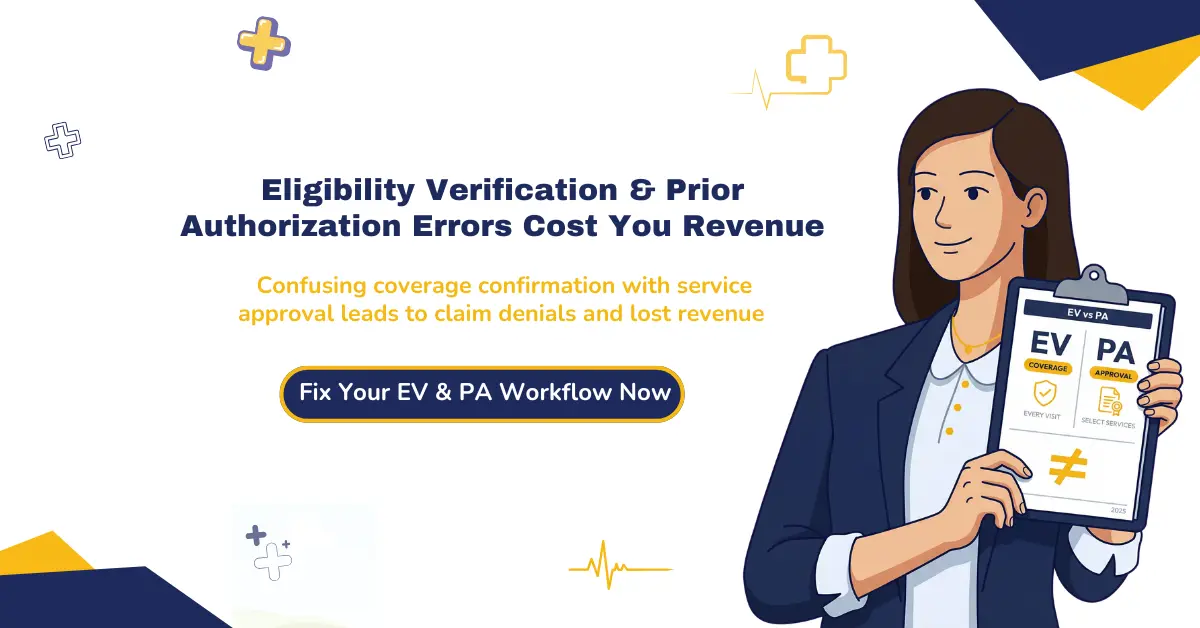
The key difference between eligibility verification and prior authorization is their purpose in the medical billing process. Insurance eligibility verification confirms that a patient’s insurance coverage is active and identifies specific benefits, copays, deductibles, and coverage limitations before any visit. Prior authorization is a separate step that secures advance approval from the patient’s insurance payer for specific procedures, treatments, or medications based on medical necessity. Eligibility verification applies to every patient at every visit, while prior authorization is required only for designated services, and one cannot substitute for the other.
What Is Insurance Eligibility Verification?
Insurance eligibility verification is the process of confirming that a patient’s insurance coverage is active, identifying their specific plan benefits, and determining their financial responsibilities, including copays, deductibles, coinsurance, and out-of-pocket maximums, before healthcare services are provided.
This eligibility verification process in medical billing answers one foundational question: “Does this patient have valid insurance that will cover services at this facility?” It doesn’t answer whether a specific procedure has been approved. That distinction, between confirming coverage and securing approval, is the core of the Eligibility Verification & Prior Authorization difference.
Don’t underestimate how often this step gets overlooked. Experian Health’s State of Claims 2024 survey found that eligibility issues are cited by 15% of providers as a leading cause of claim denials. Most of those are preventable with a thorough check before the patient walks through the door.
Core Elements of an Eligibility Check
Every eligibility and benefits verification check should confirm six things. If your team is skipping any of these, you’re leaving money on the table.
- Active Policy Status: Is the insurance policy valid and in effect on the date of service?
- Coverage Scope: Which medical services and treatments does this specific plan actually cover?
- Patient Financial Obligations: What are the copay, remaining deductible balance, coinsurance percentage, and out-of-pocket maximum?
- Network Status: Is your provider or facility in-network or out-of-network for this patient’s plan?
- Benefit Limitations: Are there visit limits, annual maximums, frequency restrictions, or plan exclusions that apply?
- Coordination of Benefits: Does the patient carry secondary or tertiary insurance, and which payer is primary?
Notice what eligibility verification does not do. It doesn’t determine whether a specific procedure has been pre-approved by the insurer. That’s the role of prior authorization, which we’ll cover next.
Is your team verifying all six of these elements for every patient, or just checking if the policy is active? Incomplete verification is one of the most common causes of preventable denials. If this sounds familiar, talk to our team about tightening your front-end workflow.
What Is Prior Authorization in Healthcare?
Prior authorization, also called pre-authorization, pre-approval, or pre-certification, is the process by which a healthcare provider obtains advance approval from a patient’s insurance company before delivering specific medical services, procedures, treatments, or medications. It confirms that the proposed care is medically necessary and covered under the patient’s plan.
Here’s where the contrast matters. While insurance eligibility verification confirms that a patient has insurance and identifies their general benefits, prior authorization goes a step further. It asks the payer to evaluate and approve a specific service before it’s delivered.
Think of it this way. Eligibility verification asks, “Does this patient have coverage?” Prior authorization asks, “Will you approve and pay for this specific procedure?”
The volume of this work is staggering. According to the AMA’s 2024 Prior Authorization Physician Survey, the average physician practice completes 39 prior authorization requests per week, spending roughly 13 hours on the process. And 93% of physicians report that prior authorization causes delays in patient care.
Services That Commonly Require Prior Authorization
Not every service triggers a prior authorization requirement. But certain categories almost always land on the payer’s designated list.
- Advanced Diagnostic Imaging: MRI, CT scans, and PET scans, where payers verify that less expensive alternatives have been considered first
- Non-Emergency Surgical Procedures: Joint replacements, bariatric surgery, and spinal procedures
- Specialty Medications: Biologics, oncology drugs, and specialty pharmaceuticals that carry step therapy requirements
- Extended Therapy Programs: Physical therapy, occupational therapy, or speech therapy beyond an initial visit threshold, typically six to 12 visits
- Durable Medical Equipment (DME): Prosthetics, powered wheelchairs, CPAP machines, and continuous glucose monitors
- Out-of-Network Referrals: When a patient’s plan requires pre-approval for specialists outside the network
If your practice handles any of these service types regularly, our prior authorization services can help streamline the submission and tracking process.
The critical distinction is this: eligibility verification is required for every patient at every visit. Prior authorization is triggered only when a specific service falls on the payer’s designated list. Understanding which process applies, and when, is the foundation of the Eligibility Verification & Prior Authorization comparison we break down in the next section.
Eligibility Verification & Prior Authorization: Side-by-Side Comparison
Both processes are defined. Now let’s make the difference between eligibility verification and prior authorization concrete, across every dimension that actually matters to your billing team.
This table covers 12 factors where insurance verification and prior authorization diverge: purpose, timing, frequency, personnel, method, turnaround, risk, and financial impact. Bookmark this. When there’s any uncertainty about which process a situation calls for, this table gives you the answer in seconds.
| Factor | Eligibility Verification | Prior Authorization |
| Primary Purpose | Confirms that the patient has active insurance and identifies their plan benefits | Secures the insurer’s advance approval for a specific procedure, treatment, or medication |
| Core Question It Answers | “Does this patient have valid, active insurance coverage?” | “Will the insurer approve and pay for this specific service?” |
| When It’s Performed | At scheduling, 48 to 72 hours before the visit, and again at check-in | Before specific designated services, typically days to weeks before the procedure |
| How Often It’s Required | Every patient, every visit, no exceptions | Only when a specific service appears on the payer’s prior authorization requirements list |
| Who Performs It | Front desk staff, billing team, or outsourced RCM partner | Clinical staff (provide documentation) + billing/admin team (submit and track the request) |
| What Information Is Checked | Policy status, copays, deductibles, coinsurance, network status, coordination of benefits | Medical necessity, clinical documentation, diagnosis codes, treatment appropriateness |
| Method / Systems Used | EDI 270/271 electronic transactions, payer portals, clearinghouse, PMS integration | Payer portals, fax, phone, electronic PA (ePA) platforms, or FHIR APIs (2027) |
| Typical Turnaround Time | 2 to 10 seconds (real-time) or overnight (batch) | 72 hours (urgent) to 7 calendar days (standard) under CMS-0057-F |
| What Happens If Skipped | Claim denied for inactive coverage or incorrect insurance information | Automatic claim denial, service not approved, often non-appealable without prior approval |
| Financial Risk Per Missed Instance | $150 to $500 per denied claim | $500 to $10,000+ per denied claim depending on the procedure |
| Patient Impact If Missed | Unexpected bills for services insurance won’t cover | Delayed or completely denied access to medically necessary treatment |
| Output / Documentation | Eligibility confirmation with coverage details and patient responsibility breakdown | Authorization reference number, approval validity period, approved service count and conditions |
Here’s the simplest way to think about it. Eligibility verification is the foundation: it confirms the patient has valid coverage at all. Prior authorization is the gate: it secures approval to deliver a specific service through that coverage.
They’re sequential and connected. They are not interchangeable. Skipping eligibility verification means submitting a claim to potentially inactive coverage. Skipping prior authorization means delivering a service the insurer never agreed to cover. Both create claim denials, but for fundamentally different reasons.
Not sure which step is causing your denials, verification gaps or authorization misses? Our team can audit your front-end workflow and pinpoint exactly where the breakdown is happening. Request a free workflow assessment.
Where Eligibility Verification Ends and Prior Authorization Begins
Knowing what eligibility verification and prior authorization are is only half the battle. The real challenge in the Eligibility Verification & Prior Authorization question is knowing exactly where one process ends and the other begins in your daily workflow. That transition point is where most errors happen.
In a well-run practice, this eligibility verification process in medical billing flows directly into a prior authorization determination. No gap. No handoff to a different team without communication. No assumption that completing one process means the other is covered. The transition is a specific moment with specific triggers, and understanding it prevents the most common and costly billing mistakes.
The Four-Step Handoff: From Coverage Confirmation to Service Approval
Step 1: Complete Insurance Eligibility Verification
Confirm active coverage, copays, deductibles, benefits, and network status through EDI 270/271 transactions or your payer portal. Document the results: eligibility confirmed with full benefits breakdown on file.
Step 2: Check Prior Authorization Requirements
Immediately after eligibility is confirmed, check one thing: does the planned service require prior authorization from this specific payer? Use automated PA-flagging tools, the payer’s authorization requirement list, or a direct portal query.
This is the handoff moment. Eligibility verification is complete. The authorization determination begins right here.
Step 3: Route Based on the PA Determination
If prior authorization is not required, document “no PA required” with the date for your audit trail. Schedule and deliver the service.
If prior authorization is required, route to clinical staff for documentation gathering and proceed to PA submission. One rule matters more than any other at this step: never schedule or deliver a PA-required service based solely on eligibility confirmation.
Step 4: Submit PA Before Service Delivery
Gather clinical documentation, including physician orders, ICD-10-CM codes, CPT codes, and clinical notes. Submit through the payer’s designated channel with complete documentation. Record the authorization reference number, approval period, and approved services. Then, and only then, schedule and deliver the service.
If your practice needs support with prior authorization submission, our team handles the entire process from documentation gathering through approval tracking.
Why the Handoff Is Where Most Billing Errors Happen
In most practices, eligibility verification and prior authorization are handled by different people. Front desk verifies eligibility. The billing team handles PA. That handoff between roles is exactly where information gets lost.
The common mistakes look like this: assuming eligibility confirmation means PA isn’t needed, verifying eligibility but never checking PA requirements, routing PA requests without the verified eligibility data (which forces redundant work), or completing PA weeks ago but never re-verifying eligibility on the actual date of service.
According to MGMA data, practices with integrated EV-to-PA workflows experience 30% to 40% fewer front-end denials than practices that treat these as disconnected processes. That gap is significant.
The solution is treating the difference between eligibility verification and prior authorization as two phases of a single medical billing workflow, not as separate tasks assigned to separate people without a structured handoff.
The handoff between eligibility verification and prior authorization is where most practices lose revenue without realizing it. ClaimMax RCM’s integrated front-end workflow eliminates the gap: our team verifies eligibility and handles authorization as a single, connected process. See how our prior authorization services work.
Why Healthcare Practices Confuse Eligibility Verification and Prior Authorization
The confusion between Eligibility Verification & Prior Authorization isn’t a sign that your team is doing something wrong. It’s a systemic issue driven by overlapping terminology, shared payer platforms, and one simple reality: both processes involve calling or querying the same insurance company about the same patient.
When one phone call to Aetna can cover both eligibility and authorization questions, it’s natural for staff to blur the line. But that blur is exactly where revenue leaks start.
The Five Root Causes of the Confusion
1. Overlapping Terminology
Insurance companies, EHR systems, and even medical billing textbooks use inconsistent language. Some payers call authorization “pre-certification.” Others refer to eligibility checks as “benefit verification in medical billing” contexts. When the terms shift depending on the payer, staff default to treating them as variations of the same process. That inconsistency masks the real difference between eligibility verification and prior authorization, and it creates problems downstream. Proper credentialing and payer contracting helps your team understand each payer’s specific terminology from the start.
2. Same Payer, Same Portal, Different Process
Both eligibility checks and prior authorization submissions often happen through the same payer portal. A billing coordinator logs into Availity to check eligibility, then uses that same platform to submit a PA request. The shared interface creates a false sense that these are one process. They’re two distinct functions with different inputs, different outputs, and different consequences when missed.
3. Combined Staff Roles in Smaller Practices
Large hospital systems assign eligibility verification and prior authorization to separate departments. Smaller practices, which make up the majority of U.S. healthcare providers, often have a single staff member handling both. When one person does both tasks under time pressure, the mental boundary between them erodes. Steps get skipped.
4. Training Gaps
Most new billing staff learn eligibility verification and prior authorization together during onboarding. Without explicit training on where one process ends and the other begins (the handoff we covered above), staff naturally compress them into a single mental workflow. The distinction never gets reinforced.
5. The “We Already Checked” Assumption
This one’s the most dangerous. A front desk staff member runs insurance eligibility verification, sees active coverage and imaging benefits, and assumes the scheduled MRI is authorized. Eligibility confirmation is not authorization. But under time pressure, the assumption gets made, and the claim comes back denied.
Recognizing these root causes is the first step toward fixing them. The next question is: what does this confusion actually cost your practice?
What Confusing Eligibility Verification with Prior Authorization Costs Your Practice
The financial damage from confusing eligibility verification with prior authorization is different from simply skipping one of them. And it’s worse in a specific way: the confusion creates a false sense of security. Your team believes it completed the necessary pre-service checks. The claim looks correct on paper. But it gets denied because the wrong process was performed.
Here’s why insurance verification volume alone doesn’t solve this. The 2025 CAQH Index shows the healthcare industry spends $43 billion annually on insurance eligibility verification transactions. Yet a significant portion of those checks still fail to prevent denials. The reason? They address coverage status without also addressing authorization requirements. The problem isn’t the volume of checks. It’s performing the right check at the right time.
The Denial Cost Breakdown: When EV and PA Get Mixed Up
Each row in this table represents a confusion scenario we see regularly. Not a case where the practice did nothing, but a case where the practice did the wrong thing.
| Confusion Scenario | What Actually Happened | Financial Impact Per Incident | Annual Risk (at 2 to 3/month) |
| Verified eligibility, assumed PA not needed | Service required PA but it was never submitted | $500 to $3,500 per denied claim | $12,000 to $42,000 |
| Submitted PA, never re-verified eligibility | Insurance had lapsed before service date | $150 to $500 per denied claim | $3,600 to $6,000 |
| Checked coverage, confused it with authorization | Eligibility confirmed active, but specific procedure not pre-approved | $800 to $2,500 per denied claim | $9,600 to $30,000 |
| Used expired authorization, thought EV covered it | Authorization expired; only eligibility was re-verified | $400 to $1,500 per denied claim | $4,800 to $18,000 |
| Total estimated annual loss from confusion | $30,000 to $96,000 |
Source: Compiled from MGMA cost data and industry research
These aren’t worst-case projections. They reflect what happens in practices that actively perform verification and authorization work but confuse which process applies when. The practice is doing work. It’s just doing the wrong work at the wrong time.
Beyond Denials: The Hidden Costs of Confusion
Claim denials are the visible damage. But the cascading costs run deeper than the denied amount on a remittance.
Staff rework and frustration. Each confused denial takes five to 20 hours to investigate, appeal, and resubmit. Staff morale drops fast when their work keeps producing denials despite genuine effort. That frustration drives turnover, which makes the confusion problem even worse.
Patient trust erosion. When a patient hears “we verified your insurance” and then receives a surprise bill because PA wasn’t obtained, they don’t blame the payer. They blame your office. Billing disputes and negative reviews follow.
Cash flow disruption. Denied claims delay payment by 30 to 120 days. Confusion-based denials carry appeal success rates below 20%, which means most of that revenue requires specialized denial management to recover, if it’s recoverable at all.
Compliance exposure. When authorization-required services are consistently billed without auth numbers, payers notice. Systematic confusion between EV and PA can trigger payer audits that create even bigger problems than the denials themselves.
Opportunity cost. Every hour spent reworking confused claims through AR follow-up is an hour not spent on proactive verification for upcoming appointments. That’s how practices get stuck in a cycle of reactive billing that never quite gets ahead.
The total cost of confusing eligibility verification with prior authorization isn’t just the denied claims. It’s the operational drag that keeps your practice from ever achieving clean billing at scale across the revenue cycle.
If your practice is losing revenue despite actively verifying insurance, the problem may not be effort. It may be confusion between the two processes. ClaimMax RCM’s integrated front-end workflow makes sure the right check happens at the right time for every patient. Want to see where your breakdowns are? Get a free denial analysis.
Real-World Scenarios: Seeing the Difference Between Eligibility Verification and Prior Authorization in Practice
The clearest way to understand the difference between eligibility verification and prior authorization is to watch what happens when a practice completes one but confuses it with the other. These three scenarios play out in medical offices every week. In each case, the outcome comes down to whether the practice understood which process was needed at which moment.
These aren’t hypothetical. They’re composites drawn from common denial patterns that billing teams deal with constantly.
Scenario 1: The Orthopedic MRI, Eligibility Confirmed, Authorization Missed
The patient. Sarah, 41, referred by her orthopedic surgeon for a right knee MRI after a sports injury. She carries Cigna PPO insurance.
What the practice did. Front desk ran an eligibility and benefits verification check 48 hours before the appointment. Cigna PPO was active. Imaging benefits were covered. The $400 imaging deductible had $250 remaining. Staff collected the estimated patient portion at check-in, and the MRI was performed.
What the practice missed. Nobody checked whether Cigna requires prior authorization for outpatient MRI. It does. Cigna PPO requires PA for all advanced imaging through eviCore. Insurance eligibility verification confirmed coverage. It did not confirm approval for this specific procedure. The practice confused “covered benefit” with “authorized service.”
The result. The claim went to Cigna and came back denied immediately: “Prior authorization required, not obtained.” Hard denial. No retroactive authorization option. The practice absorbed the full MRI facility cost of $1,800. Sarah got a refund request for her copay portion and lost trust in the office’s billing.
What should have happened. After confirming eligibility, the billing team should have immediately checked Cigna’s PA requirements for CPT 73721 (MRI knee without contrast). PA should have been submitted with clinical documentation, ICD-10 M23.51 and CPT 73721, before the MRI was even scheduled. With prior authorization services handling that step, the claim would have been clean from the start.
Financial impact. $1,800 in lost revenue plus $45 in staff rework time plus patient satisfaction damage. That’s $1,845 or more lost from confusing eligibility verification with prior authorization on a single claim.
Scenario 2: The Physical Therapy Series, Authorization Obtained, Eligibility Lapsed
The patient. Michael, 52, beginning a 12-session physical therapy program after lumbar spine surgery. He carries UnitedHealthcare (UHC) through his employer.
What the practice did. Prior authorization was properly obtained for all 12 PT sessions, valid for 90 days. Authorization reference number was documented. Sessions were tracked. Sessions one through six were completed and paid without issues.
What the practice missed. Michael’s employer switched insurance carriers from UHC to Aetna effective the first of the following month. The practice had the authorization and assumed everything was covered for all 12 sessions. Nobody re-verified insurance verification before sessions seven through 12. The practice confused “active authorization” with “active coverage.”
The result. Sessions seven through 12 went to UHC and came back denied: “Patient not eligible, coverage terminated.” The authorization was valid. The insurance was not. Six denied claims at $165 average reimbursement each: $990 gone. Michael was confused because he thought everything was approved. The practice now had to verify Aetna eligibility, check whether Aetna requires a new PA, and potentially restart the entire authorization process. That delay meant denial management work on top of the lost revenue.
What should have happened. Even with an active authorization, eligibility should be re-verified at every visit, or at minimum weekly during an ongoing treatment series. At session seven, a real-time eligibility check would have flagged the coverage change immediately. Staff would have paused treatment, contacted Michael about the insurance switch, verified Aetna eligibility, and submitted a new PA request to Aetna before resuming therapy.
Financial impact. Six denied sessions at $165 equals $990 plus roughly $60 in staff rework for new verification and PA under Aetna, plus a two-to-three-week treatment delay for the patient. That’s $1,050 or more lost from confusing active authorization with active eligibility.
Scenario 3: The Annual Wellness Visit, When Only Eligibility Verification Is Needed
The patient. Karen, 65, scheduling her annual wellness visit at her primary care office. She carries Original Medicare, not Medicare Advantage.
What the practice did right. Staff ran eligibility verification through HETS (HIPAA Eligibility Transaction System) confirming active Medicare Part B coverage. The annual wellness visit was covered at 100% as a preventive benefit, no copay, deductible waived for preventive services. Staff checked whether an annual wellness visit under Original Medicare requires prior authorization. It doesn’t. Medicare doesn’t require PA for routine preventive visits. Staff documented “PA not required” in the patient record for the audit trail. Service delivered. Claim submitted. Paid in 18 days.
Why this example matters. This scenario shows the other side of the confusion. Sometimes staff waste time seeking authorization for services that don’t require it. Submitting unnecessary PA requests adds three to five days of processing time per request, delays scheduling, and eats up staff bandwidth that should go toward services that actually need PA.
The “PA not required” documentation is just as valuable as a PA reference number. It proves the practice made a deliberate determination rather than simply forgetting to check.
Knowing when PA is not needed saves as much time and money as knowing when it is. That knowledge comes directly from understanding the difference between eligibility verification and prior authorization.
Time saved. About 45 minutes of unnecessary PA submission work avoided per patient. Across 20 similar patients per month, that’s 15 hours of staff time reclaimed monthly by correctly distinguishing EV-only visits from PA-required visits.
What These Scenarios Tell Us
The pattern is clear. Practices that consistently treat Eligibility Verification & Prior Authorization as connected but separate checks get paid faster and more reliably. Practices that blur the line face predictable, preventable losses.
Do any of these scenarios look like your practice’s Monday morning? If denied claims keep coming back despite your team actively checking insurance, the issue might be which check they’re performing, not whether they’re performing one. Talk to our team about fixing your front-end process.
Prior Authorization vs. Referral vs. Pre-Certification: Clearing Up the Full Confusion
The confusion between eligibility verification and prior authorization is the most common mix-up in medical billing. But it’s not the only one. Practices regularly blur the lines between three related terms: prior authorization, pre-certification, and referral.
All three involve contacting payers before delivering care. Each one serves a different purpose, carries different requirements, and creates different problems when missed. Here’s how to tell them apart.
The Difference Between Prior Authorization and Pre-Certification
The difference between pre-authorization and pre-certification trips up even experienced billers, partly because many payers use the terms interchangeably.
Pre-authorization is formal approval from the insurance company confirming that a specific proposed service is medically necessary and will be covered. Pre-certification is broader. It confirms the patient meets the plan’s general criteria for a service category, but it doesn’t always guarantee payment for the specific instance.
Here’s the practical distinction. A prior authorization comes with an authorization reference number, a defined approval period, and specific approved service codes. Pre-certification may only confirm that the service type is eligible under the plan. It won’t necessarily commit the payer to paying for your particular case.
The safest approach? Always obtain a formal authorization reference number with clearly stated approval dates and approved CPT codes, regardless of what the payer calls the process. If they call it “pre-cert,” fine. Get the reference number anyway.
One more related term worth knowing: insurance predetermination. It provides a coverage estimate for a planned service but is explicitly not a guarantee of payment. You’ll see this most often in dental and complex surgical cases.
The Difference Between Prior Authorization and a Referral
Prior authorization vs. referral confusion causes a surprising number of preventable denials, yet almost nobody explains the distinction clearly.
A referral is a recommendation from a patient’s primary care physician directing that patient to a specialist or specific facility. Prior authorization is approval from the insurance company confirming that a specific service will be covered.
Referrals are provider-to-provider. The PCP refers the patient to a cardiologist, an orthopedist, or a surgical center. That’s a clinical routing decision made by a physician.
Prior authorization is provider-to-payer. The provider requests approval from the insurance company. That’s a coverage and payment decision made by the plan.
Some plans require both. HMO and certain POS plans often need a PCP referral and prior authorization from the payer for the same specialist visit. Other plans, most PPOs, skip the referral requirement entirely but still require prior authorization for specific procedures.
A referral does not substitute for prior authorization. Prior authorization does not substitute for a referral. They’re parallel requirements from different entities. Understanding each plan type’s referral and PA requirements starts with proper credentialing and payer contracting, where these rules get established upfront.
Confusing these two leads to claims denied either for “no referral on file” or “no prior authorization,” depending on which one your team missed.
Quick-Reference: When Each Process Applies
| Term | Who Issues It | What It Confirms | Guarantee of Payment? | Required For |
| Eligibility Verification | Payer system (automated) | Patient has active coverage and specific benefits | ❌ No, confirms coverage only | Every patient, every visit |
| Referral | Primary Care Physician (PCP) | Clinical recommendation to see a specialist | ❌ No, clinical routing only | HMO, POS, and some EPO plans |
| Pre-Certification | Insurance company | Patient meets general criteria for a service category | ⚠️ Partial, confirms eligibility for service type but may not guarantee payment | Varies by payer and plan |
| Prior Authorization | Insurance company | Specific service is medically necessary and approved for coverage | ✅ Strongest coverage commitment (with reference number) | Designated services per payer PA list |
| Predetermination | Insurance company | Estimated coverage amount for a planned service | ❌ No, estimate only, not binding | Often used in dental and complex medical cases |
When in doubt, obtain the most protective approval available: a formal prior authorization with a reference number, approval dates, and approved service codes. No practice has ever been penalized for having too much documentation on file.
2026 CMS Rule Update: How CMS-0057-F Changes Eligibility Verification and Prior Authorization Differently
The CMS Interoperability and Prior Authorization Final Rule (CMS-0057-F), with key provisions effective January 1, 2026, reshapes both insurance verification and prior authorization workflows. But it doesn’t change them equally.
This rule applies to Medicare Advantage organizations, Medicaid managed care plans, CHIP entities, and QHP issuers, covering the majority of insured Americans. CMS projects these policies will generate approximately $15 billion in savings over ten years by cutting administrative burden.
What matters for your practice is understanding which process gets the bigger overhaul and why.
What Changed for Prior Authorization Under CMS-0057-F
Prior authorization absorbs the heaviest regulatory changes, and it’s not close.
Shorter decision timelines. Impacted payers must now respond within 72 hours for urgent requests and seven calendar days for standard requests. Previously, turnaround times stretched well beyond 14 days with little accountability.
Mandatory specific denial reasons. When PA is denied, payers can no longer send generic rejection codes. They must provide specific clinical reasoning, giving your team actionable information for appeals instead of guesswork.
Public metrics reporting. Starting March 31, 2026, payers must publish PA approval rates, denial rates, appeal overturn rates, and average decision turnaround times on their public websites.
That last point is a game changer. For the first time, practices can compare payers’ PA performance side by side. That data informs contract negotiations, referral decisions, and how you prioritize workflow around specific payers.
What Changed (and Didn’t Change) for Eligibility Verification
Here’s where the Eligibility Verification & Prior Authorization distinction shows up in regulatory focus.
CMS-0057-F is primarily a prior authorization reform. Eligibility verification was not the target. But there are indirect effects worth understanding.
What did change: The rule’s broader interoperability requirements improve the data infrastructure both processes rely on. Better data exchange standards ultimately make eligibility verification faster and more accurate over time.
Patient Access API requirement (effective January 2027): Payers must give patients electronic access to their claims, encounters, and plan information through FHIR-based APIs. This improves the data patients can share with providers during insurance eligibility verification.
What did not change: There are no new CMS-mandated timelines or reporting requirements specifically for eligibility verification transactions. The existing EDI 270/271 standards remain the primary electronic method. And as the 2024 CAQH Index shows, 96% electronic adoption for eligibility verification means the infrastructure was already mature.
The regulatory pressure falls overwhelmingly on prior authorization because that’s where the greatest administrative burden and patient care delays exist. Eligibility verification was already working. PA was not. The difference in regulatory attention mirrors the operational difference: one is a data lookup, the other is a clinical decision process requiring systemic reform.
2027 Preview: FHIR-Based APIs and the Future of Both Processes
By January 1, 2027, impacted payers must implement FHIR-based Prior Authorization APIs. These allow electronic submission, real-time tracking, and automated decision receipt for PA requests.
The long-term goal is straightforward: make prior authorization as fast as eligibility verification already is today. Real-time PA decisions at the point of scheduling, not days or weeks later.
CMS has also created a MIPS measure for electronic prior authorization under Promoting Interoperability, giving providers a financial incentive to adopt electronic PA workflows now.
But convergence is still years away. Until then, the operational reality holds: eligibility verification is a five-second electronic check, while prior authorization is a multi-day clinical review process. Understanding this difference in speed, complexity, and regulatory focus helps practices allocate staff time and technology investment where it actually matters.
Best Practices for Managing Eligibility Verification and Prior Authorization as a Connected Workflow
These aren’t general billing tips. The protocols below target one specific problem: the confusion between Eligibility Verification & Prior Authorization that costs practices thousands every year. They’re the foundation of an effective revenue cycle management strategy built around front-end accuracy.
Practices that implement structured dual-check protocols consistently report first-pass claim approval rates above 95% and front-end denial rates below 4%. The difference comes down to treating verification and authorization as two distinct steps in one connected process, not as interchangeable tasks.
Build a Pre-Appointment Dual-Check Protocol
Think of this as two layers that always run in sequence. Skipping either one, or running them out of order, creates the exact gaps that lead to preventable denials.
Layer 1: Insurance Eligibility Verification (Every Patient, Every Visit)
This is the eligibility verification process in medical billing that catches coverage problems before they become claim problems.
- At scheduling: run an initial eligibility check to confirm active coverage
- 48 to 72 hours before the appointment: batch verification with a full benefits breakdown
- Day of service: real-time insurance eligibility verification at check-in to catch last-minute changes
Layer 2: PA Determination (Immediately After Eligibility)
Once eligibility comes back clean, ask the next question immediately: does the planned service require prior authorization from this specific payer? Don’t wait. Don’t assume.
- If yes: route to your PA submission workflow before confirming the appointment
- If no: document it. Record “PA not required, verified [date]” in the patient record
Here’s the rule that prevents confusion. Layer 2 must always follow Layer 1. A clean eligibility check doesn’t mean PA isn’t needed. And a PA obtained weeks ago doesn’t mean the patient still has active coverage today.
📋 Download Our Free Dual-Check Verification Protocol: A step-by-step checklist your team can use to ensure both eligibility verification and PA determination are completed for every patient, every time. [Download Now, PDF]
Create a Payer-Specific Authorization Requirements Matrix
One of the most common confusion triggers is applying one payer’s rules to a different payer’s claims. A living authorization matrix eliminates this problem.
Build a document that lists each major payer’s PA requirements by service type and CPT code range. Include the payer name, which services require PA, the submission channel (portal, fax, or ePA), required documentation, expected turnaround time, and any auto-approval thresholds.
Update it quarterly when payer bulletins drop. PA requirements change frequently, sometimes mid-year, and staff memory isn’t a reliable substitute for a current reference document.
Make the matrix accessible to everyone involved in scheduling, verification, and authorization. Front desk, billing team, clinical coordinators: all of them.
One important detail that catches people off guard: BCBS operates as 34-plus independent companies. Each one can have different PA requirements even under the same brand name. Your matrix needs to reflect that.
Never Assume: Always Document the PA Determination
For every scheduled service, document whether PA is required or not required. Both outcomes need a record.
When PA is required, record the authorization reference number, approval dates, approved services, and any conditions attached to the approval.
When PA is not required, record that too: “PA determination: not required for [CPT code] under [payer name], verified [date].”
This “negative documentation” practice does two things. It proves your team made a deliberate determination rather than an oversight. And it creates an audit trail that protects you if a payer retroactively disputes the claim. Proper PA documentation also accelerates payment posting by ensuring clean claims match authorization records on the back end.
Train staff to understand that documenting “PA not required” isn’t optional. It’s a protective compliance measure that takes 30 seconds and can save thousands in disputed revenue.
Re-Verify Eligibility Even When Authorization Is Active
This one addresses a failure pattern we covered earlier: PT sessions denied because eligibility lapsed while the authorization was still technically active.
Active authorization does not mean active coverage. A patient’s insurance status can change monthly due to job loss, plan switches, Medicaid redetermination, or simple policy lapses. Industry data shows roughly a 12% monthly insurance status change rate across patient populations.
Set a hard rule for your team. During multi-visit authorizations, re-verify eligibility at minimum every 30 days. For single-visit authorizations, re-verify on the date of service, even if PA was obtained weeks earlier.
Consider the post-pandemic Medicaid unwinding: Kaiser Family Foundation Medicaid unwinding data shows over 25 million people disenrolled, creating massive eligibility volatility in that population. If your practice sees any Medicaid patients, skipping re-verification during active authorizations is a guaranteed path to write-offs.
Should You Outsource Eligibility Verification and Prior Authorization?
Managing insurance verification and prior authorization correctly as two distinct but connected processes requires dedicated staffing, technology, training, and constant payer-rule monitoring. For many practices, especially small-to-midsize groups, maintaining that level of precision in-house just isn’t realistic.
HFMA reports that 92% of healthcare leaders cite staffing difficulties as a top challenge. When you can’t keep verification and authorization roles consistently filled and trained, accuracy drops and denials climb.
That said, neither approach is universally better. The right call depends on your practice size, specialty, payer mix, current denial rates, and existing staff capacity.
In-House vs. Outsourced: A Direct Comparison
| Factor | In-House Management | Outsourced to RCM Partner |
| Staffing Requirement | One to three dedicated FTEs depending on volume | Partner provides trained specialists as needed |
| Technology | Practice purchases and maintains verification and PA software | Partner provides technology as part of the service |
| Payer Knowledge | Limited to staff experience with your specific payer mix | Broader expertise across hundreds of plans and specialties |
| Training Burden | Practice handles ongoing training as payer rules change quarterly | Partner’s team stays current on payer changes as a core competency |
| Scalability | Difficult to scale during volume spikes, turnover, or expansion | Easily scalable; partner adjusts resources to match volume |
| Cost Structure | Fixed costs: salaries, benefits, software, training | Variable costs: per-patient or percentage-based |
| EV-to-PA Integration | Depends on internal process discipline | Systematized workflows with built-in handoff protocols |
| Denial Prevention | Dependent on individual staff diligence | Systematized quality checks and error-prevention workflows |
| Best For | Large practices with dedicated billing departments and low turnover | Small-to-midsize practices, high-volume specialties, practices with denial rates above 8% |
Signs It’s Time to Outsource Your Front-End Workflow
Not every practice needs insurance verification outsourcing. But if several of these sound familiar, it’s worth a serious conversation.
Your front-end denial rate exceeds 8 to 10%, and eligibility or authorization errors keep showing up as leading causes. Staff turnover in billing roles creates constant knowledge gaps, so verification quality fluctuates depending on who’s working that week.
Your team frequently confuses eligibility confirmation with authorization approval. That’s the core problem this entire article addresses, and if it’s happening regularly, your training and workflow structure need more support than any single hire can provide.
Growth is outpacing capacity. New providers, new locations, or new specialties are pushing verification volume beyond what your current staff can handle accurately. You’re spending more hours on denial rework and appeals than on proactive, pre-service verification.
And maybe the clearest signal: you don’t have a formal authorization requirements matrix. Your team relies on individual memory for payer-specific PA rules, which means every resignation takes institutional knowledge out the door.
A qualified RCM partner doesn’t just check eligibility or submit PA requests in isolation. The right partner integrates verification, authorization, claims submission, AR follow-up, denial management, and payment posting into a single, cohesive revenue cycle management workflow where the handoff between EV and PA is built into the system.
ClaimMax RCM provides end-to-end insurance eligibility verification services and prior authorization management with a built-in dual-check protocol that eliminates the confusion between these two critical processes.
- ✅ Real-time and batch eligibility verification
- ✅ End-to-end prior authorization submission and tracking
- ✅ Integrated EV-to-PA handoff with no gaps and no confusion
- ✅ Payer-specific expertise across Medicare, Medicaid, and commercial plans
Want to see how this works for your practice? Schedule a free consultation and let’s look at your front-end workflow together.
Frequently Asked Questions: Eligibility Verification & Prior Authorization
What is the difference between eligibility verification and prior authorization?
The difference between eligibility verification and prior authorization comes down to what each process confirms. Insurance eligibility verification checks whether a patient’s coverage is active and identifies their specific benefits, copays, and deductibles before a visit. Prior authorization is a separate step that secures the insurance company’s advance approval for a specific procedure, treatment, or medication based on medical necessity.
Eligibility verification is required for every patient at every visit. Prior authorization is required only for services on the payer’s designated PA list. Completing one doesn’t fulfill the requirement for the other. They’re two distinct checkpoints in your front-end workflow, and skipping either one creates different types of claim denials.
Can a claim be denied even if eligibility was verified?
Yes. A clean eligibility check confirms the patient has active insurance, but it doesn’t confirm that a specific service has been pre-approved. If the planned procedure requires prior authorization and that authorization wasn’t obtained before the service was delivered, the payer will deny the claim.
That denial hits even though the patient’s insurance is active and the service is technically a covered benefit. This is the most common consequence of confusing eligibility verification with prior authorization, and it accounts for a significant portion of preventable claim denials across healthcare practices.
Is eligibility verification the same as prior authorization?
No. Eligibility Verification & Prior Authorization represents two separate processes with different purposes in medical billing. Eligibility verification checks whether a patient has active insurance and what their plan covers. Prior authorization secures the insurer’s approval for a specific service before it’s delivered.
Treating them as the same process, or assuming that completing one fulfills the other, is a leading cause of preventable denials. One confirms coverage exists. The other confirms a specific service has been approved under that coverage. Both are necessary, and neither substitutes for the other.
What is the difference between pre-authorization and pre-certification?
Pre-authorization is formal approval from the insurance company confirming that a proposed service is medically necessary and will be covered. It typically comes with an authorization reference number and a defined approval period. Pre-certification is broader: it confirms the patient meets the plan’s general criteria for a service category but doesn’t always guarantee payment for the specific instance.
The difference between pre-authorization and pre-certification gets murky because many payers use the terms interchangeably. The safest practice is to always obtain a formal authorization reference number regardless of what the payer calls the process. If you have a reference number with approval dates and approved CPT codes, you’re protected.
What is the difference between a referral and prior authorization?
A referral is a recommendation from a patient’s primary care physician directing the patient to a specialist. It’s a provider-to-provider clinical routing decision. Prior authorization is approval from the insurance company confirming coverage for a specific service. It’s a provider-to-payer payment decision.
Some plans, particularly HMOs, require both a referral and prior authorization vs referral for the same specialist visit. Most PPO plans require only authorization without a referral. A referral doesn’t substitute for prior authorization, and prior authorization doesn’t substitute for a referral. They’re parallel requirements from different entities, and missing either one triggers a different type of denial.
Who is responsible for Eligibility Verification & Prior Authorization?
Insurance eligibility verification is typically handled by front desk staff, patient registration teams, or an outsourced RCM partner using automated electronic systems. The process is largely data-driven and doesn’t require clinical input.
Prior authorization requires collaboration between clinical and administrative staff. Clinicians provide the medical documentation proving necessity, while billing or administrative staff submit the request, track its status, and follow up with the payer. In smaller practices, one person may handle both. But understanding that they’re two separate responsibilities with different inputs and skill requirements is essential for building an accurate workflow.
How long does eligibility verification take compared to prior authorization?
Insurance eligibility verification is typically completed in two to 10 seconds when performed electronically through EDI 270/271 transactions. Batch processing runs overnight and handles entire schedules at once.
Prior authorization takes significantly longer. Under the CMS-0057-F rule effective January 2026, payers must respond within 72 hours for urgent requests and seven calendar days for standard requests. Before this rule, turnaround stretched well beyond 14 days. That difference in speed is one of the clearest distinctions between the two processes and has real implications for how you staff and schedule.
What happens if you skip eligibility verification?
If insurance verification is skipped and the patient’s coverage has lapsed, changed, or was entered incorrectly, the claim gets denied for inactive or incorrect coverage. The average cost of an eligibility-related denial runs $150 to $500 per claim when you factor in staff rework time.
Patients also take a hit. They receive unexpected bills for services they assumed were covered, which leads to billing disputes, collection challenges, and potential patient attrition. Eligibility should be verified for every patient at every visit, including returning patients, because insurance status can change monthly due to employment changes, plan switches, or policy lapses.
What happens if you skip prior authorization?
If a required prior authorization isn’t obtained before a service is delivered, the insurance company will deny the claim, even if the patient has active coverage and the service is a covered benefit. This is typically a hard denial with limited appeal options and an appeal success rate below 15 to 20%.
Financial impact ranges from $500 to over $10,000 depending on the procedure. Retroactive authorization is rarely available. The AMA reports that 82% of physicians say prior authorization issues sometimes lead to patients abandoning recommended treatments entirely, creating both revenue and care-quality consequences.
Does every service need prior authorization?
No. Prior authorization is required only for services on each payer’s specific PA requirements list. Common categories include advanced imaging (MRI, CT, PET scans), non-emergency surgeries, specialty medications, extended therapy programs, durable medical equipment, and out-of-network referrals.
Routine office visits, preventive care, and emergency services generally don’t require prior authorization. But here’s the catch: requirements vary by payer, plan type, and sometimes by state. Never assume a service does or doesn’t need authorization without checking the specific payer’s current PA list. What one payer auto-approves, another may require full clinical review for.
Does every visit need eligibility verification?
Yes. Eligibility verification should happen for every patient at every visit, including established patients returning for follow-ups. Industry data shows approximately 12% of patients experience insurance status changes monthly due to employment changes, plan modifications, Medicaid redetermination, or policy lapses.
Best practice calls for verification at three points: at scheduling, 48 to 72 hours before the appointment through batch insurance verification, and at check-in through real-time re-verification. Even patients with active multi-visit authorizations should have eligibility re-verified at each session. An authorization doesn’t help if the patient’s coverage went inactive between visits.
Can prior authorization be denied even if the patient is eligible?
Yes. Active insurance coverage doesn’t guarantee that every service will be approved through prior authorization. Payers may deny a PA request if clinical documentation doesn’t adequately establish medical necessity, if less intensive treatment alternatives haven’t been tried first (step therapy requirements), if the requested service doesn’t align with the payer’s clinical guidelines, or if the submission is incomplete.
This is a critical distinction in the Eligibility Verification & Prior Authorization comparison. Eligibility verification confirms coverage exists. Prior authorization evaluates the clinical appropriateness and necessity of a specific service under that coverage. A patient can be fully eligible and still have a PA request denied.
How does the 2026 CMS rule (CMS-0057-F) change prior authorization timelines?
The CMS Interoperability and Prior Authorization Final Rule (CMS-0057-F), effective January 1, 2026, requires impacted payers to respond to urgent prior authorization requests within 72 hours and standard requests within seven calendar days. Previously, turnaround could extend to 14 business days or longer with little accountability.
The rule also requires payers to provide specific clinical denial reasons instead of generic rejection codes. Starting March 31, 2026, payers must publicly report PA approval rates, denial rates, and average decision times. These transparency requirements give practices, for the first time, the ability to compare payer PA performance and use that data in contract negotiations.
Stop Confusing the Two: Start Getting Paid Correctly
Eligibility verification and prior authorization are not the same process. They can’t substitute for each other. And confusing them is one of the most costly, yet entirely preventable, mistakes in healthcare billing.
The difference is clear: one confirms coverage exists, the other secures approval for a specific service. Together, they form the front-end defense system that protects your practice’s revenue cycle and your patients’ access to care.
Key takeaways from this guide:
- Eligibility verification confirms active insurance coverage and patient benefits; it must be performed for every patient at every visit
- Prior authorization secures payer approval for specific services based on medical necessity; it’s required only for designated procedures, not every visit
- The handoff point between EV and PA is where most billing errors occur; a structured dual-check protocol prevents confusion
- Confusing these two processes costs practices an estimated $30,000 to $96,000 annually in preventable denials
- CMS-0057-F (effective January 2026) changes PA timelines to 72 hours urgent and seven days standard but doesn’t significantly alter EV infrastructure
- Outsourcing both processes to an integrated RCM partner eliminates the confusion gap and systematizes the EV-to-PA workflow
Whether your practice handles these processes in-house or partners with an RCM expert, the fundamental requirement stays the same. Treat eligibility verification and prior authorization as connected but separate. Never confuse one for the other. Never assume that completing one means the other is covered.
The cost of confusion is too high. The fix is entirely within reach.
Stop Letting Confusion Cost Your Practice Thousands
ClaimMax RCM provides integrated eligibility verification and prior authorization services with a built-in dual-check protocol that ensures the right process happens at the right time, every patient, every visit.
- ✅ Real-time and batch eligibility verification for every patient
- ✅ Prior authorization submission, tracking, and follow-up
- ✅ Structured EV-to-PA handoff with no gaps, no confusion, no missed steps
- ✅ Payer-specific expertise across Medicare, Medicaid, and commercial plans
- ✅ Denial prevention built into every stage of your revenue cycle
- ✅ Transparent reporting so you always know where your claims stand
Schedule Your Free Consultation and see how ClaimMax RCM can eliminate front-end confusion and strengthen your cash flow.