Call Us
+1 (916) 299-5335
Email Us
info@claimmaxrcm.com
Text Message
+1 (916) 299-5335
Hospital revenue cycle management is failing most hospitals at the same point: 8 to 11 percent of net patient revenue lost every year to denied claims, underpayments, and charge leakage. The leakage isn’t a pricing problem your finance team can negotiate away. It’s an accuracy problem.
ClaimMax delivers HFMA-aligned hospital revenue cycle management run on the Access-to-Accuracy Pipeline. Patient access through final zero balance, every account, with denial prevention, underpayment recovery, and first-pass accuracy as the recovery levers. Run by senior hospital RCM specialists who know your payer mix.
Most hospitals fragment the revenue cycle across five to eight vendors covering access, coding, claims, denials, AR, and patient collections separately. Each handoff loses net patient revenue. ClaimMax handles every stage under one claims-integrity standard, one senior director, one accountable team.

Real-time verification runs 48 to 72 hours before every visit across every specialty. Specialty-specific benefits and prior authorizations are tracked per department. Results post directly into your EHR, so the front desk isn’t manually verifying or guessing on the day of service.

Real-time verification runs across payer portals before every encounter. Prior authorization is handled for inpatient, surgical, and high-dollar diagnostic procedures, with Medicare Advantage’s prior-auth burden managed end to end. Expirations are tracked. Results are posted into your EHR.

Daily charge reconciliation catches late charges before they age out. Chargemaster maintenance includes quarterly pricing review, code accuracy audits, and CDM corrections. Lost-charge recovery is net patient revenue your hospital already earned, sitting on the table at most facilities.
AHIMA-credentialed coders handle inpatient DRG coding with full CC and MCC capture, clinical documentation improvement queries to physicians, NCCI edits, and OIG Work Plan-aligned quarterly audits. DRG optimization is the single largest accuracy lever for inpatient net patient revenue.

UB-04 institutional and CMS-1500 professional claims go out via clearinghouse, including Availity, Change Healthcare, and Waystar, with payer-specific edits applied before submission. Scrubbing catches modifier, place-of-service, and NCCI conflicts. Every claim is tracked end to end through acknowledgment.
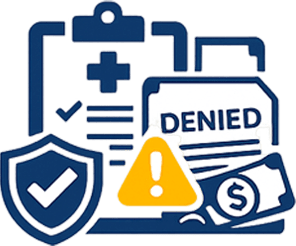
Every denial is worked within 48 hours by senior specialists, root-caused so the same pattern doesn’t repeat, and appealed with payer-specific clinical documentation. Our strategies to reduce denials in hospital RCM focus on front-end prevention, not just back-end recovery work

Aged claims are worked by dollar value, payer, and timely-filing window. Follow-up cadence runs at 30, 45, 60, and 90 days. Days in AR are tracked by payer weekly, with insurance collections completed before patient escalation begins.

Quarterly payer-contract audits identify underpayments against negotiated rates that most hospitals never detect. Underpaid claims are extracted, appealed, and recovered. Hospital underpayment recovery is net patient revenue your hospital already earned and is currently sitting on the table.

HIPAA-compliant statements go out by mail, email, and SMS. Payment plans, IRS 501(r) charity screening, and bad-debt placement coordination run together. TCPA-compliant outreach protects the patient relationship while completing collections to a reconciled zero balance.
Different hospital types carry fundamentally different revenue cycle realities. Critical access hospitals run cost-based Medicare. Teaching hospitals carry GME complexity. Behavioral health hospitals navigate parity denials. ClaimMax teams have operational experience inside each category, not generalists learning on your account.
Broadest service mix and the most accuracy levers. MS-DRG and APR-DRG optimization, CC and MCC capture through CDI queries, observation versus inpatient status determination, and OPPS outpatient prospective payment billing. Every inpatient stay carries real revenue at stake.
Tighter margins, regional commercial payer mix, and 15 percent plus self-pay populations. We handle commercial-contract performance audits, IRS 501(r) charity compliance, Medicaid managed care coordination, and bad-debt placement so a community hospital doesn't lose what its providers earned.
Cost-based Medicare reimbursement at 101 percent of allowable, Method II billing for outpatient services, Medicare bad-debt reimbursement, and cost-report support. Swing-bed billing and rural health clinic billing are handled in line, not bolted on, for the rural CAH reality.
GME and IME reimbursement optimization, DSH payment audit, 340B program compliance for participating teaching hospitals, and clinical research billing. Medicare Advantage prior-auth burden is managed separately from traditional Medicare. The complexity stays inside our team, not yours.
Mental Health Parity Act enforcement, residential and PHP and IOP billing, authorization-heavy psychiatric admissions, and dual-diagnosis complexity. Parity-violation denials are identified and appealed. Payer behavior on behavioral admissions is different, and your billing has to know that.
Most tier-1 hospital RCM vendors win on brand and lose on accuracy. The CFO disqualification questions in any real RFP come down to who reads payer contracts, who handles DRG accuracy, and who keeps NPR from leaking. Here’s how ClaimMax answers each.
Every hospital account is led by a senior director with HFMA-CRCR or HFMA-CHFP credentials and 10 plus years of hospital RCM experience. CFOs get direct access and monthly executive review, not a customer-service desk.
Quarterly payer-contract audits identify underpayments against negotiated rates. Most vendors don't do this work because they don't want to find errors that recoup money the hospital should never have lost. We do.
AHIMA-credentialed coders, CC and MCC capture through documentation queries to physicians, and CDI in workflow. Accurate DRG assignment is the largest single accuracy lever for inpatient NPR, and most hospitals lose it to documentation gaps.
Monthly CFO dashboard covering NPR, days in AR by payer, denial rate by department, and underpayment recovery. Hospital revenue cycle analytics built in. Daily operational dashboard for revenue cycle staff. Board-ready quarterly review delivered without you assembling it yourself.
Native integration with Epic, Cerner, Oracle Health, Meditech, and AllScripts. Real-time charge posting, AR visibility, and denial routing happen without manual data movement. Your IT team isn't building bridges to make billing work.
Billing migrates from R1, Conifer, Optum, Ensemble, or Cloudmed inside a structured 90-day transition without NPR disruption. Most tier-1 transitions take six to twelve months. Provider credentialing, clearinghouse setup, and payer enrollment run in parallel.

Hospital compliance is fundamentally deeper than clinic compliance. CMS Conditions of Participation, OIG Work Plan items, 340B drug pricing, EMTALA obligations, and IRS 501(r) charity care each carry separate frameworks. ClaimMax treats compliance as foundation, run daily, audited quarterly across every hospital account.
Privacy Rule and Security Rule training is completed before any account access, with annual recertification. PHI is encrypted at rest and in transit using TLS 1.2 or higher. Audit logging runs continuously. Incident-response testing happens quarterly, not just on paper.
A BAA is signed before any data access, non-negotiable at every hospital size, including all HHS-required provisions. Our legal team reviews the BAA template against your counsel pre-contract, not after a security incident.
Coding aligns to the current OIG Work Plan items affecting hospital billing. Quarterly internal audits cover upcoding, undercoding, and DRG miscoding. Stark Law and Anti-Kickback boundaries are observed. RAC, MAC, and OIG audit defense documentation is maintained per claim.
Hosting runs in a SOC 2 Type II audited environment with annual third-party security audits, continuous access-control monitoring, encryption at rest and in transit, mandatory MFA for every user, and a defined four-hour incident response SLA.
Hospital revenue cycle management is the full process from patient access registration through to a correctly paid, zero-balance account. It covers eligibility, charge capture, coding, claims, denials, AR, underpayment recovery, and patient collections. ClaimMax delivers it under one claims-integrity standard.
Nine connected workstreams: patient access and pre-registration, eligibility and prior authorization, charge capture and chargemaster maintenance, hospital coding, claims management, denial management and appeals, AR follow-up and insurance collections, underpayment recovery and payer contract audit, and patient financial services.
Cost is the wrong question for hospital RCM. The right question is what your vendor recovers versus what they leave on the table. A cheaper percentage on inaccurate claims loses more NPR than the rate saves. Talk to us about a free diagnostic.
Most hospitals already outsource at least part of the revenue cycle because the operational depth, payer-contract audit, and DRG coding accuracy needed at hospital scale is hard to staff in-house. The decision isn’t outsource yes or no. It’s accuracy and accountability.
In-house gives direct control. Outsourced gives operational depth, payer-contract audit, AHIMA-credentialed DRG coding, and senior denial specialists most hospitals can’t staff alone. The deciding variables are accuracy, continuity through turnover, and audit defense, not headcount cost on its own.
Front-end. Most preventable denials are eligibility, prior-auth, charge-capture, or coding accuracy failures at the start, not appeal failures at the end. Our strategies to reduce denials in hospital RCM fix the cause at Stages 01 through 04, then appeal what survives.
Hospital underpayment recovery is the systematic audit of paid claims against negotiated payer contract rates to identify where payers paid less than the contract requires. Recovered underpayments are NPR your hospital already earned, found through audit, not through new patient volume.
ClaimMax runs a structured 90-day transition from R1, Conifer, Optum, Ensemble, or Cloudmed. Provider credentialing, clearinghouse setup, payer enrollment, and AR cutover happen in parallel without NPR disruption. Tier-1 vendor switches typically take six to twelve months.
Yes. Privacy Rule and Security Rule training runs before any account access. BAAs are signed before data access. Hosting is SOC 2 Type II audited. Encryption, MFA, audit logging, and quarterly incident response testing run continuously, not as paper compliance.
Yes. For participating hospitals, we handle covered-entity billing support, duplicate-discount prohibition tracking, Apexus reconciliation alignment, and HRSA recertification cycles. The compliance load on 340B is real, and we treat it as foundational, not an optional add-on.

Stop letting denied claims and underpayments drain 8 to 11 percent of net patient revenue every year without recovery. Stop paying tier-1 rates for performance that doesn’t tie to accuracy. Stop multi-year contracts with no real accountability built in.
Start with hospital revenue cycle management led by HFMA-aligned senior directors, AHIMA-credentialed coders, and a claims-integrity standard that recovers NPR through correctness. The Access-to-Accuracy Pipeline, with one senior director accountable for every dollar of net patient revenue at your hospital.
States Served
EHR Systems
Response Standard