











































Floating Contact
Text Message
+1 (916) 299-5335

Accounts Receivable Services That Reduce Aging and Maximize Healthcare Practice Revenue

Accounts receivable services aren’t a back-office cleanup task. They’re the difference between revenue earned and revenue collected. ClaimMax RCM provides accounts receivable services engineered to reduce days in AR, recover aged claims, and maximize the revenue your healthcare practice has already earned. From Sacramento, California, we work with practices in all 50 states.

Outsource accounts receivable to a partner that runs dual-track recovery: dedicated insurance AR specialists working payer relationships and dedicated patient AR specialists handling self-pay collections. Different work, different teams, same operational standard. ClaimMax AR services deliver under 28 days in AR and 90% recovery on aged claims. Payer-specific, aging-stage specific, built on accountable AR specialist teams.

0 +

States Served

0 +

EHR Systems

0 h

Response Standard

The ClaimMax Accounts Receivable Recovery Process

 Aged AR is recoverable. Most practices write off claims that ClaimMax recovers because the work matches the aging stage. Different aging requires different operational tactics. ClaimMax operates five distinct AR teams running five distinct recovery protocols across the aging cycle. Each bucket has its own payer escalation matrix, its own root-cause framework, and its own recovery benchmark per HFMA reporting standards.

Step 01 / 07

Fresh Claims in Active Pursuit

Claims aged 0 to 30 days. The active monitoring stage. AR specialists pull payer status updates daily through clearinghouse reports and payer portals. Eligibility rechecks, pre-emptive denial pattern detection, status verification across every payer. When claims slow at this stage, the AR team intervenes within 48 hours. The 98% First-Pass Acceptance Standard minimizes claim volume reaching subsequent buckets across every cycle.

01  ·  FOUNDATION
Step 02 / 07

Slow-Pay Investigation and Escalation

Claims aged 31 to 60 days. The investigation stage. AR specialists identify root causes: payer information requests, missing documentation, eligibility lapses, prior authorization issues. Each delay categorized using CARC and RARC codes. Resubmissions filed with corrected information. Initial appeals filed for denied claims with documented payer policy violations. Weekly cadence touches, payer-specific escalation contacts, denial trend reporting back to practice leadership continuously.

02  ·  PRE-SERVICE
Step 03 / 07

Aged Recovery and Multi-Channel Pursuit

Claims aged 61 to 90 days. The aggressive pursuit stage. Multi-channel recovery: payer portal disputes, phone follow-up calls, formal appeals, peer-to-peer reviews for clinical denials. Specialists work each claim using payer-specific protocols across managed care, commercial insurance, Medicare, and Medicaid workflows. Underpayment recovery starts here through contracted-rate reconciliation. Recovery rate at this stage averages 65 to 80 percent per HFMA benchmarks.

03  ·  CODING
Step 04 / 07

Specialist Aged AR Cleanup

Claims aged 91 to 120 days. The specialist team stage. Dedicated aged AR specialists assigned per claim. Each claim gets root-cause analysis, payer relationship history review, and recovery feasibility scoring. Some claims pursued through formal appeals with clinical citations, others through patient billing transitions when insurance coverage has lapsed. Underpayment recovery deepens with contractual-rate audits, ERA and EOB line-level disputes, and payer escalation matrices.

04  ·  RECONCILIATION
Step 05 / 07

Deep Aged Recovery and Negotiation

Claims aged 120+ days. The most intensive stage. Senior AR specialists handle direct negotiation with payer recovery departments. Compromise settlements pursued where appropriate. Patient AR transitions for self-pay accounts. Small balance AR strategies coordinate with large dollar pursuit. Aged AR cleanup metrics tracked weekly. Practices working with ClaimMax recover an average of 30 to 45 percent of aged AR previously written off as uncollectible.

05  · RECOVERY

Aged AR is recoverable. See your practice's recovery potential.

Insurance AR and Patient AR: Two Workflows, One Recovery Standard

Insurance AR involves payer relationships, claim corrections, appeals, and underpayment recovery. Patient AR involves patient communication, statement workflows, payment plans, and self-pay collections. Different work, different teams, same recovery standard. High-deductible health plans now drive patient AR growth across the healthcare industry, and ClaimMax separates the two tracks deliberately because each requires distinct stakeholder protocols, compliance frameworks, and recovery tactics.

Insurance Accounts Receivable Recovery

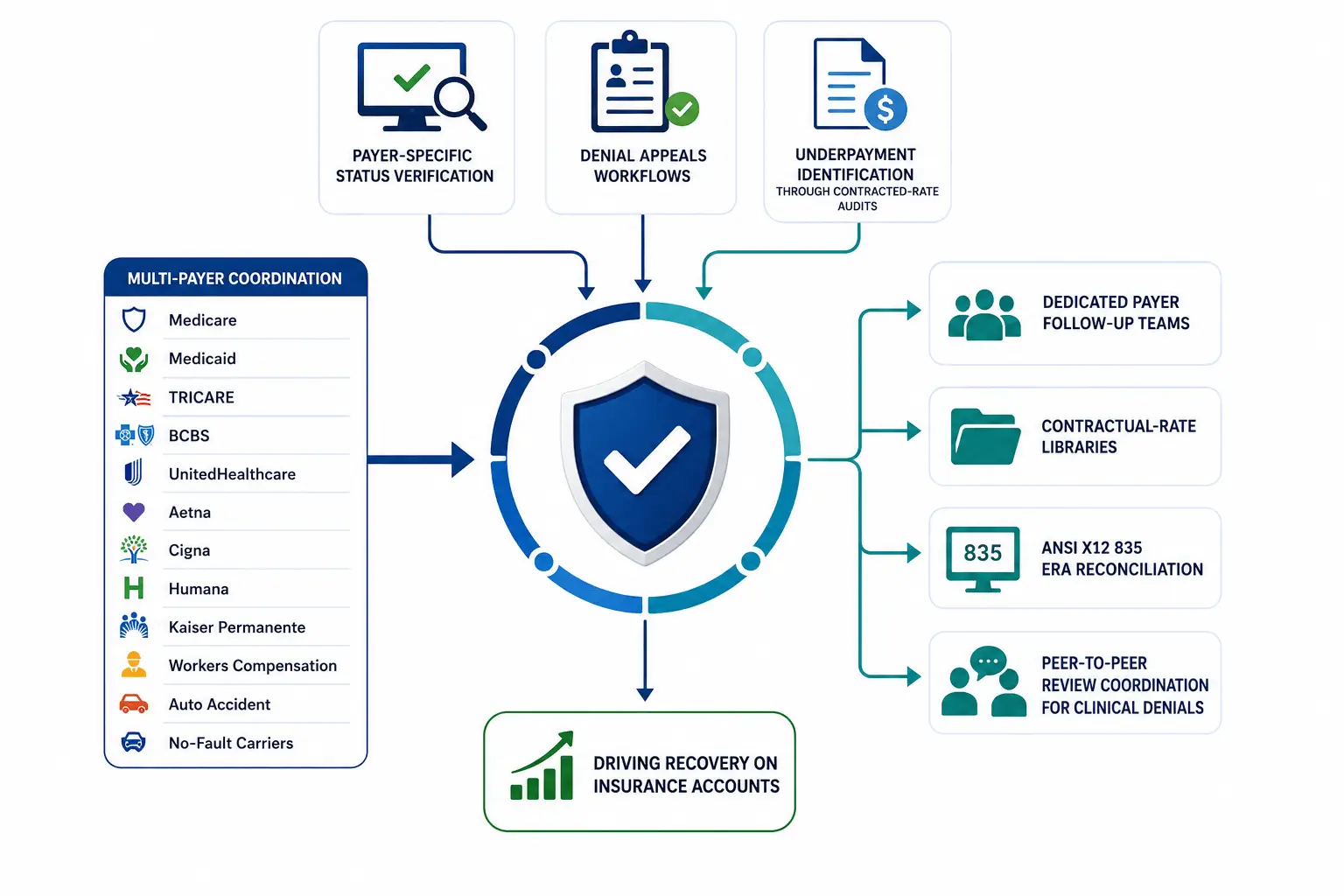
Payer-specific status verification, denial appeals workflows, and underpayment identification through contracted-rate audits. Multi-payer coordination across Medicare, Medicaid, TRICARE, BCBS, UnitedHealthcare, Aetna, Cigna, Humana, Kaiser Permanente, workers compensation, auto accident, and no-fault carriers. Dedicated payer follow-up teams, contractual-rate libraries, ANSI X12 835 ERA reconciliation, and peer-to-peer review coordination for clinical denials drive recovery on insurance accounts.

Insurance AR cleanup starts with knowing what's recoverable

Patient Accounts Receivable Recovery

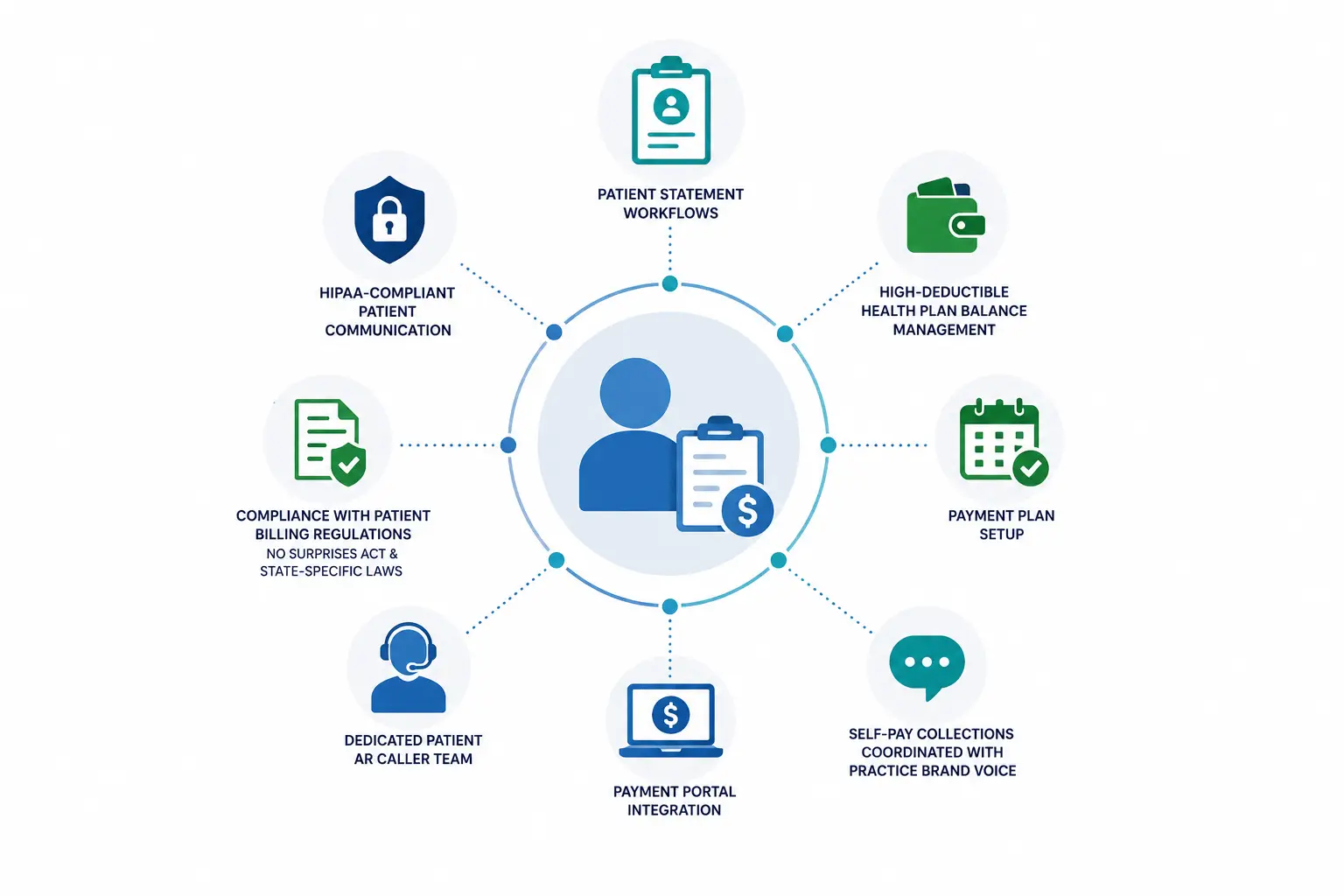
Patient statement workflows, high-deductible health plan balance management, payment plan setup, and HIPAA-compliant patient communication. Self-pay collections coordinated with the practice’s brand voice. Compliance with patient billing regulations including the No Surprises Act and state-specific patient billing laws. Branded patient statements, HIPAA-compliant text and email outreach, payment portal integration, and a dedicated patient AR caller team handle every patient account responsibly.

Patient AR has its own rules. We follow them

AR Follow-Up Inside Your EHR. Not Around It.

Switching AR vendors shouldn’t mean switching software. ClaimMax RCM works inside the practice’s existing EHR. No migration. No parallel database. No staff retraining. Aging data pulls directly from the system the practice already uses, claim status updates post back through bidirectional integration, and reconciliations happen within the existing workflow. AR follow-up services that integrate, not interrupt.

Why Healthcare Practices Choose ClaimMax RCM for Accounts Receivable

Healthcare practices have many accounts receivable services options. ClaimMax RCM differentiates on five operational specifics, delivered every cycle, every account, every report. Not aspirational claims. Operational realities engineered into how ClaimMax runs AR services for healthcare practices across all 50 states.

Dedicated AR Specialist Team

Every practice gets a dedicated AR specialist team assigned at onboarding. Named contacts, weekly cadence, named recovery specialists per aging stage. Insurance AR specialists separate from patient AR specialists. Accountable single-point ownership.

Payer-Specific Recovery Protocols

Recovery work is payer-specific, not generic. ClaimMax operates payer-rule libraries for Medicare, Medicaid, TRICARE, BCBS, UnitedHealthcare, Aetna, Cigna, Humana, Kaiser Permanente, and managed care plans with documented escalation matrices.

Real-Time AR Visibility

Live dashboards, not delayed monthly reports. Total AR, aging buckets, recovery rate by payer, and KPI trends updated continuously. Monthly performance reviews benchmark against HFMA and MGMA industry standards quarterly.

Real-Time Visibility

Live dashboards, not delayed monthly reports. Total denials, denial rate by category, recovery rate by payer, and KPI trends updated continuously. Monthly performance reviews benchmark against HFMA and MGMA industry standards.

California-Based, Nationwide Reach

Headquartered in Sacramento, California. Serving healthcare practices in all 50 states. US-based AR operations, US-based account management. HIPAA-compliant infrastructure with signed BAAs, 256-bit AES encryption, and SOC 2 compliant systems.

See how these operational standards apply to your practice's AR.

Tell Us About Your Accounts Receivable

Healthcare practices that benefit most from ClaimMax accounts receivable services share common operational signals. Check the boxes that match your practice and submit the form for your free AR Aging Audit.

HIPAA Compliant Accounts Receivable Services You Can Trust

Opening Paragraph:

Accounts receivable work involves continuous PHI access. AR specialists handle claim status, payer correspondence, and patient billing records daily. ClaimMax RCM’s compliance infrastructure is designed around this reality: signed BAAs before AR work begins, encryption at every layer, audit trails on every PHI touchpoint.

HIPAA, BAA, and Patient Data Protection

Every healthcare practice signs a Business Associate Agreement before AR work begins. ClaimMax operates under HIPAA Privacy Rule, HIPAA Security Rule, and HITECH Act requirements. PHI and ePHI protocols govern all data handling. OIG Exclusion List screening quarterly.

SOC 2 Compliant Infrastructure and Audit Trails

ClaimMax runs SOC 2 compliant infrastructure with 256-bit AES encryption for AR data at rest and in transit. Role-based access controls restrict PHI to assigned practices. Audit trails on every PHI touchpoint. Annual third-party SOC 2 attestation maintained.

Payer-Specific Protocols

Each major payer has its own denial patterns. ClaimMax operates payer-rule libraries for Medicare, Medicaid, BCBS, UnitedHealthcare, Aetna, Cigna, Humana, Kaiser, and TRICARE. CMS-0057-F payer transparency integrated. Each payer library updated quarterly minimum.

Front-End Workflow Fixes

Many denials originate at the front desk: eligibility gaps, prior authorization misses, demographic errors, COB sequencing failures. ClaimMax pattern analysis identifies which front-end workflows cause downstream denials and recommends targeted process improvements to practice administrators.

Request our compliance documentation.

Healthcare Practices That Trust ClaimMax RCM

Healthcare practices across all 50 states partner with ClaimMax RCM for revenue cycle management services. Different specialties, different practice sizes, same operational standard. Real results, attributable to real practices, delivered every cycle.
JM

We'd tried two other billing companies before ClaimMax RCM. Both promised results and delivered reports. What we actually needed was someone who understood our payer mix and fixed our AR problem. Within 90 days, our average AR days dropped from 58 to 29 and our denial rate went from 18% down to 6%. I don't think we'll ever go back in-house.

Dr. Jennifer M., MD

Lakewood Internal Medicine  ·  Denver, CO

MT

Our AR days were sitting at 74 when we made the switch. They're at 31 now. The billing team actually follows up on denials instead of just reporting them. That alone changed our cash flow significantly.

Marcus T.

Practice Administrator
Riverside Family Health  ·  Houston, TX

PO

We had three providers stuck in credentialing limbo for months. The team got all three enrolled and billing within six weeks. That was revenue we'd been leaving on the table without realizing it.

Dr. Patricia O., DO

Blue Ridge Medical Group  ·  Asheville, NC

SK

Our denial rate was sitting over 20%. The team categorized every denial by root cause, built payer-specific appeal templates, and got it under 5% in four months. Monthly collections haven't looked back since.

Sandra K.

Billing Manager
Premier Orthopedic Associates  ·  Phoenix, AZ

EW

I had real doubts about outsourcing dermatology billing because the codes are so payer-specific. The team knew our requirements better than our in-house biller ever did. We haven't had a clean-claim issue since.

Dr. Elliot W., MD

Clear Skin Dermatology  ·  Atlanta, GA

Accounts Receivable Services FAQ

What are accounts receivable in medical billing?

Accounts receivable in medical billing represent revenue owed to healthcare practices for clinical services delivered but not yet collected. AR includes insurance AR (claims awaiting payer reimbursement) and patient AR (balances owed by patients including HDHP responsibility and self-pay). Per HFMA framework, AR management drives practice cash flow directly.
AR follow-up happens within standard payment timeframes through structured payer communication, claim corrections, and appeals. Collections happens after AR becomes uncollectible through standard means, typically when accounts move to third-party agencies. ClaimMax accounts receivable services focus on AR follow-up recovery before claims age into collections territory.
Five tactics reduce days in AR. First, pre-submission claim engineering for 98% first-pass acceptance. Second, payer-specific scrubbing libraries. Third, real-time aging review with daily payer status updates. Fourth, aged AR specialist team for claims past 60 days. Fifth, underpayment recovery through contracted-rate audits across every payer.
HFMA’s high-performer benchmark sits at 35 to 45 days in AR. MGMA reports similar standards for top-quartile practices. ClaimMax practices typically operate under 28 days in AR through pre-submission claim engineering and structured aged AR recovery. Days in AR below 30 days indicates strong revenue cycle health.
Outsource accounts receivable when AR over 90 days exceeds 20 percent, days in AR exceeds 45, in-house teams can’t keep up with claim volume, or underpayment recovery isn’t happening. In-house works for stable high-volume practices with dedicated AR leadership. ClaimMax operates outsourced AR services with specialty teams and continuous compliance maintenance.
Aged AR recovery operates in three stages. First, dedicated aged AR specialist team assignment per claim. Second, root-cause analysis identifying eligibility, coding, authorization, or contract issues. Third, multi-channel recovery through appeals, peer-to-peer reviews, payer negotiation, and patient AR transitions. Industry recovery rate averages 30 to 45 percent on previously written-off claims.
Underpayment recovery identifies claims paid below contracted payer rates. Contracted-rate audits compare actual payments to fee schedules. Underpayments pursued through ANSI X12 835 disputes, contractual reconciliation, and payer escalation matrices. Most billing companies skip underpayment recovery entirely. ClaimMax practices typically recover 2 to 5 percent of net collections from underpayments alone.
ClaimMax completes AR onboarding within 30 days from signed agreement to first claim recovery work. Parallel approach means existing AR work continues during transition with zero recovery gaps. Aged AR cleanup starts in week 2. Full operational cutover happens at week 4 with dedicated account manager assignment.
Insurance AR involves payer relationships, claim corrections, appeals, and underpayment recovery handled by dedicated insurance AR specialists. Patient AR involves patient communication, statement workflows, payment plans, and HIPAA-compliant self-pay collections handled by dedicated patient AR specialists. Different teams, different protocols, same operational recovery standard across both tracks.
Yes. ClaimMax operates under HIPAA Privacy Rule, HIPAA Security Rule, and HITECH Act baseline. Every practice signs a Business Associate Agreement before AR work begins. PHI handling follows audit-trail protocols. Infrastructure runs SOC 2 compliant systems with 256-bit AES encryption. OIG Exclusion List screening completed quarterly across all AR specialists.

Get Your Free AR Aging Audit

Tell us where your accounts receivable stands. ClaimMax RCM provides a free AR Aging Audit that analyzes your aging report bucket by bucket, identifies recovery potential, surfaces underpayment opportunities, and quantifies revenue leakage. The audit is yours to keep, share with your team, or use however helps your practice grow. No commitment.

0 +

States Served

0 +

EHR Systems

0 h

Response Standard

Begin Your ClaimMax RCM Analysis