


Subtotal $0.00

You submitted a clean claim. Everything looked right: the diagnosis codes, the procedure codes, the patient information. Then it came back rejected with a message that said “this code requires use of an entity code.” No further explanation. Just a rejection sitting in your queue costing you time and money.
That’s one of the most common and frustrating rejections in the revenue cycle, and it happens to practices of every size, every specialty, every day.
So what is an entity code in medical billing? An entity code in medical billing is a standardized alphanumeric identifier that specifies the role of each party on a healthcare claim, defining whether they are the patient, the provider delivering care, the organization billing for that care, or the insurance company responsible for payment.
This guide covers everything you need to handle these codes correctly. You’ll learn what entity codes are, exactly where they appear on claim forms, all entity code types with their values, how to fix the most common errors, and how to prevent entity code denials from disrupting your revenue cycle management before they start.
Quick Answer: What Is an Entity Code in Medical Billing?
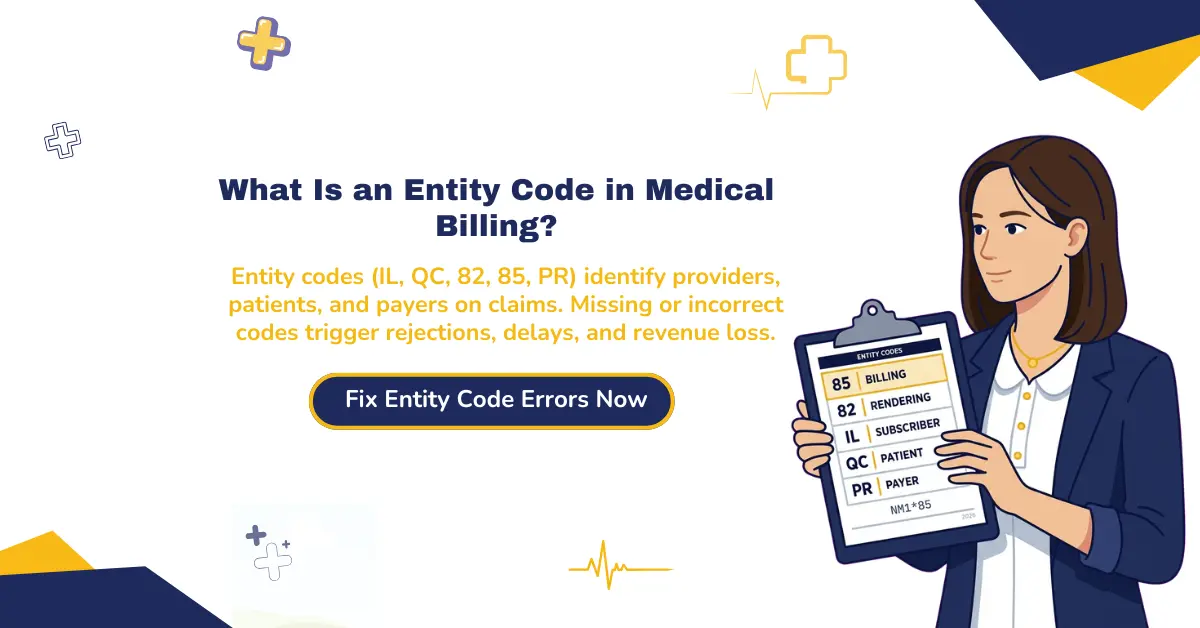
An entity code is a short alphanumeric code used in HIPAA-standard electronic claim transactions to identify who is involved in a healthcare claim and what role they play.
Five most common entity codes:
- 85: Billing Provider—the organization submitting the claim
- 82: Rendering Provider — the practitioner who performed the service
- IL: Subscriber/Insured—the primary policyholder
- QC: Patient—the person who received care
- PR: Payer—the insurance company processing the claim
These codes appear in the NM101 segment of ANSI X12 837 claim files and in rejection notices from clearinghouses and payers.
What Is an Entity in Medical Billing?
In medical billing, an entity is any person or organization with a defined role in a healthcare transaction. That includes everyone from the patient sitting in the exam room to the insurance company cutting the check.
Before you can fully understand what is an entity code in medical billing, you need to know what the entities themselves are. Every entity code maps directly to a specific type of participant on the claim, so the two concepts are inseparable.
Here are the eight core entities that appear in healthcare billing:
- Patient: the person who received the medical service
- Subscriber/Insured: the primary policyholder under whose insurance the claim is filed
- Dependent: a person covered under the subscriber’s policy, such as a child or spouse
- Rendering Provider: the clinician who physically performed the service
- Billing Provider: the individual or organization that submits the claim and receives payment, also called the billing entity
- Referring Provider: the provider who ordered or referred the patient for the service
- Payer: the insurance company, Medicare, Medicaid, or government program responsible for payment; the entity that is sending the claim to the payer in reverse, because the payer is the entity receiving the claim
- Service Facility: the location where care was delivered, such as a hospital, clinic, or laboratory
An entity is the role itself. An entity ID, such as the NPI for providers or TIN for organizations, is the unique identifying number assigned to that role. Both work together on every claim, but they serve completely different functions.
Once each entity’s role is established, the entity code system translates those roles into standardized alphanumeric identifiers that payers can process electronically.
The Billing Entity: A Specific Definition
A billing entity in medical billing is the organization or individual legally authorized to submit claims and receive reimbursement on behalf of healthcare services provided. It might be the treating provider, a group practice, a hospital, or a third-party revenue cycle management company submitting claims on the provider’s behalf.
Regardless of who fills that role, the billing entity is always identified by entity code 85 in electronic claim transactions. That’s the one number that tells the payer: this is who submitted this claim and who should receive payment.
What Is an Entity Code in Medical Billing? The Official Definition
An entity code in medical billing is a short alphanumeric code, typically two or three characters, that tells the payer exactly who each party on a claim is and what role they play in the transaction. That’s the plain-language version. Here’s the official one.
In the formal standards framework governing electronic healthcare transactions, an entity code is officially called an Entity Identifier Code. The entity code meaning goes deeper than a label: these codes are defined in the ANSI X12 Version 5010 standard, the transaction format mandated by HIPAA’s Administrative Simplification provisions for all electronic healthcare claims. Per CMS, ASC X12 Version 5010 is the adopted standard for EDI 837 claim transactions, specifically 837P for professional claims and 837I for institutional claims. Entity Identifier Codes appear in the NM101 field of the NM1 segment within specific loops of these transactions.
What this means for your practice is straightforward. When a claim goes out electronically, every party on that claim is identified in a structured NM1 segment. The entity code in the NM101 position tells the payer’s adjudication system whether the following identifier belongs to a billing provider, a rendering provider, a patient, or another party. If that entity code is wrong or missing, the claim fails. Not because the rest of the information is wrong, but because the system can’t properly assign the identifiers it receives.
What is entity code in medical billing at a regulatory level? It’s a mandatory field governed by multiple overlapping authorities. Here’s who controls the rules:
Who Governs Entity Codes in Medical Billing?
- HIPAA: Mandates the use of standardized electronic transaction formats for all covered entities
- ASC X12N: Develops and maintains the EDI standards, including ANSI X12 Version 5010, where Entity Identifier Codes are defined
- CMS: Sets implementation guidelines for Medicare, Medicaid, and the broader payer ecosystem
- X12.org: Official host of the Entity Identifier Code external code list, updated continuously
- NUCC: Maintains CMS-1500 claim form standards for professional billing
- NUBC: Maintains UB-04 claim form standards for institutional billing
The official Entity Identifier Code list is maintained at X12.orgunder the External Code Lists section, per HIPAA Administrative Simplification requirements.
One more thing that trips up a lot of billers: an entity code is not the same as an NPI. The NPI is a 10-digit number that identifies who a provider is. The entity code identifies what role that provider plays on this specific claim. Both appear together in every claim transaction, with the entity code in NM101 and the NPI in NM109 of the same segment. Same segment, two completely different jobs.
Complete List of Entity Codes in Medical Billing — 2025-2026 Reference
The following table lists the entity codes most commonly used in healthcare billing claims. These codes are drawn from the official ANSI X12 Entity Identifier Code list maintained at X12.org and reflect the codes appearing in the NM101 segment of 837 claim transactions and in rejection messages issued through 277CA Claim Acknowledgment files. Understanding the entity code meaning for each of these identifiers is foundational to preventing claim rejections.
Bookmark this table. You’ll come back to it every time a rejection lands in your queue and you can’t immediately place which party the payer is flagging.
Common Entity Codes in Medical Billing: NM101 Identifiers in ANSI X12 837 Transactions
| Entity Code | Official Name | Role in the Claim | CMS-1500 Location | UB-04 Location | EDI Loop |
| 85 | Billing Provider | Organization/provider submitting the claim and receiving payment | Box 33, Box 33b (NPI) | FL 56 | Loop 2010BB, NM1 85 |
| 82 | Rendering Provider | Individual practitioner who performed the service | Box 24J (NPI qualifier) | FL 82 reference | Loop 2310B, NM1 82 |
| 71 | Attending Physician | Physician responsible for patient during inpatient care | Not applicable | FL 76 | Loop 2310A, NM1 71 (837I) |
| 72 | Operating Physician | Surgeon who performed operative procedure | Not applicable | FL 77 | Loop 2310C, NM1 72 (837I) |
| 77 | Service Location | Facility where service was delivered (hospital, clinic, lab) | Box 32 (service facility) | Facility fields | Loop 2310E, NM1 77 |
| 87 | Pay-To Provider | Entity receiving payment if different from billing provider | Pay-to section | Pay-to fields | Loop 2010AC, NM1 87 |
| IL | Insured or Subscriber | Primary policyholder under whose insurance claim is filed | Box 4, Box 7 | FL 58–60 | Loop 2010BA, NM1 IL |
| QC | Patient | Person who received medical care | Box 2 | FL 58 patient fields | Loop 2010CA, NM1 QC |
| PR | Payer | Insurance company or government program processing the claim | Box 11c (payer name) | Payer identification fields | Loop 2010BB (payer level) |
| DN | Referring/Ordering Provider | Provider who referred or ordered the service | Box 17, Box 17b (NPI) | Ordering provider fields | Loop 2310A (837P) |
| 1P | Provider (Individual) | Individual provider identifier (legacy/payer-specific usage) | Legacy usage | Legacy usage | Varies by companion guide |
The complete Entity Identifier Code list, including all codes beyond those listed above, is maintained at X12.org under the External Code Lists section. Payer-specific companion guides may restrict which entity codes are valid for specific transaction types, so always consult your payer’s companion guide for transaction-level requirements.
One thing this table makes clear: entity codes for medical billing aren’t interchangeable. Each code locks to a specific party, a specific form location, and a specific EDI loop. Get any one of those wrong and the claim won’t make it through.
Each of these entity codes occupies a specific position on the claim forms your practice uses every day, and knowing exactly where they appear is the first step toward catching errors before they reach the payer.
Where Do Entity Codes Appear on a Medical Claim?
Entity codes don’t float around a claim form looking for a home. Each one lives in a defined location, whether you’re looking at a paper CMS-1500, a UB-04, or the raw EDI file underneath both of them. Knowing where to look is half the battle when you’re trying to figure out which entity code on claim caused a rejection.
Entity Codes on the CMS-1500 Form
The CMS-1500 form, also called the HCFA 1500, is the standard claim form for physician services, outpatient professional billing, and most non-facility provider claims. Entity codes don’t appear as standalone labeled fields on the paper version. They’re embedded in how each provider box gets completed and become explicit in the corresponding electronic 837P transaction that mirrors the paper form.
Here’s where each entity code lives on the CMS-1500:
Box 33 and Box 33b carry the billing provider’s name, address, and NPI. In the electronic 837P, this information populates the NM1 85 segment in Loop 2010BB, which is entity code 85 for the billing provider. When the NPI in Box 33b doesn’t match the enrolled provider record with the payer, the claim rejects at entity code 85. That’s the most common source of entity code errors on CMS-1500 claims.
Box 24J carries the rendering provider’s NPI. In the 837P, this populates Loop 2310B using entity code 82. Group practices run into trouble here constantly. When the group bills under the group NPI but a different rendering provider performed the service, Box 24J and Loop 2310B must both reflect the rendering provider’s individual NPI, not the group’s.
Box 17 and Box 17b carry the referring provider’s name and NPI. In the 837P, this populates Loop 2310A using entity code DN.
Box 32 carries the service facility location. In the 837P, this populates Loop 2310E using entity code 77.
Box 33b is the single most common entity code error location on CMS-1500 claims. Before submission, verify that the billing provider NPI entered there exactly matches the NPI enrolled with each specific payer.
Entity Codes on the UB-04 Form
The UB-04 form, formally called the CMS-1450, handles hospital inpatient billing, outpatient facility billing, skilled nursing facility claims, and other institutional services. Entity codes on the UB-04 operate through both the paper Form Locators and the corresponding electronic 837I transaction.
Here’s how the Form Locators map to entity codes:
FL 56 carries the billing provider NPI. In the 837I, this populates Loop 2010AA using entity code 85, the same billing provider entity code used in professional claims.
FL 58 through FL 60 carry subscriber and patient information. These map to entity codes IL for the Subscriber and QC for the Patient in the 837I subscriber loops.
FL 76 carries the attending physician’s name and NPI. In the 837I, this populates Loop 2310A using entity code 71. That’s a meaningful distinction from professional claims, where Loop 2310A uses entity code DN for referring providers. Same loop position, different entity code, depending on the transaction type.
FL 77 carries the operating physician. In the 837I, this populates Loop 2310C using entity code 72.
FL 78 and FL 79 carry other providers involved in care. These map to additional provider loops in the 837I with entity codes corresponding to their specific roles.
The professional and institutional claim formats don’t always use entity codes the same way. Always reference the payer’s companion guide for the 837I transaction when you’re billing on UB-04 forms, because the loop-to-entity-code mapping can vary from what you’d expect coming from professional billing.
Entity Codes in EDI Transactions: The NM1 Segment
In electronic claims, entity codes appear inside the NM1 segment, formally called the Individual or Organizational Name segment in the ANSI X12 standard. The NM101 field within that segment is where the Entity Identifier Code lives.
Here’s what the full NM1 segment structure looks like:
text
NM1 SEGMENT STRUCTURE:
NM1 | Entity Code | Entity Type | Last Name or Org Name | First Name | Middle | Prefix | Suffix | ID Qualifier | ID Number
Real example for a billing provider:
NM1*85*2*CLAIMMAX RCM LLC****XX*1234567890
Breaking that down:
NM1 — Name segment identifier
85 — Entity code: Billing Provider
2 — Entity type: Non-person entity (organization)
CLAIMMAX RCM LLC — Organization name
XX — ID qualifier: NPI
1234567890 — The actual NPI number
What is an entity code in medical billing at the EDI level? It’s literally this: a two-character value sitting in the NM101 position that tells the entire downstream adjudication system how to read everything that follows it in that segment.
This same structure appears in the 277CA Claim Acknowledgment. When a claim gets rejected, the STC segment in the 277CA identifies both what’s wrong through a Claim Status Code and which entity has the problem through an Entity Identifier Code. If you can read an NM1 segment, you can read a rejection notice. They’re built from the same logic.
What Does “This Code Requires Use of an Entity Code” Mean?
You pulled up the 277CA. There it is: “this code requires use of an entity code.” No further explanation. Just that message sitting next to a claim you were sure was clean.
Here’s what that message actually means. When a clearinghouse or payer returns the message “this code requires use of an entity code,” it’s not a vague system error. It’s a specific instruction embedded in the ANSI X12 standard itself. X12’s official Claim Status Code definitions explicitly mark certain status codes with the notation: “Usage: This code requires use of an Entity Code.” That notation means the status code alone isn’t enough to describe the problem. The rejection system must pair the status code, which identifies what is wrong, with an entity code that identifies which party on the claim has the problem.
Two status codes trigger this message more than any other. X12 Status Code 145 is defined as “Entity’s specialty/taxonomy code” and is marked with that exact usage notation. When Status Code 145 appears in a 277CA rejection, a specific provider’s taxonomy code is missing or invalid. The entity code in the STC segment tells you whether the problem belongs to the billing provider (entity 85), the rendering provider (entity 82), or another party. X12 Status Code 501 is defined as “Entity’s State/Province” and carries the same notation, meaning a provider’s state or address information is incomplete or incorrect for a specific entity on the claim.
Resolving either of these errors starts in one place: the STC segment of the 277CA Claim Acknowledgment. You’re looking for three pieces of data, a status category code, a claim status code, and an entity code. Those three elements together tell you exactly what is wrong and for whom. Pull all three before you touch the claim.
How to Resolve an Entity Code Rejection: Step-by-Step
Step 1: Locate the entity code in your rejection notice.
Open your clearinghouse portal or 277CA file and find the STC segment. You’re looking for a three-part code combination: Category Code, Status Code, and Entity Identifier Code. A combination of A7 / 145 / 85 means: rejected for invalid information, taxonomy code issue, affecting the Billing Provider. Each part of that string answers a different question.
Step 2: Identify which entity has the problem.
The entity code sitting in the third position of the STC segment tells you who to look at:
- 85: check your Billing Provider record
- 82: check your Rendering Provider record
- 71: check your Attending Physician record
- IL: check your Subscriber and Insured information
- QC: check your Patient record
Don’t skip this step by guessing. Read the code.
Step 3: Identify what is wrong with that entity.
The Claim Status Code tells you what to fix:
- Status Code 145: check the taxonomy code for the identified entity
- Status Code 128: check the tax identification number or NPI
- Status Code 501: check the state or province address field
- Status Code 21: missing or invalid information across multiple fields
Step 4: Correct the root record in your billing system.
Don’t just fix the claim sitting in your queue. Go into the master provider record, patient record, or enrollment record in your practice management system and correct it there. This is the step most billing staff skip. Fixing only the current claim leaves the identical error ready to fire on every future submission involving that same entity.
Step 5: Resubmit with the original ICN.
When you resubmit a corrected claim after an entity code rejection, you need the Internal Control Number that the payer assigned to the original claim. The ICN in medical billing is that payer-generated tracking number, and including it on your corrected submission links the two together. Leave the ICN number in medical billing off the resubmission and the payer processes your corrected claim as a brand-new duplicate. Pull the original ICN from the 277CA before you resubmit anything.
Step 6: For Medicare providers, use your MAC’s tools.
Medicare Part B providers can use Palmetto GBA’s 277CA Edit Lookup Tool to decode entity code rejection messages by their specific STC code combinations. Your Medicare Administrative Contractor publishes payer-specific edit support resources built for exactly this kind of 277CA denial management work. Use them.
Common Entity Code Errors: Quick-Reference Table
| Error Message | Entity Typically Involved | Most Likely Cause | Immediate Fix |
| HICN not matching | PR (Payer level) | Corrected claim submitted without original payer claim number | Pull ICN from 277CA; resubmit with original claim number |
| Wrong member ID | QC (Patient) or IL (Subscriber) | Incorrect insurance ID, policy change, or wrong payer | Re-verify eligibility; confirm current payer and member ID |
| Entity code needed | 82, 85, DN, or 77 (varies by claim) | Required entity/party not identified in claim | Review all NM1 segments; ensure all required entities are populated |
| Service location ZIP error | 77 (Service Facility) | Missing last four digits of ZIP code | Enter full ZIP+4; avoid using 0000 as last four digits |
| Taxonomy code invalid | 85 or 82 | Taxonomy does not match payer enrollment/CAQH record | Update taxonomy to match CAQH and payer enrollment |
If entity code rejections are showing up regularly in your claims, that pattern isn’t a coincidence. It’s a systemic gap somewhere in your billing process. Claimmax RCM’s denial management services include real-time 277CA monitoring, entity code validation, and provider enrollment verification built to catch these issues before they become a queue full of rework. If that sounds like what your practice needs, schedule a free revenue cycle audit and we’ll show you exactly where the gaps are.
Entity Code Denial in Medical Billing: Causes, Types, and How to Resolve Them
Before you can fix an entity code problem, you need to know what kind of problem you actually have. An entity code rejection and an entity code denial aren’t the same event, and treating them the same way leads to the wrong resolution workflow every time.
An entity code rejection occurs before adjudication. The claim fails at the intake stage, either at the clearinghouse or the payer’s front-end editing system, because the entity information fails a format or validity check. You’ll see this communicated through the 277CA Claim Acknowledgment. The claim never entered the payer’s adjudication system.
An entity code denial is different. The claim got in. The payer processed it. But the entity information, while technically formatted correctly, didn’t match the payer’s records or failed a policy-level edit. You’ll see this on the 835 ERA or a paper Explanation of Benefits.
Both require you to correct entity data. The resolution path, timeline, and documentation requirements are not the same, though. Rejections can typically be corrected and resubmitted without a formal appeal. Denials often require a formal appeal with supporting documentation, and the clock on that appeal starts the day the EOB lands, not the day you notice it.
Common Entity Code Denial Reasons
| Denial Reason | Entity Code Involved | Common Cause | Resolution Path |
| NPI not enrolled with payer | 85 or 82 | Provider not contracted; new group NPI not set up | Verify enrollment with payer; complete enrollment if needed |
| Taxonomy code mismatch | 85 or 82 | Taxonomy in billing system differs from CAQH/payer enrollment | Update taxonomy in billing system to match payer record |
| TIN/EIN mismatch | 85 | Tax ID on claim does not match payer credentialing record | Verify TIN with payer; resubmit with correct information |
| Member ID not found | IL or QC | Incorrect insurance ID, plan change, or wrong payer | Re-verify eligibility; confirm correct payer and member ID |
| Service location not enrolled | 77 | Facility NPI not recognized or not enrolled with payer | Verify facility enrollment; add facility to payer network if required |
| Pay-to address incorrect | 87 | ERA/payment routing linked to incorrect address or banking details | Update pay-to information directly with payer |
Entity Codes vs. Related Billing Identifiers — Understanding the Key Differences
Healthcare billing runs on dozens of identifiers, codes, and numbers. Confusion between them isn’t just a learning problem—it’s one of the most common root causes of entity code errors in the first place. The six sub-sections below clarify exactly how entity codes relate to the identifiers that billing staff most frequently mix them up with.
Entity Code vs. NPI
An entity code identifies the role a provider plays on a specific claim. An NPI, the National Provider Identifier, is the unique 10-digit number that identifies who the provider is. The NPI is permanent. The entity code is a transaction-level role qualifier that tells the payer how to read the NPI sitting next to it.
Both appear together in every NM1 segment: the entity code in NM101 and the NPI in NM109, with the ID qualifier XX in NM108 sitting between them. Individual providers hold a Type 1 NPI and organizations hold a Type 2 NPI. Submitting a Type 1 NPI in an entity code 85 position, which expects an organizational Type 2, is one of the most common billing provider loop errors and it’s entirely preventable once you understand what is an entity code versus what an NPI actually does.
Entity Code vs. EIN and TIN
EIN stands for Employer Identification Number in medical billing. It’s the nine-digit tax identification number the IRS issues to identify healthcare organizations: hospitals, group practices, and medical billing companies. The TIN, or Tax Identification Number, is the broader category that covers EIN for organizations and SSN for sole-proprietor providers.
What is an EIN number in medical billing in practical terms? It’s the financial identity of the billing entity. The EIN appears in the billing provider loop alongside the NPI, both sitting under entity code 85 in the 837 claim. When the EIN submitted on the claim doesn’t match what a payer has on file from credentialing, the claim denies at entity code 85. Most billing teams see this as a TIN mismatch, but the root cause is a tax id in medical billing discrepancy that traces back to the entity code 85 loop specifically. Correcting the claim without updating the enrollment record on file with the payer fixes nothing long-term.
Entity Code vs. Billing State Code
A billing state code in medical billing identifies the state where a healthcare provider is enrolled to bill and practice. Medicaid programs and some commercial payers use it to confirm that the provider submitting the claim is licensed and enrolled in the correct state jurisdiction.
Here’s where the confusion with entity codes comes in. Unlike an entity code, which identifies the role of a party within the claim transaction itself, the billing state code is an enrollment verification identifier tied to geographic licensure. What is billing state code in practice: it’s the gate that confirms a provider is eligible to render and bill in the jurisdiction where care was delivered. When a billing state code doesn’t match the enrolled state on file with the Medicaid Management Information System, the claim rejects. That rejection will typically include entity code 85 or 77 in the STC segment to identify which party carries the state code discrepancy. So while the billing state code and an entity code serve completely different functions, they appear together in the rejection notice when the state code check fails.
Entity Code vs. Taxonomy Code
A taxonomy code is a 10-character alphanumeric code that classifies a provider’s specialty, type, and practice area. The code 207Q00000X, for example, designates a Family Medicine physician. Taxonomy codes are maintained by the NUCC and are required in HIPAA electronic transactions for provider identification.
An entity’s specialty and taxonomy code isn’t itself an entity code, but the two are directly linked at the point of rejection. X12 Status Code 145 is defined as “Entity’s specialty/taxonomy code” and explicitly requires a paired entity code, either 85 for the billing provider or 82 for the rendering provider, to indicate whose taxonomy is invalid. That’s why taxonomy code errors always arrive in rejection notices with an entity code attached. You can’t fix a Status Code 145 rejection without knowing which entity’s taxonomy is the problem.
Keeping taxonomy codes current and correctly matched across all payer enrollment records is a core function of Claimmax RCM’s credentialing services, and it’s the single most effective prevention against entity code 145 rejections.
Entity Code vs. ICN
An ICN, or Internal Control Number, is the unique tracking number a payer assigns to each claim upon receipt. The ICN number in medical billing has nothing to do with identifying a party’s role. It’s a payer-generated reference number for tracking one specific claim transaction through the adjudication system.
Where ICNs become critical is in the entity code correction workflow. When resubmitting a corrected claim after an entity code rejection, the original ICN must be included to link the corrected submission to the initial claim. Leave it off and the payer reads your corrected submission as a brand-new claim, flags it as a duplicate, and denies it again. The primary identifier in medical billing that connects your resubmission to your original rejected claim is that ICN. Pull it from the 277CA before you touch the resubmission.
Entity Code vs. Condition Code 40 and Value Code 82
Two codes that regularly cause confusion on UB-04 claims are Condition Code 40 and Value Code 82. Condition Code 40 signals that a claim involves a same-day transfer between facilities. It’s a claim circumstance code, not an entity identifier. Value Code 82 represents a specific dollar amount tied to home health services, making it a financial value code, not a provider role identifier.
The overlap that trips people up: entity code 82, the Rendering Provider identifier, shares the number 82 with Value Code 82. On a UB-04, the position of the code on the form is what determines how it gets read, whether as an entity code, a condition code 40, or a value code. Before concluding you have an entity-related error on an institutional claim, always verify which field the code actually occupies. A payer assigned provider ID error looks very different from a value code field error, and solving the wrong one wastes time the claim doesn’t have.
How Entity Codes Work Across Medicare, Medicaid, and Commercial Payers
The underlying HIPAA and ANSI X12 framework for entity codes is consistent across all payers. What changes is how each payer category validates those codes during adjudication. Understanding what is entity code in medical billing at a payer-specific level is where the costly, hard-to-diagnose denials get prevented.
Medicare Entity Code Requirements
Medicare requires all providers to use their NPI in ANSI X12 Version 5010 transactions: Type 1 NPI for individuals and Type 2 NPI for organizations. For Medicare Part B claims on the CMS-1500, the billing provider identified by entity code 85 must be enrolled in PECOS, the Provider Enrollment, Chain, and Ownership System.
The NPI submitted in the billing provider loop has to match the PECOS enrollment record exactly. Any discrepancy generates an entity code rejection at entity code 85. CMS doesn’t give partial credit for close matches. Medicare Administrative Contractors publish 277CA companion guides and edit lookup tools built specifically for this. Palmetto GBA’s 277CA Edit Lookup Tool, for instance, lets Medicare Part B billing staff decode entity code rejections by their specific STC code combinations without guessing. Use it every time a 277CA comes back from a Medicare claim with an entity code error.
Medicaid Entity Code Requirements
Medicaid entity code billing follows the same ANSI X12 framework as other payers, but each state administers it through its own Medicaid Management Information System. State MMIS platforms can apply editing logic on top of the federal X12 standard that goes beyond what the base framework requires.
New York’s eMedNY system, for example, follows the ANSI X12 EDI framework for entity identification but applies state-specific edits that require separate familiarity. Effective denial management for Medicaid entity code errors requires knowing both the federal X12 standard and the specific state’s companion guide. Practices billing across multiple states face a compounded challenge: the billing state code and entity code 85 NPI must both match active enrollment records in each state’s MMIS independently. A provider enrolled in New Jersey but not yet active in Pennsylvania can’t bill Pennsylvania Medicaid successfully regardless of how clean the rest of the claim is.
Commercial Payer Entity Code Requirements: Real Examples
Commercial payers publish 277CA companion guides and rejection matrices that map entity codes to specific edit scenarios. These documents are the definitive reference for understanding how a specific payer will reject entity code errors, and they’re worth reading before you spend hours trying to decode a rejection pattern.
Three documented examples show how this plays out in practice across major commercial payers.
Aetna’s 277CA documentation maps STC01-3 entity code 85 to Billing Provider errors and STC01-3 entity code 82 to Rendering Provider errors. When Aetna returns Status Code 145 paired with entity code 85, the billing provider’s taxonomy code is invalid in Aetna’s enrollment system specifically, not just in your billing software.
AmeriHealth’s rejection matrix documents specific three-part STC combinations. A7 / 128 / 85 indicates an invalid provider tax ID for the billing provider. A7 / 128 / 87 indicates an invalid provider tax ID for the pay-to provider. Those aren’t interchangeable. Getting the entity code wrong in the resolution step means correcting the wrong record entirely.
CareFirst’s 277CA companion guide explicitly maps NM101 to entity code 85 for billing provider identification and NM101 QC for patient information. Their guide is one of the clearest published examples of how entity code medical billing logic translates into an actual payer’s edit system.
The pattern across all three payers is consistent: entity code errors appear as three-part STC combinations in the 277CA, and companion guides are the only reliable tool for decoding them accurately. Claimmax RCM maintains current companion guide knowledge across all major commercial payers as a standard part of our entity code medical billing validation process.
How to Prevent Entity Code Errors — Best Practices for Healthcare Providers
Every entity code error that reaches a payer was a failure that could have been caught earlier. Prevention costs less than correction. Staff training, automated validation, and enrollment monitoring are a fraction of the expense you absorb reworking denied claims, managing aged AR, and waiting out delayed reimbursements.
The six steps below are the operational foundation Claimmax RCM applies across client practices to maintain entity codes medical billing accuracy and sustain clean claim rates above 90%.
Step 1: Real-Time NPI Validation Before Every Submission
Before any claim goes out, every NPI on that claim needs to be validated against the NPPES registry. NPPES provides free API access that lets billing systems confirm NPI status, entity type, and associated taxonomy codes in real time. An NPI that’s been deactivated, reassigned, or placed in the wrong entity code position in the EDI 837 transaction will generate a clearinghouse rejection. Real-time validation catches it before the payer ever sees it.
Step 2: Taxonomy Code Verification Against Payer Enrollment Records
A taxonomy code that’s accurate in your billing system but doesn’t match what a specific payer has on file generates a Status Code 145 rejection: the most common “this code requires use of an entity code” error in professional billing. Cross-check the taxonomy code in your practice management system against the CAQH provider profile and each active payer’s enrollment record. Run this verification after every credentialing update, re-enrollment, or group affiliation change. The NUCC maintains the official taxonomy code set, and any code outside that set fails payer edits automatically.
Step 3: Patient Eligibility Verification at the Point of Service
Member ID errors at entity code QC and IL are the most preventable category of entity code failure. Real-time eligibility verification at the point of service, not just at initial registration, catches coverage changes, plan switches, newborn additions, and terminated policies before a claim gets built on bad subscriber data. Confirm the member ID, plan group number, coverage effective dates, and correct payer for each date of service. Verifying once at registration and never again is where IL and QC denials come from.
Step 4: Full Nine-Digit Zip Code Entry for All Service Locations
Entity code 77, the service location, generates rejections when the facility zip code is entered as a five-digit code without the four-digit extension, or when “0000” is used as a placeholder. Every service location address in your billing system needs the full zip-plus-four. This is a one-time data quality fix that eliminates an entire category of entity 77 rejections permanently.
Step 5: 277CA Monitoring Within 24 Hours of Submission
The 277CA Claim Acknowledgment comes back from payers and clearinghouses within hours to a few days of submission. Monitoring it within 24 hours lets your billing staff catch entity code rejections at the earliest point, before claims age and correction windows tighten. Build a rejection log that captures every STC combination received: status category, claim status code, and entity identifier code. Pattern analysis of that log surfaces systemic failures, such as taxonomy mismatches or enrollment gaps, affecting entire claim batches rather than isolated submissions.
Step 6: Quarterly Provider Enrollment Audits
Enrollment records aren’t static. They change with every credentialing update, group practice change, pay-to address modification, and payer contract renewal. A quarterly audit across all active payers confirms that your entity code for medical billing information, specifically entity code 85 for the billing provider and entity code 82 for the rendering provider, matches what each payer actually has on file. The audit should cover NPI status, TIN, taxonomy code, pay-to address, and group versus individual enrollment status. Outdated enrollment data is the most common cause of recurrent entity code errors that don’t respond to claim-level fixes because the problem isn’t in the claim, it’s in the record behind it.
The six steps above represent the systematic approach to entity codes medical billing accuracy. The following frequently asked questions cover the specific situations and uncertainties that come up even inside a well-managed billing operation.
Frequently Asked Questions About Entity Codes in Medical Billing
Q1: What is an entity code in medical billing?
An entity code in medical billing is a standardized alphanumeric identifier, typically two to three characters, that specifies the role of each party in a healthcare claim. Common entity codes include 85 for the billing provider, 82 for the rendering provider, IL for the subscriber, QC for the patient, and PR for the payer. These codes appear in ANSI X12 837 electronic claim transactions.
Q2: What does entity code mean on a medical claim?
Entity code means the role that a specific person or organization plays in a healthcare claim transaction. When entity code 85 appears on a claim, it means that identifier belongs to the billing provider. When entity code QC appears, it means the identifier belongs to the patient who received care. The entity code gives the payer context for every identifier submitted.
Q3: What does “this code requires use of an entity code” mean?
This message comes directly from ANSI X12 Claim Status Code definitions. It means the payer’s rejection identifies what is wrong with a claim, for example Status Code 145 meaning an invalid taxonomy code, but must be paired with an entity code to indicate which party has the problem. Check the 277CA STC segment for the three-part combination: status category, status code, and entity code.
Q4: What is an entity code on a CMS-1500 form?
On the CMS-1500 form, entity codes are not displayed as standalone labeled fields. They are embedded in specific boxes that correspond to entity roles. Box 33b carries the billing provider NPI corresponding to entity code 85. Box 24J carries the rendering provider NPI corresponding to entity code 82. Box 17b carries the referring provider NPI corresponding to entity code DN.
Q5: What is an entity code on a UB-04 form?
On the UB-04 form, entity codes correspond to specific Form Locators. FL 56 carries the billing provider NPI, corresponding to entity code 85 in Loop 2010AA of the 837I transaction. FL 76 carries the attending physician information, corresponding to entity code 71 in Loop 2310A. FL 77 carries the operating physician, corresponding to entity code 72 in Loop 2310C of the institutional claim.
Q6: What is an entity code rejection in medical billing?
An entity code rejection occurs when a claim is bounced by the clearinghouse or payer’s intake system before adjudication because entity information, such as an NPI, member ID, taxonomy code, or service location zip code, fails a format or validity check. The rejection is communicated through the 277CA Claim Acknowledgment and must be corrected before resubmission.
Q7: What is the entity that is sending the claim to the payer?
The entity that is sending the claim to the payer is the billing entity, identified on the claim by entity code 85, the Billing Provider. This may be the treating provider themselves, a group practice, a hospital, or a third-party revenue cycle management company submitting claims on the provider’s behalf. The billing entity’s NPI and TIN must be enrolled with the payer.
Q8: Is an entity code the same as an NPI?
No. An NPI is a permanent 10-digit number that identifies who a healthcare provider is. An entity code identifies what role that provider plays on a specific claim. Both appear together in every electronic claim: the entity code in the NM101 field of the NM1 segment, and the NPI in the NM109 field of the same segment.
Q9: What is EIN in medical billing?
EIN stands for Employer Identification Number in medical billing. It is the nine-digit tax identification number issued by the IRS to identify healthcare organizations, including hospitals, group practices, and billing companies, in financial and claims transactions. The EIN appears alongside entity code 85 in the billing provider loop of the 837 claim and must match the TIN on file with the payer.
Q10: What is a billing entity number in medical billing?
A billing entity number is the unique identifier assigned to the organization or individual submitting a claim and receiving reimbursement, the billing provider identified by entity code 85. This number is typically the billing provider’s NPI, which is a 10-digit identifier required by HIPAA for all covered healthcare providers, and the TIN, which is the tax identification number for the organization.
Q11: What is ICN in medical billing?
ICN stands for Internal Control Number in medical billing. It is the unique tracking number assigned by a payer to each claim upon receipt. The ICN is essential in the entity code correction process: when resubmitting a corrected claim after an entity code rejection, the biller must include the original ICN to link the correction to the initial submission and prevent duplicate claim processing.
Q12: What are the top entity code errors in medical billing?
The most common entity code errors in medical billing are: submitting the wrong NPI or TIN for the billing provider at entity code 85; invalid or mismatched taxonomy codes triggering X12 Status Code 145; incorrect member IDs at entity code QC or IL; incomplete service location zip codes at entity code 77; and HICN mismatches on resubmitted claims. All five errors are preventable through real-time validation and enrollment audits.
What Entity Code Errors Actually Cost Healthcare Providers
One practice tracked a 30% increase in claim denials over six months before tracing the root cause to incorrect entity coding. After implementing targeted billing staff training and automated entity code validation, the practice cut denials by 50% within three months, with measurable improvement in cash flow and days in AR.
That’s not an unusual result. What is entity code in medical billing from a financial perspective: it’s a two-character field with direct revenue consequences.
Each corrected and resubmitted claim after an entity code rejection typically adds 14 to 45 days to the payment cycle, depending on payer processing timelines. Industry benchmarks place the administrative cost of reworking a single denied claim at $25 to $118 when staff time, overhead, and opportunity cost are included. A practice running a 10% entity-related denial rate on 100 claims per week spends between $250 and $1,180 per week on rework, which translates to $12,000 to $61,000 per year correcting errors that shouldn’t have occurred in the first place.
Aged denials compound the problem. When entity code denials sit past 90 days in the AR Follow-Up queue without resolution, collection probability drops sharply. Aged entity code denials consistently appear among the top contributors to write-offs that should have been recoverable revenue, not because the claims weren’t payable, but because the correction window closed while the denial sat unworked.
For providers ready to stop absorbing this category of preventable revenue loss, the next section outlines how Claimmax RCM addresses entity code accuracy as a systematic function of full-service revenue cycle management.
How Claimmax RCM Keeps Entity Code Errors Out of Your Revenue Cycle
Entity code accuracy isn’t a billing task. It’s a systems function. When entity code errors appear consistently in a practice’s claims, the source is almost never a one-time data entry mistake. It’s a gap between the billing system data, the provider’s active enrollment records with each payer, and the real-time validation that should catch discrepancies before any claim goes out.
Fixing individual rejections without correcting the underlying record is like mopping the floor while the faucet runs. The queue clears temporarily. Then the same errors come back on the next batch.
Claimmax RCM’s medical billing service addresses entity code accuracy at the system level. That means maintaining current NPI, TIN, and taxonomy records across all active payer enrollments; running 277CA monitoring within 24 hours of every submission batch; validating all provider entity information against NPPES before claims are built; and conducting quarterly enrollment audits that cross-check billing system data against payer records for every provider in the practice.
For practices experiencing recurring entity code rejections, particularly Status Code 145 taxonomy errors, billing provider TIN mismatches, or service location zip code failures, Claimmax RCM provides a full entity code audit at no charge as part of our onboarding process. That audit identifies every entity-related gap before the first claim goes out under our management.
If entity code errors are delaying your reimbursements, aging your AR, or consuming your billing staff’s time, schedule a free revenue cycle audit with Claimmax RCM. Our certified billers handle everything from entity code validation and denial management to credentialing services and AR Follow-Up, so your practice can focus on patient care.

