


Subtotal $0.00

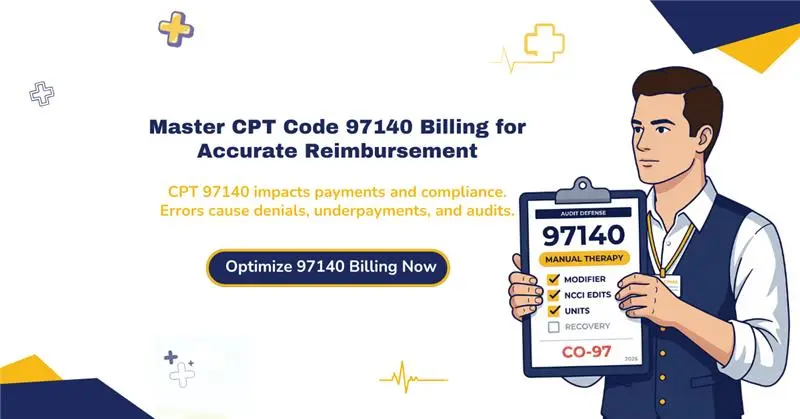
CPT code 97140 is the billing code for manual therapy techniques, including mobilization, manipulation, manual lymphatic drainage, and manual traction, performed for one or more regions, each 15 minutes, as defined by the American Medical Association CPT Editorial Panel.
For practices already billing this code, the more important question is not what it is. The question is whether your claims are being paid correctly. CPT 97140 carries one of the highest denial and underpayment rates of any outpatient therapy code in the 2026 Medicare Physician Fee Schedule.
| Quick Facts | Details |
| Code Category | Physical Medicine and Rehabilitation Therapeutic Procedures |
| Time Requirement | 8-minute minimum per unit; 15-minute unit increments |
| 2026 Medicare Rate (Non-Facility) | Approximately $32 to $34 per unit |
| Most Common Denial Code | CO-97 (mutually exclusive or not separately billable) |
| Most Financially Costly Modifier Error | Missing GP or GO on Medicare claims |
| Top Audit Risk Factor | Same-region billing of 97140 alongside CMT codes 98940 to 98942 |
What Is CPT Code 97140 Definition, Code History, and Why Revenue Risk Starts Here
CPT code 97140 is the billing code for manual therapy techniques, including mobilization, manipulation, manual lymphatic drainage, and manual traction, performed for one or more body regions in 15-minute units, as formally defined by the American Medical Association Current Procedural Terminology Editorial Panel.
“Manual therapy techniques (e.g., mobilization/manipulation, manual lymphatic drainage, manual traction), one or more regions, each 15 minutes.”
Source: American Medical Association CPT Editorial Panel
According to the American Medical Association CPT Editorial Panel, CPT code 97140 is formally defined as manual therapy techniques for one or more regions, each 15 minutes. Every 15-minute interval of skilled, hands-on manual treatment must be captured as one unit, and the 8-minute rule determines whether a partial interval earns a billable unit.
The cpt 97140 code replaced three separate legacy codes in 1999: 97260 and 97265 for joint mobilization, 97122 for manual traction, and 97250 for myofascial release. That consolidation created a single time-based manual therapy CPT code that is now one of the most frequently billed and most frequently underpaid codes in outpatient therapy.
Knowing the 97140 CPT code description is not the problem for most practices. Payers exploit ambiguity in time documentation, modifier requirements, and bundling rules to deny or underpay claims that were correctly performed and correctly documented. Most practices never recover that revenue through their revenue cycle management for therapy practices. That’s the real problem this guide addresses.
The Revenue Leakage Map: Which CPT 97140 Techniques Are Most Frequently Undercoded
The AMA defines the techniques within CPT 97140 by example rather than exhaustively. That flexibility is intentional. It covers any skilled manual technique that addresses joint mobility, tissue restriction, pain, or lymphatic dysfunction. The revenue problem isn’t with what qualifies. It’s with how practices document what they performed and how that documentation determines whether the claim survives payer review.
CPT code 97140 covers 14 clinically recognized manual therapy techniques. Across those 14, three patterns account for the majority of documented revenue leakage: technique name omission in SOAP notes, region-level vagueness that disqualifies modifier support, and unit miscalculation from blending technique time with total session time. Each pattern gets exploited differently by different payers.
The table below maps every covered technique to its most common documentation error and its revenue risk level. This is where most practices start losing money without realizing it.
Technique Revenue Risk Table
| Quick Facts | Details |
| Code Category | Physical Medicine and Rehabilitation Therapeutic Procedures |
| Time Requirement | 8-minute minimum per unit; 15-minute unit increments |
| 2026 Medicare Rate (Non-Facility) | Approximately $32 to $34 per unit |
| Most Common Denial Code | CO-97 (mutually exclusive or not separately billable) |
| Most Financially Costly Modifier Error | Missing GP or GO on Medicare claims |
| Top Audit Risk Factor | Same-region billing of 97140 alongside CMT codes 98940 to 98942 |
| Technique | Qualifies Under CPT 97140 | Most Common Documentation Error | Revenue Risk Level |
| Joint Mobilization | Yes | Grade not specified; joint not named | High: payers flag vague joint entries for medical review |
| Joint Manipulation (HVLA) | Yes | Not differentiated from CMT in chiropractic notes | Critical: same-region CMT bundling causes automatic denial |
| Myofascial Release | Yes | “MFR performed” without region or technique variant | High: myofascial release CPT code claims denied as non-specific |
| Manual Traction | Yes | Cervical vs. lumbar not specified; force and duration absent | Moderate: time documentation errors most common |
| Manual Lymphatic Drainage | Yes | CMS lymphedema documentation requirements not met | Critical: additional MAC requirements apply; high ADR rate |
| Soft Tissue Mobilization | Yes | Tissue and region combined into one vague line | High: region overlap with CMT not addressed |
| Trigger Point Therapy | Yes | Not distinguished from dry needling in note language | Moderate: CPT 20560 confusion creates denial exposure |
| Muscle Energy Technique | Yes | Patient effort component not documented | Low to moderate: skilled care standard undermined without patient participation note |
| Neural Mobilization | Yes | Nerve root or peripheral nerve target not named | Low: rarely audited but undercoded due to note brevity |
| Strain-Counterstrain | Yes | Position and region absent | Low: not a high-audit technique but unit time often unverified |
| Craniosacral Therapy | Yes, with caveats | Payer coverage not verified before billing | Moderate: not universally covered; verify by plan before billing |
| Graston or IASTM | Yes | Instrument listed as a separate billable item | High: instrument itself is not separately billable; bill only the manual therapy performed |
| Scar Mobilization | Yes | Scar location and size absent | Low: rarely audited but documentation gaps cause ADR delays |
| Active Release Technique | Yes | Tension direction and tissue target absent | Moderate: skilled care flag if note reads as routine soft tissue contact |
The myofascial release CPT code pattern deserves specific attention. When a SOAP note reads “MFR performed” without naming the region or the technique variant, payers classify that as a non-specific entry. That’s a denial waiting to happen. The same logic applies to the cpt code for manual therapy involving IASTM: the instrument is a tool, not a separately billable service. Bill the manual therapy, not the device.
Services Not Billable Under CPT 97140
| Service | Correct Code | Risk If Miscoded as 97140 |
| Dry needling | CPT 20560 or 20561 | CO-4 denial; potential fraud flag on pattern review |
| Relaxation massage | CPT 97124 | CO-97; mutually exclusive; no modifier override |
| Therapeutic exercise | CPT 97110 | Unbundled correctly if separate; denied if same-time blending |
| Electrical stimulation | CPT 97032 | CO-97; always bundled when same technique area |
| Ultrasound | CPT 97035 | CO-97; bundled into 97140 per NCCI |
Who Can Bill CPT 97140: Provider Types, Underpayment Rates, and Payer Behavior Patterns
CPT code 97140 may be billed by physical therapists, occupational therapists, chiropractors, physiatrists, and osteopathic physicians who have appropriate training, licensure, and active Medicare enrollment.
Physical therapist assistants and occupational therapist assistants may perform manual therapy under supervision, but Medicare applies an 85% payment rate when an assistant performs more than a de minimis 10% of the service. Many practices fail to append the required CQ or CO modifier, which creates both underpayment and compliance exposure at the same time.
The table below maps each provider type to their Medicare modifier requirements and the underpayment patterns documented through payer audits and MAC reviews. The fourth column is where practices typically find problems they didn’t know existed.
Provider Eligibility and Underpayment Risk Table
| Provider Type | Can Bill 97140 | Medicare Modifier Required | Documented Underpayment Pattern |
| Physical Therapist (PT) | Yes | GP | Missing GP causes automatic rejection; commercial payers deny 97140 CPT code physical therapy claims when notes lack functional goal specificity |
| Physical Therapist Assistant (PTA) | Yes, under supervision | GP plus CQ | 85% rate applies; billing at full rate without CQ is a recoupment liability |
| Occupational Therapist (OT) | Yes | GO | Same rejection pattern as PT when GO is absent on Medicare claims |
| Occupational Therapist Assistant (OTA) | Yes, under supervision | GO plus CO | Same 85% exposure as PTA; CO is frequently omitted in multi-provider clinic billing |
| Chiropractor (DC) | Yes | 59 or XS when billed alongside CMT | Highest denial rate among all provider types for 97140; same-region CMT bundling is the primary cause |
| Physiatrist or Rehabilitation Physician (MD) | Yes | None required as physician | Incident-to billing errors cause underpayments when supervising staff bill without proper documentation |
| Osteopathic Physician (DO) | Yes | None required as physician | OMT code confusion (98925 to 98929) leads to downcoding in some payer systems |
| Massage Therapist | No | Not applicable | Billing as 97140 without qualifying licensure is a compliance violation regardless of payer |
| Athletic Trainer | No under Medicare | Not applicable | Commercial plan variation; billing without verifying individual contract is a denial risk |
Chiropractors face the highest CPT 97140 denial rate of any provider type under Medicare. Per First Coast Service Options and Palmetto GBA published TPE results, chiropractic medical billing services claims combining 97140 with CMT codes account for a disproportionate share of post-payment audit recoveries in outpatient rehabilitation. The documentation and modifier errors driving these results are specific, patterned, and entirely preventable with the right billing workflow. Section 10 of this guide addresses that directly.
Physical therapists and chiropractors billing CPT 97140 face the most complex modifier and bundling rules of any provider type in outpatient therapy. ClaimMax RCM manages these claims from submission through adjudication, handling modifier selection, NCCI compliance, and payer-specific rule sets so your clinical team focuses on care, not corrections.
See How ClaimMax Handles Therapy Billing
The 8-Minute Rule Compliance Audit: How to Find Under-Billed Units in Your Own Claim History
The 8-minute rule states that a minimum of eight minutes of direct, one-on-one manual therapy must be performed and documented to bill one unit of CPT code 97140. Each unit represents 15 minutes of treatment time. Minutes counted toward 97140 cannot overlap with minutes counted toward any other timed service billed on the same claim.
Per CMS MLN Outpatient Therapy Documentation and Billing Guidance providers must record either total minutes per CPT code alongside total timed minutes for the session, or start and stop times per intervention. Here’s the thing: a unit calculation error doesn’t always produce a denial. Sometimes it produces a paid claim that is financially incorrect.
Under-billing by one unit on a single cpt 97140 claim loses approximately $32 to $34. Across 200 therapy visits per month, a consistent one-unit under-calculation costs a practice $77,000 to $82,000 annually in forfeited Medicare revenue alone. That’s not a rounding error. It’s a workflow problem.
Units Calculation Table
| Total Manual Therapy Minutes | Billable Units of 97140 | Most Common Error at This Duration |
| Less than 8 minutes | 0 units | Billing 1 unit; triggers CO-97 on audit |
| 8 to 22 minutes | 1 unit | Correct; confirm time is exclusive of other timed services |
| 23 to 37 minutes | 2 units | Billing only 1 unit due to rounding to nearest 15 minutes; most common under-billing pattern |
| 38 to 52 minutes | 3 units | Billing 2 units; 38-minute threshold missed; frequent in documentation systems that auto-calculate by round number |
| 53 to 67 minutes | 4 units | Billing 3 units; 53-minute threshold missed |
| 68 to 82 minutes | 5 units | Billing 4 units; pattern of under-billing by one unit across the entire session |
How to Audit Your Own CPT 97140 Unit History in Three Steps
Step 1: Pull all 97140 CPT code claims from the last 12 months from your billing software or clearinghouse and sort by units billed per claim. Flag every claim where units billed is 1. Cross-reference those claims against the corresponding therapy notes to verify the documented time. If documented time is 23 minutes or more and only 1 unit was billed, you have an under-billing pattern.
Step 2: Calculate the dollar value of the under-billed units. Take the number of claims where 1 unit was billed but 2 units were documented and multiply by your contracted rate per unit for the applicable payer. For Medicare non-facility claims, use $32 to $34 per unit as your rate estimate. That figure is the recoverable revenue sitting in your audit window right now.
Step 3: For overbilling patterns, where two or more units were billed but documented time supports only one, flag those for compliance review before a payer does. Overbilling discovered by a MAC during a TPE review results in recoupment plus potential referral for further review. Self-identified overbilling corrected through voluntary refund is handled under a significantly lower risk threshold.
Time documentation errors in CPT code 97140 billing run in both directions. They cost practices money through under-billing and create compliance liability through overbilling, and most billing software doesn’t flag either pattern automatically.
Practices that want a professional review of their CPT 97140 unit calculation history can request a claim audit through ClaimMax RCM’s revenue cycle management audit for therapy practices.
CPT 97140 Underpayment Detection: 2026 Rate Variance Analysis Across Medicare and Commercial Payers
The CMS CY2026 Physician Fee Schedule Lookup Tool final rule, documented in MLN Matters MM14315, set the conversion factor for non-APM clinicians at $33.40, up from $32.35 in 2025, a 3.25% improvement. For CPT code 97140, that puts the Medicare non-facility rate at approximately $32 to $34 per unit depending on geographic locality. The national rate is the starting point. Whether your practice is actually receiving it is a separate question entirely.
Underpayment for cpt 97140 doesn’t always appear as a denial. It appears as a paid claim where the amount received is below the contracted amount. Practices that don’t systematically compare their 97140 payment receipts against contracted rates on a payer-by-payer basis are accepting underpayments silently. Based on published payment posting data and ERA analysis patterns, underpayment rates for CPT code 97140 range from 3% to 12% of total 97140 revenue depending on payer and practice specialty.
2026 Rate Reference and Underpayment Detection Table
| Payer | Expected Rate Per Unit (Non-Facility) | Common Underpayment Trigger | Detection Method |
| Medicare | $32 to $34 | Locality adjustment not applied correctly by MAC | Compare remittance against CMS PFS locality lookup; file MAC inquiry if variance exceeds $2 per unit |
| UnitedHealthcare | $28 to $43 | Contract rate not updated after renegotiation | Pull ERA data for last 90 days; compare paid amount to fee schedule addendum |
| Blue Cross Blue Shield | $27 to $45 | Regional plan applies different contracted rate than national PPO rate | Verify which BCBS plan the patient carries; request fee schedule confirmation from provider relations |
| Aetna | $27 to $34 | Prior auth requirement triggered retroactively; claims paid at non-contracted rate | Check auth requirements before service; verify payment against contract tier |
| Cigna | $30 to $34 | Contract-specific rate not loaded correctly in payer system | Compare rate to executed contract document; escalate to provider relations for rate correction |
| Medicaid | $15 to $28 | State fee schedule not applied; managed Medicaid plan pays at lower capitated rate | Identify managed Medicaid plan vs. fee-for-service; verify plan-specific rate |
| Humana | $24 to $38 | Silent PPO rate applied from network not in primary contract | Verify network participation; challenge silent PPO reductions |
If your practice has been billing CPT 97140 for more than six months without systematically auditing payment receipts against contracted rates, you likely have recoverable underpayments in your AR. ClaimMax RCM’s billing specialists audit payment patterns, identify underpaid claims, and recover the difference through payer disputes and appeals.
Request a CPT 97140 Payment Audit
The recovery window for underpaid 97140 CPT code reimbursement claims varies by payer. Medicare allows 12 months from the date of service for timely filing, but disputes over payment amounts must be initiated within the payer’s dispute window, typically 60 to 180 days from the remittance date. Practices that identify underpayments after the dispute window has closed lose those funds permanently.
ClaimMax RCM’s payment posting services for therapy practices flags CPT 97140 underpayments in real time during ERA processing, ensuring every underpaid claim is identified before the dispute window closes.
2026 CMS Updates That Open a Retroactive Audit Exposure Window for CPT 97140
CPT code 97140 itself is unchanged for 2026. The AMA code description and technique definitions remain as published. What changed is the policy environment around it. Several CMS updates effective for calendar year 2026 either raise the financial stakes of documentation errors or open a new retroactive audit exposure window for practices that haven’t updated their billing protocols. The practices most at risk are those that received the CMS MLN Matters MM14315 CY2026 MPFS Final Rule update notification and did nothing with it.
What usually happens in these situations is predictable. The practice keeps billing under the old protocol. Payers process claims under the new rules. The gap between those two realities become a retroactive audit liability, sometimes 12 to 18 months before anyone notices.
2026 Audit Exposure Updates Table
| Policy Change | 2025 Status | 2026 Status | Retroactive Audit Risk If Not Updated |
| KX Modifier Threshold (PT and SLP combined) | $2,410 | $2,480 | Billing KX at the old $2,410 threshold exposes claims above $2,410 but below $2,480 to retroactive review; those claims may be flagged as improperly documented |
| KX Modifier Threshold (OT) | $2,410 | $2,480 | Same exposure as PT; OT practices that carried the 2025 threshold into 2026 have a documentation gap in the $70 variance range |
| Conversion Factor | $32.35 | $33.40 | Practices not updated on the new factor may have accepted 2025-rate underpayments on 2026 claims without flagging them |
| NCCI Policy Manual | CY2025 edition | CY2026 edition effective January 1, 2026 | Chapter XI updates to timed-code and CMT bundling rules; billing software running the 2025 edit table is out of compliance as of January 1 |
| NCCI PTP Edit Files | Quarterly updates | Latest: April 1, 2026 | Edit engine must be updated quarterly; an outdated edit table creates denial exposure on combination claims |
| CQ and CO Assistant Modifier Rules | Required since 2022 | Unchanged; continued enforcement | Practices still missing CQ or CO have 85% rate claims paid at full rate, which is an active recoupment liability |
| Targeted Medical Review Threshold | $3,000 | $3,000, unchanged | Unchanged but actively enforced; practices near this threshold for any patient should verify documentation completeness before reaching it |
The 97140 CPT code physical therapy billing environment shifts every time CMS releases a quarterly NCCI update. Practices that treat these updates as optional reading are the ones that show up in TPE probe samples.
All updates in this table are sourced from CMS NCCI PTP Edit Files 2026 CMS MLN Matters MM14315 (CY2026 MPFS Final Rule Summary), and the CMS MLN Connects Newsletter dated February 26, 2026. ClaimMax updates client billing protocols automatically with each quarterly NCCI release. Practices running ClaimMax’s billing platform aren’t exposed to outdated edit tables.
The Modifier Error Audit: The Most Financially Costly CPT 97140 Modifier Mistakes by Payer
Whether CPT code 97140 requires a modifier depends on the payer, provider type, and whether other services appear on the same claim. Under Medicare, Modifier GP is required on every physical therapy claim for this code and Modifier GO is required on every occupational therapy claim. Missing either causes automatic rejection regardless of clinical accuracy.
The more financially damaging CPT code 97140 modifier errors aren’t the ones that cause outright rejections. They’re the ones that cause silently incorrect payments or create audit liability that surfaces 12 to 18 months after the service date. That’s where practices lose the most money without knowing it.
Modifier GP: The Rejection Risk and the Hidden Compliance Trap
Modifier GP is required on all CPT code 97140 modifier GP claims submitted by or under the direction of a physical therapist for Medicare. A claim without GP rejects at the clearinghouse. That’s the obvious risk.
The less obvious problem is a practice that adds GP to 97140 but not to all other same-day therapy codes on the same claim. Mixed modifier status on a single claim date triggers payer review in UnitedHealthcare and Humana post-adjudication audit systems. GP needs to appear on every therapy code for that date of service, not just the 97140 line.
Modifier GO: The OT Practice Oversight Pattern
GO is required on all cpt 97140 claims submitted by or under the direction of an occupational therapist for Medicare. It’s the OT equivalent of GP, but the error pattern is different.
OT practices typically apply GO correctly on evaluation codes and then drop it on treatment codes when the same clinician bills both on the same date. Payers running automated consistency checks flag that pattern and generate ADRs for the full date-of-service record. It’s not just the 97140 line that gets pulled; it’s everything billed that day.
Modifier 59: The Highest Audit Risk Modifier in 97140 Billing
Modifier 59 applied to CPT code 97140 is the single most audited modifier combination in outpatient therapy billing. Per CMS MLN Proper Use of Modifiers 59 XE XP XS XU, Modifier 59 must only be used when no X-modifier applies and when the services are genuinely separate and distinct.
Here’s the error pattern that causes the most damage: practices that apply CPT code 97140 modifier 59 to every 97140 claim that also includes 97110 or 97112, without documentation confirming separate regions or non-overlapping time blocks. MAC automated review systems flag this pattern. When a claim triggers the flag, the entire billing history for 97140 with Modifier 59 gets reviewed, not just the claim that triggered it.
A practice billing 97140 with Modifier 59 as a routine unbundling override on 50 claims per month at $33 per unit, where 30 of those 50 claims lack supporting documentation, carries an audit liability of approximately $990 per month. Over 18 months, the typical MAC lookback window, that’s $17,820 in potential recoupment exposure on the Modifier 59 pattern alone.
X-Modifiers: The CMS-Preferred Alternative Practices Underuse
CMS created the X-modifiers specifically to replace routine Modifier 59 use. Most practices either don’t know them or don’t use them correctly with the 97140 CPT code modifier.
| Modifier | Descriptor | Correct Use With CPT 97140 | Error if Used Incorrectly |
| XE | Separate Encounter | 97140 performed at a different session time on the same date | Denied if documentation does not confirm a distinct session time |
| XS | Separate Structure | 97140 performed on a different anatomical structure from another billed service | Denied if note uses the same anatomical language for both services |
| XP | Separate Practitioner | A different qualified provider performed the 97140 from the provider performing the other service | Compliance violation if biller attributes both services to the same NPI |
| XU | Unusual Non-Overlapping Service | 97140 serves a purpose that does not overlap the usual components of the other billed service | Denied on audit if purpose is not explicitly stated in documentation |
Modifier KX: The Threshold Tracking Failure
Modifier KX must be appended to CPT code 97140 and all therapy codes when Medicare therapy services exceed $2,480 for 2026. KX is the provider’s attestation of continued medical necessity.
The issue is practices that tracked the 2025 threshold of $2,410 into 2026, or worse, don’t track the threshold at all. Claims above the threshold without KX attached get paid at the non-therapy cap rate, which is lower, and flagged for Targeted Medical Review. KX omission above the threshold costs a practice both the rate differential and the documentation protection KX provides against medical review.
Modifiers CQ and CO: The 85% Rate Error
When a PTA performs more than a de minimis 10% of a CPT 97140 session, CQ must be added alongside GP. When an OTA performs more than a de minimis 10%, CO must be added alongside GO.
The recoupment pattern here is serious. A MAC audit identifying three or more years of 97140 claims where a PTA performed services without CQ generates an 85% rate recoupment on every identified claim in the lookback window. In a high-volume PT practice with three PTAs seeing 15 patients per day, uncorrected CQ omission across 24 months creates a six-figure recoupment liability. That’s not a hypothetical. It’s a documented TPE outcome.
Payer-Specific Modifier Error and Financial Impact
| Payer | Most Costly Modifier Error for 97140 | Typical Financial Impact | Recovery Difficulty |
| Medicare (PT) | Missing GP causing rejection; CQ omission causing 15% overpayment | Rejection: correctable on resubmission; CQ omission: recoupment liability up to 24-month lookback | High; requires ADR response and documentation package |
| Medicare (OT) | GO absent; CO omission | Same pattern as PT side | High |
| UnitedHealthcare | Modifier 59 without supporting documentation | Claims paid then reversed on retrospective audit; 60 to 180-day recovery window | Moderate; appeal succeeds when documentation is complete |
| Aetna | Modifier 59 on every 97140 and 97110 combination claim | Pattern triggers bundling audit; paid claims reversed | Moderate to high |
| BCBS | GP missing on PT claims; inconsistent modifier application across same-date codes | Plan-specific rejection or payment reduction | Moderate |
| Humana | GP missing or incorrectly stated as invalid | Denied on first pass; correctable on appeal with original claim documentation | Low to moderate |
| Cigna | KX absent when services near threshold | Underpayment at non-capped rate; requires rate reconciliation dispute | Moderate |
Practices experiencing recurring modifier errors across CPT 97140 claims benefit most from an AR follow-up services for therapy billing modifier errors and denial management services for outpatient therapy review that identifies the upstream cause, not just the individual denied claim.
NCCI Denial Recovery: How to Identify and Appeal Wrongfully Bundled CPT 97140 Claims
CPT code 97140 can be billed with CPT 97110 (therapeutic exercise), 97112 (neuromuscular re-education), and 97530 (therapeutic activities) on the same date of service when documentation supports separate services. CPT 97140 cannot be billed with CPT 97124 (massage therapy) under any circumstances. These two codes are mutually exclusive under CMS National Correct Coding Initiative PTP Edits 2026 and no modifier overrides that restriction.
For practices that have already received bundling denials on cpt 97140, the question isn’t what the rule is. The question is whether those denials were correct, and if they weren’t, how to recover the revenue. NCCI edits carry a modifier indicator of 1 for most 97140 code pairings, meaning the bundle is breakable with the correct modifier and the correct documentation. A denial issued without a modifier on a claim where the documentation supports separate services is an appealable denial. Don’t write it off.
NCCI Denial Recovery Reference Table
| Code Paired With 97140 | Bundle Type | Appealable If Denied | Recovery Strategy | Appeal Documentation Required |
| CPT 97110 | Breakable with Modifier 59 or XS | Yes, if separate regions documented | File first-level redetermination with SOAP note confirming separate anatomical regions or time blocks | Therapy note with technique, region, and time for each code; claim correction with modifier added |
| CPT 97112 | Breakable with Modifier 59 or XS | Yes, same conditions as 97110 | Same recovery strategy as 97110 | Same documentation requirements |
| CPT 97530 | Not bundled per NCCI; no modifier needed | Yes, if denied without modifier | File redetermination with NCCI edit reference confirming no modifier requirement | NCCI PTP edit printout confirming modifier indicator for this pair; SOAP note confirming distinct services |
| CPT 97124 | Mutually exclusive; not breakable | No | Cannot appeal; remove 97124 from future claims; do not refile 97124 | Not applicable |
| CPT 97161 to 97163 | Not bundled; no modifier needed | Yes | File redetermination; same-date evaluation and treatment is allowed | Evaluation note plus treatment note on same date |
| CPT 98940 to 98942 | Breakable with Modifier 59 or XS if separate region | Yes, if separate region documented | File redetermination with note confirming CMT region and 97140 region are different | Note language specifying each region explicitly; see Section 10 |
The myofascial release CPT code documentation in your appeal package matters as much as the modifier itself. A redetermination submitted without the SOAP note confirming region separation gets denied on the same grounds as the original claim.
NCCI PTP edits are updated quarterly. The April 1, 2026 update is the current operative version. Denials based on an outdated edit table, where a payer applied an edit that was modified or removed in a subsequent quarterly release, are recoverable. Identifying this requires cross-referencing the denial date against the NCCI edit effective date for the specific code pair.
ClaimMax RCM’s denial management services for NCCI bundling appeals cross-references every bundled 97140 denial against the current NCCI PTP edit file, identifies appealable denials, and submits first-level redeterminations with the supporting documentation required for each code pair.
If your practice has received bundling denials on CPT 97140 in the last 12 months, a significant portion of those denials may be recoverable. ClaimMax RCM reviews your claim history, identifies incorrectly denied bundles, and manages the appeal process from redetermination through reconsideration.
Request a Bundling Denial Review
CPT 97140 Versus 97110, 97124, and 97530: Upcoding Risk, Downcoding Patterns, and Audit Flags
The primary difference between CPT code 97140 and CPT 97110 is that 97140 is a passive, therapist-administered hands-on intervention while 97110 is an active, patient-performed exercise program targeting strength, endurance, range of motion, and flexibility.
That distinction sounds straightforward. In practice, it’s where a significant portion of therapy billing audit flags originate, because the line between the two codes blurs the moment a biller enters the wrong verb in a SOAP note.
CPT 97140 Versus CPT 97110: Where Payers Find the Audit Flag
| Feature | CPT 97140 Manual Therapy | CPT 97110 Therapeutic Exercise | Audit Risk When Confused |
| Who Performs the Work | Therapist applies hands-on technique (passive) | Patient performs exercises with guidance (active) | Note language describing “assisted exercise” without specifying passive technique triggers payer review for code accuracy |
| Primary Clinical Goal | Restore joint mobility, reduce pain, release tissue restriction | Develop strength, endurance, range of motion, flexibility | Identical goal language in both code notes is a cloning flag; each note must use clinically distinct language |
| Common Examples | Joint mobilization, myofascial release, manual traction | Resistance exercise, post-surgical ROM exercise, strengthening | Using exercise-language verbs (performed, completed, repeated) in a 97140 note suggests the service was not passive |
| Billed Together | Yes, with Modifier 59 or XS and documented separate regions or distinct time blocks | Same rule applies | Billing both without a modifier and without separate region documentation triggers CO-97 on audit; retrospective review covers all same-day billings |
| Most Common Downcoding Error | Performing skilled joint mobilization and billing only 97110 to avoid modifier complexity | Performing patient-guided exercise and billing 97140 for higher reimbursement | Both patterns are audit-triggerable; undercoding 97140 as 97110 costs revenue; overcoding 97110 as 97140 creates compliance liability |
| Note Language Red Flag | “Patient participated in manual techniques” (implies active, not passive) | “Therapist applied pressure” in a 97110 note (implies passive technique) | Red flag language in either note creates cross-audit risk when both codes appear on the same claim |
When billing the 97140 CPT code and 97110 together, Modifier 59 must be applied to 97140 only when documentation confirms separate anatomical regions or non-overlapping time blocks, not as a routine unbundling override on every combined claim.
CPT 97140 Versus CPT 97124: The Mutually Exclusive Rule and the Downcoding Trap
CPT code 97140 and CPT 97124 (massage therapy, including effleurage, petrissage, and tapotement) are mutually exclusive under NCCI edits. They cannot be billed together on the same claim under any circumstance. No modifier overrides this restriction.
The less-discussed risk runs in the opposite direction. Practices that perform skilled manual therapy meeting the cpt 97140 standard but bill 97124 instead, either because of payer familiarity or billing system defaults, are systematically downcoding a higher-value service and forfeiting the rate differential on every affected claim.
When a technique required clinical decision-making, skill selection, and a functional therapeutic goal, the manual therapy CPT code 97140 is the correct code regardless of whether the physical contact involved soft tissue. Billing 97124 in that scenario isn’t conservative. It’s incorrect and costly.
CPT 97140 Versus CPT 97530: The No-Modifier Confusion That Causes Preventable Denials
CPT 97530 (therapeutic activities) covers functional task training using equipment, activities, or work simulations. Unlike the 97140 and 97110 pairing, can CPT code 97110 and 97140 be billed together rules don’t apply here in the same way: CPT code 97140 and 97530 don’t require Modifier 59 when billed on the same date per NCCI guidance, yet practices routinely add Modifier 59 to this combination, creating a documentation burden for a modifier that was never required.
Both services must still be documented as distinct and separately justified. The absence of a modifier requirement means a denial on this pairing without a modifier is an incorrectly applied edit that is always appealable. If you’ve received a CO-97 on a 97140 and 97530 combination without a modifier on the claim, that denial is worth challenging.
10. Chiropractic CPT 97140 Audit Defense: CMT and 97140 Documentation That Survives MAC Review
CPT code 97140 can be billed on the same date as chiropractic manipulative treatment codes 98940, 98941, or 98942, but only when manual therapy was performed in a different anatomical region from where the spinal manipulation occurred. Modifier 59 or XS must be applied to the 97140 claim line, and documentation must explicitly name both regions.
This rule is established in the CMS NCCI Policy Manual Chapter XI 2026, effective January 1, 2026.
For chiropractic practices that have already received an ADR or TPE notice for chiropractic CPT 97140 claims, the documentation response must accomplish three things simultaneously: confirm the manipulation region by name, confirm the manual therapy region by name, and confirm through clinical language that the two regions are anatomically distinct and independently justified. Notes that describe services without specifying regions, or that use the same anatomical language for both, won’t survive MAC review regardless of whether the services were clinically appropriate.
Five CPT-Defined Spinal Regions
| Spinal Region | Anatomical Coverage | Included Joints | Documentation Language Required |
| Cervical | C1 through C7 | Includes atlanto-occipital joint | “Cervical manipulation performed at C4-C5 using HVLA technique” |
| Thoracic | T1 through T12 | Includes costovertebral and costotransverse joints | “Thoracic mobilization T6-T8; Grade III posterior-anterior technique” |
| Lumbar | L1 through L5 | Lumbar vertebrae and facet joints | “Lumbar manipulation L3-L4; side-posture HVLA” |
| Sacral | Sacrum | Sacral segments | “Sacral manipulation using drop-table technique” |
| Pelvic | Sacroiliac joint | SI joint region | “SI joint mobilization; Grade II-III anterior-to-posterior force” |
Five CPT-Defined Extraspinal Regions
| Extraspinal Region | Examples | Documentation Language for 97140 in This Region |
| Head | Temporomandibular joint, cranial | “Manual therapy to right TMJ; Grade II distraction mobilization for restricted opening” |
| Upper Extremities | Shoulder, elbow, wrist, hand, fingers | “Posterior capsule myofascial release, right glenohumeral joint, for restricted shoulder flexion” |
| Rib Cage | Ribs excluding costovertebral joints | “Soft tissue mobilization to left intercostal musculature; rib cage region, extraspinal” |
| Abdomen | Abdominal soft tissue structures | “Manual lymphatic drainage, abdominal region; post-surgical adhesion management” |
| Lower Extremities | Hip, knee, ankle, foot, toes | “Grade III inferior glide mobilization, right hip; restricted internal rotation” |
The two tables above aren’t just reference material. They’re the framework your documentation response needs to be built around when a MAC auditor is reviewing your chiropractic CPT 97140 claims.
MAC Audit Scenario Defense Table
| Audit Scenario | CMT Region Billed | 97140 Region Billed | Documentation That Survives MAC Review | Documentation That Fails MAC Review |
| Lumbar CMT plus right shoulder 97140 | Lumbar (spinal) | Right shoulder (extraspinal upper extremity) | “Lumbar manipulation L4-L5 using HVLA. Separately, posterior capsule myofascial release performed at right glenohumeral joint for restricted flexion, 15 minutes” | “Spinal manipulation and manual therapy performed to lumbar and shoulder region”: region language too vague; shoulder not confirmed as extraspinal |
| Cervical CMT plus rib cage 97140 | Cervical (spinal) | Rib cage (extraspinal) | “Cervical HVLA at C3-C4. Separately, intercostal soft tissue mobilization performed to left rib cage, extraspinal region, for restricted thoracic expansion, 8 minutes” | “Cervical and rib manipulation performed”: rib not confirmed as extraspinal; technique not described |
| Cervical CMT plus cervical soft tissue 97140 | Cervical (spinal) | Cervical (same spinal region) | Cannot survive; same region; 97140 is included in CMT | Any note language; region overlap is fatal regardless of documentation quality |
| Thoracic CMT plus lumbar 97140 | Thoracic (spinal) | Lumbar (contiguous spinal region) | Cannot survive; contiguous spinal regions are not considered separate | Any note language; the contiguous spinal region rule disqualifies separate billing regardless of technique description |
| Lumbar and sacral CMT plus knee 97140 | Lumbar and sacral (spinal) | Knee (extraspinal lower extremity) | “Lumbar and sacral manipulation. Separately, Grade III inferior glide mobilization at right knee, lower extremity region, for restricted flexion, 15 minutes” | “Spinal and knee manipulation”: “knee manipulation” language conflates CMT and 97140 in the reviewer’s reading |
Row three and row four in this table are the ones that catch practices off guard. Same-region and contiguous-region billings can’t be saved by better documentation. The fundamental billing structure is wrong, and no amount of note specificity changes that.
Per CMS NCCI Policy Manual Chapter XI 2026, the documentation supporting a combined CMT and CPT code 97140 claim must state the specific region for each service, the clinical rationale for treating the separate region, and the distinct technique. Notes written in general terms, such as “soft tissue work performed, multiple regions,” fail MAC review at the documentation adequacy threshold, regardless of what was clinically performed.
Chiropractic practices under active MAC review for combined CMT and 97140 claims need an immediate documentation audit and ADR response, not a billing correction going forward. ClaimMax RCM’s audit defense and denial management services for chiropractic practices reviews the specific claims flagged, builds the documentation response package, and manages the redetermination and reconsideration process. Practices that also have credentialing gaps can address payer enrollment through chiropractic credentialing and payer enrollment services in parallel.
Chiropractic practices billing CPT 97140 alongside CMT codes face the highest MAC audit rate of any provider type in outpatient therapy. ClaimMax RCM handles chiropractic billing, audit response, and payer credentialing, with no setup fees and billing managed at a competitive rate structure.
See Chiropractic Audit Defense and Billing Services
11. Medicare ADR and TPE Response Guide for CPT 97140
Yes, Medicare Part B covers CPT code 97140 when the service is medically necessary, performed by a qualified provider, and documented as skilled manual therapy aimed at measurable functional improvement, not maintenance care or comfort treatment.
For practices that have already received a Medicare Additional Documentation Request (ADR) or a Targeted Probe and Educate (TPE) notification for CPT 97140 claims, coverage eligibility isn’t the issue. Documentation adequacy is, and the response deadline is not flexible.
Medicare ADR and TPE Response Framework
| Stage | What Medicare Is Asking | Response Deadline | Documentation Required | What Happens If Missed |
| ADR (Additional Documentation Request) | Proof that the specific 97140 claims billed were medically necessary and correctly documented | Typically 45 days from ADR date; verify with MAC | Complete therapy notes, plan of care, physician certification, progress notes, and modifier justification for every flagged claim date | Claim denied automatically; only recourse is the appeal process, which carries a higher documentation burden |
| TPE Round 1 Probe Sample | MAC reviews 20 to 40 claims and calculates error rate | No deadline for response to probe, but documentation for each reviewed claim must be submitted as requested | Same documentation as ADR plus any additional clinical records requested; each claim reviewed individually | Error rate used to set future audit intensity; high error rate triggers Round 2 probe |
| TPE Round 2 | Second 20 to 40-claim probe after education | New probe sample reviewed post-education | Corrected documentation practices must be demonstrable; same documentation requirements | Continued high error rate triggers referral to Zone Program Integrity Contractor (ZPIC), a significantly more adversarial review process |
| Redetermination (Level 1 Appeal) | First formal appeal submitted to the MAC | 120 days from the denial notice date | Complete documentation package plus a written argument explaining why the documentation meets Medicare skilled care standards | Only higher-level appeals remain; Qualified Independent Contractor (QIC) reconsideration |
| Reconsideration (Level 2 Appeal) | Independent review by Qualified Independent Contractor | 180 days from the redetermination decision | Same documentation plus any additional clinical evidence; written argument addressing the MAC’s specific denial reasoning | ALJ hearing is the next level; success rate drops significantly above this level |
| Recoupment Suspension Request | Request to stop payment recovery during appeal | Must be filed alongside the appeal; timing is critical | Copy of appeal filing plus notice to MAC that recoupment should be suspended per 42 CFR 405.379 | Medicare begins recoupment within 41 days of the demand letter if suspension is not requested |
The recoupment suspension row is the one practices most often miss. If you’re appealing a Medicare denial and you haven’t filed a suspension request alongside that appeal, recoupment starts on a 41-day clock. File the suspension request and the appeal at the same time.
Medicare doesn’t cover CPT code 97140 when the service is performed solely for relaxation, when the patient has demonstrated independence with self-management, when time is spent on documentation during the session rather than treatment, or when manual therapy is performed in the same spinal region as CMT. For lymphedema, manual lymphatic drainage coded under CPT 97140 is a covered Medicare service per CMS Billing and Coding Lymphedema Decongestive Treatment A52959, but additional MAC-specific documentation requirements apply and vary by contractor.
First Coast Service Options Medicare Administrative Contractor and Palmetto GBA publish contractor-specific documentation guidance for 97140 CPT code Medicare claims, including lymphedema and physical therapy-specific requirements. Check your MAC’s published guidance before submitting claims in these categories.
Practices that have received an ADR for 97140 CPT code physical therapy claims have a limited response window. ClaimMax RCM’s AR follow-up and Medicare ADR response services builds ADR response packages, manages TPE probe documentation, and files redetermination requests before the deadline, protecting revenue that would otherwise be forfeited through non-response.
The CPT 97140 Documentation Gap Audit Score Your SOAP Notes Before a Payer Does
Per CMS outpatient therapy documentation guidance, a compliant CPT code 97140 claim requires documentation of the specific manual therapy technique performed, the exact anatomical region treated, total time in minutes with start and stop times, the clinical rationale connecting the technique to the patient’s functional deficit, the patient’s response to treatment, and a measurable functional goal that demonstrates skilled care intent rather than maintenance.
Most practices know these requirements exist. The documentation audit problem is that knowledge of requirements and execution of requirements are different things, especially in high-volume clinical environments where note templates get copied, clinical language becomes generic over time, and documentation quality degrades between audits. The six-element rubric below scores a CPT 97140 documentation note before a payer does.
Six-Element Documentation Scoring Rubric
| Element | What Passing Documentation Looks Like | What Failing Documentation Looks Like | Denial Code Triggered by Failure | Compliance Score |
| Technique Specificity | “Grade III inferior glide mobilization, right glenohumeral joint; posterior capsule myofascial release, right shoulder” | “Manual therapy performed to shoulder” | CO-50: classified as non-specific, unskilled, or non-covered | Fail if technique name is absent |
| Anatomical Region | “Right glenohumeral joint; posterior capsule; C4-C5 facet joints” | “Shoulder and neck treated” | CO-50: fails to identify region for modifier justification; also fails CMT region separation test | Fail if region is described by area only, not structure |
| Time Documentation | “Manual therapy start 10:00 AM, end 10:23 AM; 23 minutes; 2 units CPT 97140” | “Manual therapy performed; 2 units” | CO-97: time not documented; 8-minute rule unverifiable; unit count cannot be audited | Fail if start and stop times or per-code minutes are absent |
| Clinical Rationale | “Posterior capsule restriction limiting glenohumeral flexion; myofascial release to reduce guarding before joint mobilization” | “Manual therapy performed for pain and limited ROM” | CO-50: lacks clinical decision-making language; fails skilled care standard | Fail if rationale does not explain why this technique was clinically selected |
| Patient Response | “Post-treatment: flexion improved 90 to 110 degrees; patient reports pain reduction from 7 to 4 out of 10” | “Patient tolerated treatment well” | CO-50 on ongoing review: pattern of non-specific response triggers medical necessity challenge | Fail if response is non-specific or identical across multiple dates |
| Functional Goal Linkage | “Goal: patient will achieve 150 degrees shoulder flexion for independent overhead function within six visits” | “Continued manual therapy for ongoing pain management” | CO-50: maintenance care classification; Medicare does not cover manual therapy without functional improvement intent | Fail if goal language is maintenance-oriented or absent |
The myofascial release CPT code entries in row one are where many PT and chiropractic notes fall apart. “MFR performed” without naming the technique variant and the specific region fails the technique specificity element and the anatomical region element at the same time. That’s two rubric failures on one SOAP note entry.
Run this rubric against your current note templates before a payer does. A note that fails two or more elements has a high probability of denial on post-payment review, and a pattern of failures across multiple dates triggers extrapolation.
The Note Cloning Red Flag: How Copy-Paste Documentation Creates Retroactive Audit Liability
Per CMS outpatient therapy documentation guidance and AAPC compliance standards, documentation that is identical or near-identical across multiple visit dates for the same patient is classified as cloned documentation, and cloned documentation is treated as an absence of documentation during post-payment review.
The most common cloning pattern in manual therapy CPT code billing is copy-pasting the objective section, particularly the technique and region language, across multiple dates of service without updating the patient response, technique variant, or progress measurement.
When a MAC auditor reviews 20 claims in a TPE probe and finds that the objective section of a CPT 97140 physical therapy SOAP note is identical across 15 of those dates, the audit doesn’t stop at those 15 claims. It extrapolates the error rate across the full billing history and generates an overpayment demand based on the projected error universe.
Practices should audit a random sample of 10 consecutive CPT 97140 notes per provider per quarter and compare the patient response and technique language across dates. Identical language across more than three consecutive notes is a cloning flag that requires immediate template remediation.
Practices that identify documentation gaps in their CPT 97140 note history can work with ClaimMax RCM’s denial management and documentation compliance services to audit existing templates and correct documentation workflows before a payer review initiates.
High-Risk ICD-10 Pairings That Trigger CPT 97140 Medical Necessity Reviews
Every CPT code 97140 claim requires a supporting ICD-10 diagnosis code that establishes medical necessity for the specific manual therapy technique billed. A mismatch between the diagnosis specificity and the technique sophistication is one of the most reliable audit triggers in outpatient therapy. Payer automated systems flag claims where the diagnosis is unspecified but the technique documentation implies a precise clinical condition.
The table below stratifies the most common ICD-10 pairings by audit risk level. Low-risk pairings have specific diagnoses that directly support the technique billed. High-risk pairings are where practices tend to stay too long on a non-specific code while the clinical complexity of the treatment keeps increasing.
ICD-10 Audit Risk Pairing Table
| ICD-10 Code | Description | Manual Therapy Rationale | Payer Audit Risk Flag |
| M54.50 | Low back pain, unspecified | Lumbar soft tissue mobilization, joint mobilization, manual traction | High: unspecified back pain on recurring claims triggers medical necessity review after six to eight visits; upgrade to a more specific code when diagnosis is confirmed |
| M54.2 | Cervicalgia (neck pain) | Cervical joint mobilization, myofascial release, manual traction | Moderate: cervicalgia is acceptable for initial visits; payers expect specificity such as radiculopathy or spondylosis as treatment progresses |
| M25.511 | Pain in right shoulder | Glenohumeral mobilization, posterior capsule myofascial release | Moderate: pain-only diagnosis on recurring claims without functional deficit language triggers maintenance care classification |
| M47.812 | Spondylosis with radiculopathy, cervical region | Manual traction, neural mobilization | Low: specific diagnosis strongly supports medical necessity for manual therapy; preferred for established cervical cases |
| M54.12 | Radiculopathy, cervical region | Neural mobilization, cervical traction | Low: specific and well-supported by manual therapy technique documentation |
| M62.830 | Muscle spasm | Soft tissue mobilization, myofascial release, trigger point therapy | Moderate: muscle spasm without a causative or structural diagnosis is vulnerable to maintenance care classification beyond four to six visits |
| M25.311 | Stiffness of right shoulder | Glenohumeral joint mobilization, capsular stretching | Low: functional deficit diagnosis directly supports skilled manual therapy intent |
| I97.2 | Postmastectomy lymphedema syndrome | Manual lymphatic drainage | High: additional CMS documentation requirements apply; ADR rate for lymphedema-coded manual therapy is above average |
| M79.3 | Panniculitis | Myofascial release, soft tissue mobilization | Low: specific tissue diagnosis; well-matched to technique documentation |
The diagnosis pointer on the claim form must connect each cpt 97140 line to the specific diagnosis that supports that technique. Submitting all codes under a single unrelated or non-specific diagnosis is a claim integrity error that triggers automated pre-payment or post-payment review.
CPT 97140 Denial Recovery Matrix: Remark Code to Appeal Strategy Reference
CPT code 97140 generates one of the highest denial rates in outpatient therapy billing across Medicare and commercial payers. Based on published MAC TPE results, AAPC member billing data, and payer-specific policy analysis, six denial patterns account for the recoverable majority of lost 97140 revenue. The table below maps each remark code to its root cause, the appeal strategy that succeeds, and the documentation the appeal must include.
Practices with CPT 97140 claims aging past 60 days in AR without adjudication should initiate AR follow-up services for denied therapy claims immediately. Every payer has a dispute window, and once it closes, those funds are gone regardless of how strong the clinical documentation is.
Denial Recovery Matrix
| Code | Denial Reason | Root Cause | Appeal Strategy | Model Language Anchor for Appeal Letter |
| CO-4 | Modifier inconsistent with procedure | Modifier 59 applied without supporting documentation; or required modifier absent | Redetermination with corrected claim and supporting note confirming separate regions or distinct time blocks | “Documentation confirms that CPT 97140 was performed in the [region] and [second code] was performed in the [separate region], constituting separate and distinct services per CMS NCCI Policy Manual.” |
| CO-16 | Claim lacks information needed for adjudication | Missing Modifier GP or GO; missing diagnosis pointer; missing plan of care reference | Correct claim and resubmit; verify all required fields are populated | Not an appeal situation; correct the claim and resubmit within the timely filing window |
| CO-50 | Non-covered service; not deemed medical necessity | Documentation does not support skilled care; maintenance care classification; missing functional goal | Redetermination with a cover letter citing CMS skilled care standard; include functional goal documentation and pre- and post-treatment objective measures | “The service meets Medicare’s skilled care standard under the Jimmo v. Sebelius settlement, which confirmed that improvement is not required for Medicare coverage. Skilled care is necessary to prevent decline.” |
| CO-97 | Service included in another service billed on the same date | Bundling with CPT 97124 (non-appealable); or incorrect NCCI edit applied to a breakable pair | For breakable pairs: redetermination with Modifier 59 or XS added and note confirming separate regions; for 97124 mutual exclusion: not recoverable | “The NCCI edit for this code pair has a modifier indicator of 1, permitting unbundling when services are performed in distinct anatomical regions, as documented in the attached therapy note.” |
| CO-52 | Service not authorized by treating provider | Missing or expired plan of care; unsigned certification | Redetermination with signed and dated plan of care; ensure dates align with service dates | “The plan of care was in effect on the date of service as evidenced by the attached signed certification dated 2026, which precedes the service date of 2026.” |
| PR-204 | Service not covered by this payer | Payer does not cover 97140 for the patient’s specific plan type; or assistant modifier triggered non-covered status | Verify coverage with payer; if covered under the contract, escalate to provider relations | “Per our executed provider agreement with [payer], CPT 97140 is a covered benefit under plan type [plan type] for outpatient physical therapy services.” |
The CO-16 row is worth emphasizing separately. A CO-16 denial isn’t an appeal situation; it’s a correction situation. File a corrected claim with the missing element and resubmit inside the timely filing window. Treating CO-16 as an appealable denial wastes the appeal window on a problem that should have been fixed at the clearinghouse level.
Payer-Specific Appeal Success Rate Reference
| Payer | Most Common Denial Remark Code for 97140 | First-Level Appeal Success Rate Pattern | Key to Success |
| Medicare | CO-50, CO-97 | High when documentation package is complete | Include functional goal, patient response, and objective pre- and post-treatment measurements in every redetermination |
| UnitedHealthcare | CO-50, CO-97 | Moderate; appeals reviewed by clinical staff | Clinical language in the appeal letter must match UHC’s own clinical criteria documents; request the applicable clinical policy before filing |
| Aetna | CO-97 (bundling) | Moderate to high for 97140 and 97110 when regions are documented | Submit NCCI modifier indicator documentation alongside clinical notes |
| BCBS | CO-4, CO-50 | Variable by state plan | Contact regional provider relations before filing; some BCBS plans have non-standard appeal submission portals |
| Humana | CO-4 (modifier error) | High when corrected claim is submitted | Humana accepts corrected claims as appeals in many modifier error cases; verify the plan-specific appeal pathway |
| Cigna | CO-50 (medical necessity) | Moderate; peer-to-peer review available | Request peer-to-peer review with a Cigna medical director before filing a formal appeal; peer-to-peer success rate exceeds standard written appeal success rate for Cigna |
Practices with billing CPT code 97140 denial patterns across multiple payers benefit most from a denial management services for CPT 97140 claim recovery review that identifies the root cause at the workflow level, not just the claim level. ClaimMax RCM’s denial management team identifies recurring remark codes, corrects the upstream billing error, and submits appeals within every payer’s deadline.
ClaimMax RCM’s denial management team reviews your full CPT 97140 claim history, maps denial patterns to root causes, and manages the appeal process from redetermination through reconsideration, recovering revenue that most practices write off as uncollectable.
Start With a Free Denial Pattern Review
Pre-Submission Risk Scoring: The 12-Point Audit Checklist for Every CPT 97140 Claim
Every CPT code 97140 claim carries a denial probability score before it is submitted, determined by 12 verifiable factors that experienced billers check before the claim leaves the practice. Missing any single factor raises the denial probability significantly.
1. Verify Provider Enrollment Status
Confirm the rendering provider has active, verified Medicare or commercial enrollment for the date of service. A provider whose Medicare enrollment lapsed or whose revalidation is overdue generates a claim rejection regardless of clinical accuracy. Check CMS PECOS before the first claim of each month.
2. Confirm Plan of Care Is Active and Signed
Verify the plan of care is signed, dated, and covers the service date. Unsigned or expired plans of care cause CO-52 denials that can’t be appealed on clinical grounds, only on documentation grounds, and only within the appeal window.
3. Apply the 8-Minute Rule Before Entering Units
Count manual therapy minutes per code from the therapy note before entering units in the billing system. Don’t use the billing system’s auto-calculate function without verifying against the note. One miscounted unit across a high-volume practice costs five figures annually.
4. Select the Most Specific ICD-10 Code Available
Use the most specific diagnosis code supported by the therapy note. Unspecified diagnosis codes on recurring claims trigger medical necessity reviews. If the note supports a more specific code than what’s currently in the patient’s file, update the diagnosis before billing.
5. Verify Modifier Requirement by Payer and Provider Type
GP for Medicare PT. GO for Medicare OT. 59 or XS if another same-day code is present and documentation confirms separate regions. KX if the patient has crossed the $2,480 threshold. CQ or CO if a PTA or OTA performed the service above de minimis.
6. Run the NCCI Edit Check Before Submission
Verify no bundling conflict exists for the specific code combinations on the claim. Use the April 1, 2026 NCCI PTP edit table, not a prior quarter version. Update the edit engine quarterly without exception.
7. Check for Prior Authorization Requirements
Verify whether the specific payer plan requires prior authorization for continued manual therapy. Aetna and Cigna plans frequently require auth after the initial visit window. Billing without auth when required results in a PR-204 denial that’s difficult to overturn retroactively.
8. Verify Real-Time Eligibility on the Date of Service
Confirm the patient’s coverage is active and that the specific plan covers outpatient manual therapy. Secondary insurance status, coordination of benefits, and plan changes mid-treatment are the most common eligibility-based denial triggers.
9. Confirm Timely Filing Deadline Has Not Passed
Medicare requires submission within 12 months of the date of service. Commercial payers range from 90 days to 12 months. Claims outside the timely filing window can’t be recovered regardless of clinical or documentation merit.
10. Verify KX Threshold Status for Medicare Patients
Check the patient’s running therapy dollar total before each claim submission. When the total crosses $2,480 in 2026, KX must be applied to every therapy code on the claim, not just 97140. A single missed KX modifier above the threshold triggers underpayment and a medical necessity documentation audit.
11. Confirm the Diagnosis Pointer Maps 97140 to the Correct ICD-10 Line
Verify that the diagnosis pointer on the CPT 97140 claim line connects to the ICD-10 code that specifically supports the manual therapy performed, not to a general diagnosis used for another service on the same claim.
12. Review the Note One Final Time for the Six Documentation Elements
Before submitting, verify the therapy note contains all six elements from the scoring rubric in Section 12: technique name, anatomical region, start and stop times, clinical rationale, patient response, and functional goal. A claim submitted with a note that fails two or more elements has a high probability of denial on post-payment review.
Practices that implement this 12-point checklist at the claim level, rather than catching errors in post-denial AR work, significantly reduce denial rates and protect revenue without increasing billing staff headcount. ClaimMax RCM builds this checklist into every client’s full-service medical billing with pre-submission audit protocols.
Frequently Asked Questions: CPT Code 97140 Audit Defense and Revenue Recovery
What is CPT code 97140?
CPT code 97140 is the billing code for manual therapy techniques, including mobilization, manipulation, manual lymphatic drainage, and manual traction, performed for one or more body regions in 15-minute units, as defined by the American Medical Association CPT Editorial Panel. For practices already billing this code, the more pressing question is not what it is but whether every qualifying technique is being captured correctly and every unit is being billed at the correct rate for the applicable payer.
What is CPT code 97140 used for?
CPT code 97140 is used to bill for skilled, hands-on manual therapy techniques that address joint restriction, soft tissue dysfunction, lymphatic impairment, or musculoskeletal pain through direct therapist-applied intervention. Common uses include treating cervical and lumbar conditions, post-surgical restricted range of motion, shoulder adhesive capsulitis, and lymphedema. The cpt code for manual therapy does not apply to general massage, relaxation techniques, or any service that does not require the skill and clinical judgment of a licensed provider.
Does CPT code 97140 need a modifier?
Whether CPT code 97140 requires a modifier depends on the payer, provider type, and other services billed on the same claim. Medicare always requires Modifier GP for physical therapy services and Modifier GO for occupational therapy services; claims missing either modifier reject automatically. Modifier 59 or XS is required when 97140 appears alongside another same-day therapy code with documented separate regions. Modifier KX is required above the $2,480 Medicare threshold for 2026. Missing any required modifier creates both a denial and, in some cases, a retroactive compliance liability.
What is the difference between CPT 97140 and CPT 97124?
CPT 97140 covers skilled manual therapy techniques targeting a functional deficit, including joint mobilization, myofascial release, and manual traction. CPT 97124 covers massage therapy (effleurage, petrissage, tapotement) for relaxation and circulation. These two codes are mutually exclusive under NCCI edits and cannot be billed together on any claim. The audit risk runs in both directions: billing 97124 when a 97140-level technique was performed is systematic downcoding, costing practices the rate differential on every affected claim.
Can CPT 97110 and CPT 97140 be billed together?
Yes, CPT code 97140 and CPT 97110 can be billed on the same date when performed as genuinely separate services in distinct anatomical regions or distinct time blocks. Modifier 59 or XS must be applied to CPT 97140 on the same-day claim. Practices that apply Modifier 59 routinely to every combined 97110 and 97140 claim, without documentation confirming separate regions, create an audit pattern that MACs flag for retrospective review covering the full billing history, not just the most recent claims.
Does Medicare cover CPT code 97140?
Yes, Medicare Part B covers CPT code 97140 when the service is medically necessary, provided by a qualified provider, and documented as skilled manual therapy aimed at functional improvement. Medicare does not cover the 97140 CPT code for maintenance care or relaxation. Modifier GP for PT claims and GO for OT claims are required on every Medicare submission. Practices that have received a Medicare denial for CPT code 97140 have a defined appeal pathway: redetermination, reconsideration, and ALJ hearing, each with specific deadlines and documentation requirements.
What is the reimbursement rate for CPT 97140 in 2026?
The 2026 Medicare rate for CPT code 97140 is approximately $32 to $34 per unit in non-facility settings and $22 to $26 in facility settings, based on the CY2026 conversion factor of $33.40 per CMS MLN Matters MM14315. Commercial payers including UnitedHealthcare, BCBS, Aetna, and Cigna reimburse between $27 and $45 per unit depending on the negotiated contract. Practices receiving payments consistently below these ranges should audit their payment posting records for 97140 CPT code reimbursement shortfalls against contracted rates.
Can CPT 97140 and chiropractic CMT be billed together?
Yes, CPT code 97140 and CMT codes 98940, 98941, or 98942 can be billed together when manual therapy was performed in an anatomically separate region from the spinal manipulation. Modifier 59 or XS must be applied to cpt 97140 and the documentation must explicitly name both regions. Billing 97140 in the same region as CMT violates NCCI edits and results in denial. Chiropractic practices under TPE review for this combination need a documentation response package, not just a corrected billing workflow.
How many units of CPT 97140 can be billed per session?
Units of CPT code 97140 are determined by documented manual therapy minutes using the 8-minute rule: eight to 22 minutes equals one unit, 23 to 37 minutes equals two units, 38 to 52 minutes equals three units, and 53 to 67 minutes equals four units. There is no universal per-session cap, but Medically Unlikely Edits may flag high unit counts for review. The most financially costly error is systematic under-billing, particularly the 23-minute threshold, where billing one unit instead of two is the most common single unit miscalculation in therapy billing.
What are the most common reasons CPT 97140 claims are denied?
The most common denial reasons for CPT code 97140 claims are missing Modifier GP or GO on Medicare claims (CO-4, CO-16), bundling with CPT 97124, which is mutually exclusive and non-appealable (CO-97), insufficient time documentation that fails the 8-minute rule audit (CO-97), generic SOAP note language that does not support skilled care (CO-50), and missing or expired plan of care (CO-52). Most of these denials are preventable at the pre-submission stage and recoverable through redetermination when the supporting documentation exists.
How ClaimMax RCM Recovers CPT 97140 Revenue That Other Billing Companies Miss
Billing CPT code 97140 at scale means managing 14 technique-level documentation requirements, seven modifier types across five payer categories, quarterly NCCI edit updates, payer-specific denial patterns, and a Medicare audit environment where a single documentation error can trigger a 24-month lookback. Most billing companies submit claims and work denials reactively. ClaimMax RCM builds the pre-submission audit layer that prevents the denials before they occur, and pursues the revenue that reactive billing companies never recover.
ClaimMax Service Connection Table
| Revenue Risk From This Guide | How ClaimMax Addresses It | ClaimMax Service |
| Technique-level documentation gaps causing CO-50 denials | Documentation gap audit identifies failing SOAP note elements before claims are submitted; template remediation at the practice level | Denial Management |
| Modifier GP, GO, 59, XS, KX, CQ, and CO applied incorrectly | Modifier selection verified on every CPT 97140 claim before submission; payer-specific modifier rules built into the billing workflow | Medical Billing Service |
| Quarterly NCCI edit updates missed; outdated edit engine | NCCI PTP edit table updated every quarter; client protocols updated automatically with each CMS release | Medical Billing Service |
| Underpayments accepted silently during ERA processing | Payment posting team flags every CPT 97140 payment below contracted rate; payer disputes filed within the recovery window | Payment Posting Service |
| Bundling denials not appealed or appealed incorrectly | Denial management team cross-references each bundled denial against current NCCI modifier indicators; correct appeals filed with region-specific documentation | Denial Management |
| Medicare ADR and TPE responses missed or incomplete | AR follow-up team builds ADR documentation packages and files redetermination requests before the deadline on every flagged claim | AR Follow-Up |
| Prior authorization not obtained before billing | Prior authorization team manages auth requirements by payer and plan type; prevents PR-204 denials before the service date | Prior Authorization |
| Provider not enrolled with all active payers; credentialing gaps | Credentialing team enrolls providers with payers; manages revalidation and re-enrollment to prevent rejection at the clearinghouse level | Credentialing Services |
ClaimMax RCM provides full-service revenue cycle management for physical therapy, chiropractic, and occupational therapy practices. Billing CPT code 97140 is managed at a competitive percentage of collections, with no setup fees, no long-term contracts, and no per-claim charges. Credentialing and payer enrollment are handled at a rate significantly below the industry average of $150 to $300 per payer. For practices billing cpt 97140 across multiple provider types and payers, ClaimMax offers the most audit-specialized billing infrastructure in the full-service therapy billing market.
Physical therapists, chiropractors, and occupational therapists billing CPT 97140 can recover denied claims, identify underpayments, and eliminate pre-submission audit gaps through ClaimMax RCM. Full-service billing. Audit defense included. Credentialing at below-market rates. No setup fees.


