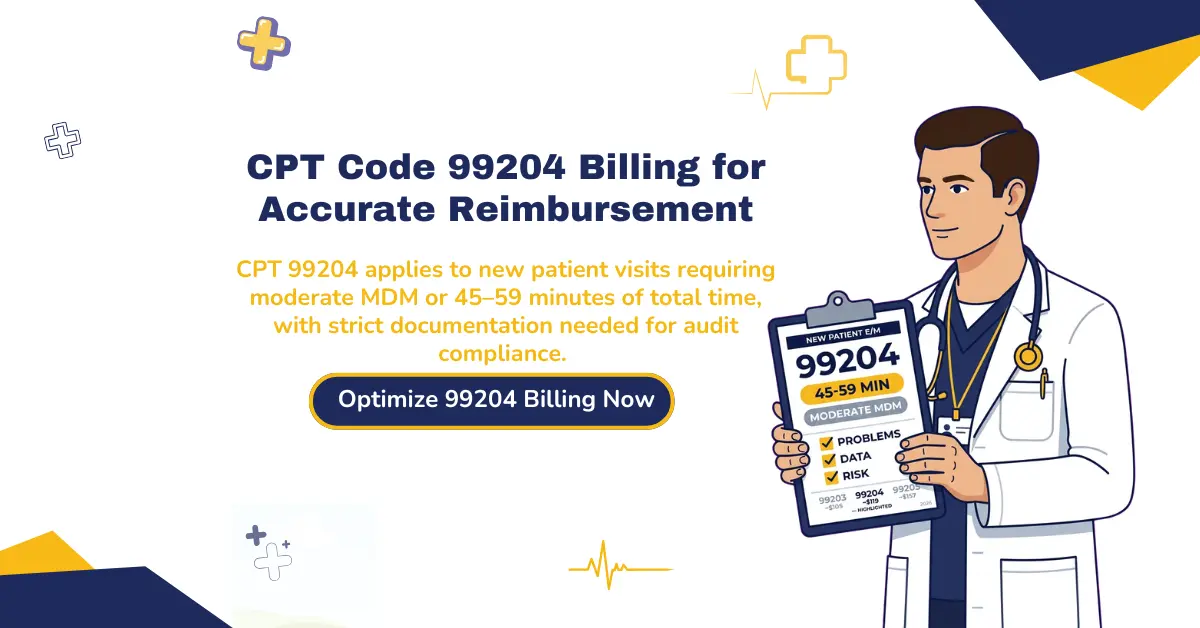
CPT code 99204 is an evaluation and management code used for new patient office or other outpatient visits requiring moderate medical decision making or 45 to 59 minutes of total time on the date of the encounter. It’s also one of the most frequently audited new patient E/M codes by Medicare Recovery Audit Contractors. Documentation precision is the first line of financial protection. Not an optional compliance step.
The HHS Office of Inspector General has consistently identified new patient evaluation and management coding as a payment integrity priority across its annual Work Plan. Recovery Audit Contractors recovered more than $900 million in improper E/M payments over the most recent multi-year audit cycle. Moderate complexity codes, including 99204, sit at a threshold where small documentation gaps produce large reimbursement consequences.
This guide covers the 2026 CMS definition and documentation standards, MDM requirements with audit defense framing, five specialty-specific clinical scenarios with ICD-10 pairs, reimbursement rates and payment accuracy tools, modifiers and prior authorization compliance rules, G2211 compliance risks, the nine audit triggers RAC contractors target in 2026, and how ClaimMax RCM’s medical billing service is built to protect 99204 revenue from pre-submission errors through post-denial recovery.
How to Select CPT Code 99204: MDM or Time
Time Requirements: 45 to 59 Minutes and the Audit Standard for Documentation
When selecting CPT code 99204 based on time, the provider must spend at least 45 minutes but less than 60 minutes of total time on the date of the encounter. Time below 45 minutes doesn’t support 99204 — consider 99203 instead. Time at or above 60 minutes crosses into 99205 territory, provided the documentation supports it.
Per AMA guidance and the CMS Evaluation and Management Services booklet, total time includes face-to-face evaluation and non-face-to-face activities performed personally by the billing provider on the same calendar date. Reviewable activities include pre-visit chart review, face-to-face evaluation, patient counseling, ordering and reviewing tests, coordinating care with other providers, and EHR documentation. Time contributed by nurses, medical assistants, or any other clinical support staff can’t be counted under any circumstances.
Here’s where practices run into audit problems. Recording “45 minutes” without describing the contributing activities fails the RAC review standard. A bare time entry is unverifiable by an independent reviewer. The compliant format states total minutes and briefly identifies the activities the billing provider personally performed on that date.
A compliant documentation example looks like this: “Total clinician time on date of service: 51 minutes. Activities included: pre-visit review of outside specialist records, face-to-face comprehensive evaluation and physical examination, counseling on diagnosis and treatment plan, ordering diagnostic imaging and labs, reviewing in-office results, and EHR documentation.”
One clarification worth stating directly: if MDM is chosen as the code selection method, time documentation isn’t required. The two methods are entirely independent.
Medical Decision Making: Moderate Complexity and the Audit Documentation Standard
When selecting CPT code 99204 based on medical decision making, the MDM must be classified as moderate complexity. The AMA defines MDM using three elements, and the provider must meet or exceed the moderate complexity threshold in two of the three to support this code. That’s the clinical standard. The documentation standard is a separate question entirely.
The Three-Element Moderate MDM Table
| MDM Element | Moderate Complexity Threshold | Audit Documentation Standard |
| Number and complexity of problems addressed | One or more chronic illnesses with mild exacerbation or progression; two or more stable chronic illnesses; an undiagnosed new problem with uncertain prognosis; or an acute illness with systemic symptoms | Name the specific problem(s) and classify each explicitly, for example, “stable chronic illness” or “acute illness with systemic symptoms.” Do not leave complexity implied by the diagnosis alone. |
| Amount and complexity of data reviewed | Review of prior external notes from a unique source; independent interpretation of test results; or discussion with an external provider | Identify each external data source by name, date, or institution. If independent interpretation is claimed, state “independent interpretation” explicitly. Generic references to “records reviewed” satisfy no auditor. |
| Risk of complications, morbidity, or mortality | Prescription drug management; decision for minor surgery with identified risk factors; or diagnosis or treatment significantly limited by social determinants | Name the prescription drug and state it represents moderate risk management. If surgery is considered, document the specific risk factors that elevate this decision above low risk. |
The AMA’s “2 of 3” rule works like this: when two elements meet moderate complexity criteria, the MDM supports 99204, even if the third element lands at a lower level. Auditors apply this rule as a floor. Two of three in documentation is different from two of three clinically. Both matter, but the documentation is what a reviewer actually sees.
One clarification that no competitor article makes explicitly: some sources incorrectly associate 99204 with high complexity MDM. That’s wrong. Per AMA CPT 2026 and CMS, 99204 requires moderate complexity MDM. CPT 99205 requires high complexity. This confusion drives both undercoding, when a provider uses 99203 for a visit that clearly supports moderate MDM, and overcoding, when 99205 gets selected when 99204 is the correct level.
99203 vs 99204 vs 99205: Code Differences, Reimbursement Impact, and Payer Audit Implications
Comparison Table: New Patient E/M Codes (99202 Through 99205) with Payer Audit Trigger Column
| Code | MDM Level | Total Time | 2026 Medicare Non-Facility Rate | Work RVU | Payer Audit Trigger |
| 99202 | Straightforward | 15 to 29 minutes | Approximately $72 | 0.93 | Single-provider practices billing all new patients at 99202 regardless of problem count or data review |
| 99203 | Low | 30 to 44 minutes | Approximately $105 | 1.60 | Time entries clustering at exactly 30 minutes across high claim volumes; MDM elements stated but not documented to audit standard |
| 99204 | Moderate | 45 to 59 minutes | Approximately $119 | 2.60 | Upcoding from 99203 without explicit moderate MDM documentation; time entries clustering at exactly 45 minutes; G2211 appended without longitudinal care context |
| 99205 | High | 60 to 74 minutes | Approximately $157 | 3.50 | Statistical outlier when the majority of new patient visits in a non-specialist practice are billed at this level; MDM elements described but not differentiated from moderate complexity |
Source: CMS CY 2026 Physician Fee Schedule.
99203 vs 99204: The Dual Audit Risk at the Low-to-Moderate Threshold
The MDM boundary between these two codes is specific. CPT 99203 applies when the provider manages a stable chronic illness or an acute uncomplicated condition with limited data review and low risk treatment. CPT 99204 applies when the provider manages a chronic illness with mild exacerbation or progression, or an undiagnosed new problem with uncertain prognosis, with at least one external data source reviewed and moderate risk treatment initiated.
At Medicare rates, that distinction is worth approximately $14 per visit. At commercial payers, it’s often $50 to $80 per visit. That gap adds up fast across a full new patient schedule.
What usually creates the real problem is billing in the wrong direction. Consistently coding 99203 when 99204 is documented is a revenue problem: legitimate revenue left uncollected visit after visit. Consistently coding 99204 when only 99203 is documented is a compliance problem: a pattern that triggers payer downcode review and potential RAC targeting. Both directions carry real financial consequences. Accurate revenue cycle management catches both errors before the claim reaches the payer.
99204 vs 99205: When Moderate Complexity Becomes High Complexity
Moderate complexity for 99204 involves managing a chronic illness with mild exacerbation, initiating a new prescription, or making a decision carrying moderate risk. High complexity for 99205 involves managing a chronic illness with severe exacerbation, prescribing a drug requiring intensive monitoring for toxicity, or making decisions under significant uncertainty with high risk of morbidity, mortality, or severe functional impairment.
Time-wise, 99204 covers 45 to 59 minutes and 99205 covers 60 to 74 minutes. That’s a clear line on paper. The audit risk is what makes this boundary worth paying attention to.
The jump from 99204 to 99205 increases reimbursement by approximately 30%. RAC contractors specifically weight that percentage in their statistical outlier analysis. Visit duration and patient severity alone don’t justify 99205. The documentation must explicitly support high complexity MDM, with each element written at that level, not at the moderate level with a higher code selected.
99204 vs 99214: New Patient vs Established Patient and the Audit Pattern for Each
CPT 99204 applies when the patient hasn’t been seen by the same provider or same specialty group within three years. CPT 99214 applies to established patients with moderate MDM for visits of 30 to 39 minutes. The 2026 Medicare non-facility reimbursement difference is approximately $25 per visit, with 99204 paying more for the same MDM level.
Each direction of misclassification carries its own audit consequence. Billing 99204 for an established patient triggers a RAC cross-reference review against the patient’s prior visit history: an automated query that runs without manual intervention. Billing 99214 for a new patient produces an underpayment, because 99204 is the correct and higher-paying code for a new patient at the same MDM level.
Systematic code selection errors in either direction represent preventable revenue risk. ClaimMax RCM’s billing team reviews code selection accuracy before every claim reaches the payer. Learn how our medical billing service protects your E/M revenue at every complexity level.
When to Bill CPT Code 99204: Five Clinical Scenarios with Audit Documentation Rationale
Per the CMS Evaluation and Management Services guidelines, moderate medical decision making requires meeting two of three MDM elements at the moderate threshold. Each scenario below maps the clinical reality to the documentation language an auditor actually needs to see. The ICD-10 code, MDM rationale, and audit note are specific to each specialty.
Scenario 1: Urology: New Patient Hematuria Evaluation
Patient: 62-year-old male, new patient, painless gross hematuria discovered two weeks ago.
ICD-10: R31.0 (Gross hematuria)
Time: Approximately 47 minutes
What happened at the visit: The provider completed a comprehensive history and genitourinary examination, ordered urine cytology and culture, placed a cystoscopy referral, and reviewed outside primary care records brought by the patient.
MDM rationale: One undiagnosed new problem with uncertain prognosis, because malignancy can’t be excluded at this visit. Outside primary care records represent a unique external data source. The cystoscopy referral is a moderate-risk invasive diagnostic procedure.
Why 99204 and not 99203: The “uncertain prognosis” element is what separates this from low complexity. Gross hematuria in a 62-year-old male requires urgent malignancy exclusion. That clinical urgency supports the moderate MDM problems element.
Why 99204 and not 99205: No high-risk treatment was initiated, no drug requiring toxicity monitoring was prescribed, and no severe functional impairment was documented.
Audit Documentation Note: Write “one new undiagnosed problem, uncertain prognosis” explicitly in the MDM section. Don’t let the diagnosis code do that work for you. Identify the outside records by source name, not as “prior records.” State “cystoscopy referral, moderate-risk diagnostic procedure” in the plan.
Scenario 2: Pulmonology: New Patient Chronic Cough Evaluation
Patient: 49-year-old female, new patient, persistent cough for four months not responding to reflux treatment.
ICD-10: R05.9 (Cough, unspecified)
Time: Approximately 50 minutes
What happened at the visit: The provider completed a detailed respiratory history and full pulmonary examination, ordered spirometry, reviewed a chest X-ray the patient brought from her primary care practice, and initiated a trial of an inhaled corticosteroid.
MDM rationale: One undiagnosed new problem with uncertain prognosis at this visit, because the cough etiology hasn’t been identified despite prior treatment. The chest X-ray from an outside source satisfies the external data review element. Initiating an inhaled corticosteroid is prescription drug management at moderate risk.
Why 99204: Undiagnosed new problem plus external imaging review plus prescription management satisfies two of three moderate MDM elements. That’s the threshold. It’s met clearly here.
Audit Documentation Note: Don’t write “reviewed prior X-ray.” Write “reviewed outside chest X-ray from [Practice Name], dated [Date].” Name the inhaled corticosteroid specifically and classify its risk level: “inhaled corticosteroid, moderate-risk prescription management.” Auditors can’t verify what isn’t named.
Scenario 3: Rheumatology: New Patient with Polyarthritis Workup
Patient: 44-year-old female, new patient, symmetric joint pain and morning stiffness affecting hands and wrists for three months.
ICD-10: M13.0 (Polyarthritis, unspecified)
Time: Approximately 54 minutes
What happened at the visit: The provider completed a full rheumatological history and joint examination documenting specific joints involved, ordered RF, anti-CCP, ESR, and CRP, initiated an NSAID with a GI protective agent, and documented consideration of a disease-modifying agent if labs confirmed inflammatory disease.
MDM rationale: One chronic illness under initial evaluation, because the inflammatory arthritis etiology hasn’t been confirmed. Multiple labs ordered and under review satisfy the moderate data element. The NSAID with GI protective agent combination is moderate-risk prescription management.
Why 99204: Chronic illness under initial evaluation with a moderate lab workup and prescription management satisfies two of the three moderate MDM elements.
Audit Documentation Note: Name the NSAID specifically. Document the GI protective agent and state explicitly that this combination represents “moderate risk prescription management.” Write “chronic illness under initial evaluation, inflammatory arthritis etiology being determined” in the assessment. That phrase distinguishes initial workup from ongoing established care, which payers sometimes try to reclassify differently.
Scenario 4: Gastroenterology: New Patient Dysphagia Evaluation
Patient: 57-year-old male, new patient, solid food dysphagia progressing over two months.
ICD-10: R13.10 (Dysphagia, unspecified)
Time: Approximately 48 minutes
What happened at the visit: The provider completed a detailed swallowing and GI history, performed a head and neck and abdominal examination, ordered a barium swallow, initiated a proton pump inhibitor empirically, and placed an upper endoscopy referral.
MDM rationale: One new problem with uncertain prognosis, because progressive dysphagia in a 57-year-old male requires malignancy exclusion before any other diagnosis is assigned. The barium swallow order and endoscopy referral satisfy the moderate data element. The PPI prescription plus endoscopy referral for a procedure with identifiable procedural risk satisfies the moderate risk element.
Why 99204: Uncertain prognosis plus diagnostic referral plus prescription management satisfies two of three moderate elements.
Audit Documentation Note: State “one new undiagnosed problem, uncertain prognosis, malignancy not yet excluded” in the MDM section. Name the PPI and classify its risk. Document the endoscopy referral as “referral for diagnostic procedure with identifiable procedural risk.” A note that skips these labels leaves the auditor guessing, and guessing always goes against the provider.
Scenario 5: Orthopedics: New Patient Shoulder Instability Evaluation
Patient: 35-year-old male, competitive athlete, new patient, recurrent right shoulder subluxation episodes for six months.
ICD-10: M25.311 (Pain in right shoulder)
Time: Approximately 46 minutes
What happened at the visit: The provider completed a detailed orthopedic history, performed provocative shoulder examination including apprehension and relocation tests, ordered an MRI, prescribed physical therapy, and documented a surgical consultation discussion for failure of conservative management.
MDM rationale: Two problems addressed: shoulder instability and activity limitation. MRI ordering and physical therapy prescription satisfy the moderate data element. Physical therapy prescription plus the documented surgical risk-benefit discussion satisfy the moderate risk element.
Why 99204: Two problems plus imaging order plus prescription-level management satisfies two of three moderate MDM elements.
Audit Documentation Note: Document both problems separately in the assessment. Don’t combine them into one line. Name the specific MRI type ordered. Write “physical therapy prescription” explicitly, because therapy referral carries the same risk classification weight as a drug prescription in the MDM framework. If the surgical conversation happened, state “surgical option discussed, minor procedure with identified risk factors” in the plan. Without that language, the risk element is difficult to defend.
Selecting the right E/M code for every new patient encounter requires precise MDM mapping and documentation that survives payer scrutiny. ClaimMax RCM’s billing team reviews every 99204 claim for code accuracy and documentation completeness before submission. Learn how our medical billing service protects your E/M revenue.
Documentation Requirements for CPT Code 99204: The Audit Defense Standard
When a 99204 claim gets pulled for audit review, the written record is the only thing standing between your practice and a recoupment demand. A Recovery Audit Contractor doesn’t observe the clinical encounter. Reviewers read the note. Under Medicare’s standard, if it isn’t documented, it wasn’t done. That’s not a figure of speech. It’s the actual review standard applied to every claim selected for audit.
The 10-Point Audit Defense Documentation Checklist
#Documentation Element1Patient status confirmed as new. No professional services from the same provider, same specialty, or same group within the previous three years. Verify through EHR and prior claims data before code assignment, not at billing.2Code selection method specified. State whether the code was selected by time or MDM. The two methods can’t be mixed in the same claim support.3If time-based: Total minutes recorded with a description of the specific activities contributing to that total on the date of service. A bare number isn’t sufficient for audit defense.4If MDM-based: All three MDM elements explicitly addressed. Problem named and classified by complexity type. External data source identified specifically, or explicitly noted as none. Risk level stated with the specific treatment decision that evidences it. The classification must be written in the note, not inferred from the plan.5Medically appropriate history and examination documented, proportionate to the presenting complaint. The examination must describe findings, not just list systems reviewed.6Assessment with specific ICD-10-CM codes. Don’t default to a symptom code when a definitive diagnosis is available and documented in the note.7Treatment plan with specific management decisions. Medications named, tests identified, referrals specified, and follow-up timeframe stated.8Provider attestation. The billing provider personally performed the service or directly supervised it in compliance with applicable supervisory standards.9If a same-day procedure was also performed: Modifier 25 appended to 99204, and the E/M note stands independently with its own chief complaint, history, assessment, and plan, fully separate from the procedure documentation.10Prior authorization confirmed and authorization number documented on the claim. Required when the payer, plan, or location mandates authorization for new patient specialty visits. This step must be completed before the date of service, not discovered at billing.
Three Audit-Triggering Documentation Failures Specific to 99204
Failure 1: Problem Complexity Left Implied
Writing “patient with hypertension and diabetes” reads as a past medical history summary to an auditor. That’s not MDM problem element documentation. The compliant version states “two stable chronic illnesses, both without exacerbation or complication at today’s visit.” One version tells a reviewer what’s in the chart. The other tells a reviewer what you assessed and at what complexity level. Auditors need the second format. Without it, the problems element fails regardless of the patient’s actual clinical complexity.
Failure 2: External Data Source Not Individually Identified
Writing “reviewed prior records” is the documentation equivalent of saying “I looked at some things.” CMS and AMA guidelines require each unique external data source to be individually identified by name, date, or institution. A vague reference satisfies the clinical intent but fails the RAC review standard completely. The consequence is that the data element drops to none, which eliminates one of the two required moderate MDM elements.
Failure 3: Risk Level Stated as a Conclusion Without Evidence
Writing “moderate risk” in the MDM section without naming the treatment decision that supports it gives the auditor nothing to verify. The prescription name, the surgical discussion, or the treatment limitation by social determinants, whichever applies, must appear in the plan. “Moderate risk” as a standalone conclusion isn’t citable. Auditors need something specific to point to, and if it’s not there, the risk element fails.
How to Build an Audit-Proof Documentation Record for CPT Code 99204
Step 1: Confirm Patient Status
Verify the patient hasn’t received professional services from the same provider, specialty, or group within three years. Complete this check before the encounter, not at coding.
Step 2: Determine Code Selection Method
Decide whether the encounter will be coded by MDM or by time. Document this decision explicitly at the bottom of the clinical note so the billing team knows which standard to verify against.
Step 3: Document All Supporting Elements
For MDM: name and classify each problem, identify each external data source specifically, and state the risk level with the treatment decision that evidences it. For time: record total minutes and list the contributing activities the billing provider personally performed.
Step 4: Verify Modifier Requirements
Confirm whether a same-day procedure requires Modifier 25. If it does, make sure the E/M note stands entirely independently before submission.
Step 5: Confirm Prior Authorization
Check the payer’s current policy before the encounter. Record the authorization number in the EHR and confirm it carries automatically to the claim submission. Finding out at billing that authorization was never obtained is a denial that won’t be overturned.
CPT Code 99204 Reimbursement Rates and RVU Breakdown (2026)
2026 Medicare Payment Calculation
The 2026 Medicare national non-facility reimbursement rate for CPT code 99204 is approximately $118 to $120, based on a total RVU of approximately 3.56 per the CMS Physician Fee Schedule. That’s the number most practices focus on. What they often don’t track is whether they’re actually receiving it.
Knowing the correct expected rate is step one of underpayment detection. Practices that don’t systematically verify posted payments against expected amounts allow payer remittance errors to accumulate silently. Payment posting accuracy is how those discrepancies get caught before they age into uncollectable revenue.
Per the CMS CY 2026 Physician Fee Schedule Final Rule, CMS finalized two separate conversion factors for 2026: $33.4009 for non-QP clinicians and $33.5675 for Qualifying APM Participants. The payment formula is: Medicare payment = (Work RVU x Work GPCI + PE RVU x PE GPCI + MP RVU x MP GPCI) x Conversion Factor.
RVU Component Breakdown for 99204 (2026)
| RVU Component | Value |
| Work RVU | 2.60 |
| Non-Facility Practice Expense RVU | Approximately 0.76 |
| Facility Practice Expense RVU | Approximately 0.40 |
| Malpractice RVU | Approximately 0.20 |
| Total RVU (Non-Facility) | Approximately 3.56 |
| Total RVU (Facility) | Approximately 3.20 |
Source: CMS CY 2026 PFS RVU Files.
The non-facility total RVU of approximately 3.56 multiplied by the applicable conversion factor produces the expected Medicare payment before GPCI adjustment. A payment posting specialist uses that calculation to flag remittances that fall below the expected amount. Systematic gaps between expected and received payments are identified only through payment-by-payment verification. That’s where underpayment recovery starts.
Estimated Commercial Payer Reimbursement Rates for 99204
| Payer | Estimated Reimbursement Range |
| Blue Cross Blue Shield | Approximately $165 to $195 |
| UnitedHealthcare | Approximately $160 to $190 |
| Aetna | Approximately $155 to $185 |
| Cigna | Approximately $180 to $250 |
| Medicare | Approximately $118 to $120 (national average, non-facility) |
| Medicaid | Approximately $78 to $105 (varies by state) |
Commercial payers frequently pay below contracted amounts for moderate-complexity E/M codes because of automated claim scrubbing edits. Practices that don’t verify posted payments against contracted rates can’t identify whether the payment received is actually correct. That gap in payment posting discipline means underpayment becomes an ongoing, undetected revenue loss, visit after visit.
Facility vs Non-Facility Rate Difference
When 99204 is billed from a facility setting such as a hospital-based outpatient clinic at Place of Service 22, the physician payment is lower because the facility bills separately for overhead costs. The non-facility rate at Place of Service 11 is higher because the physician absorbs overhead directly. The 2026 difference is approximately $38 to $42 per visit.
Providers employed by hospital systems should confirm the correct POS code for their specific location before billing. A systematic POS mismatch doesn’t just affect individual claims. It suppresses every 99204 payment across the full billing cycle until someone catches it.
Year-Over-Year Medicare Rate Trend for 99204
| Year | Non-Facility Medicare Rate | Conversion Factor |
| 2023 | Approximately $127 | $33.06 |
| 2024 | Approximately $122 | $32.74 |
| 2025 | Approximately $121 | $32.35 |
| 2026 | Approximately $119 | $33.40 (non-QP) |
The 2026 rate partially recovers from the 2024 and 2025 reductions because of the conversion factor increase from $32.35 to $33.40. The net payment still reflects both that conversion factor increase and the practice expense RVU methodology changes CMS applied this cycle. Don’t rely on prior-year estimates for billing projections. Verify current rates through the CMS Physician Fee Schedule Look-Up Tool before modeling expected revenue for 2026.
Accurate reimbursement for 99204 depends on correct RVU configuration, clean claim submission, and systematic payment verification against contracted rates. ClaimMax RCM’s revenue cycle management services and payment posting service are built to catch underpayments before they age out of the collection window.
Billing Guidelines for CPT Code 99204: Step-by-Step Workflow and ICD-10 Pairing
Clean claim submission for the 99204 CPT code requires more than selecting the correct code. It requires a structured pre-submission workflow that addresses patient status verification, documentation completeness, modifier requirements, prior authorization status, and ICD-10 accuracy, in that sequence. Each step in the wrong order or skipped entirely produces a different category of denial.
Step-by-Step Billing Workflow for 99204
Per the AMA CPT guidelines for office and outpatient E/M codes, code 99204 medical billing requires a verified documentation and pre-submission sequence before the claim ever reaches the payer. Here’s the workflow that protects every submission.
- Verify patient status. Confirm the patient has not received professional services from the same provider, same specialty, or same group within the previous three years. Complete this check at scheduling or registration, never at billing.
- Confirm code selection method. The provider documents code selection by time or MDM. Both methods are independent. The billing team verifies which method is documented before assigning any code.
- Verify MDM documentation completeness. If MDM-based: confirm all three elements are explicitly addressed, problems named and classified, data source identified, and risk level stated. If time-based: confirm total minutes and contributing activities are recorded.
- Assign ICD-10 diagnosis code. Select the most specific ICD-10-CM code supported by the documentation. Avoid symptom codes where a definitive diagnosis has been established and documented in the note.
- Confirm prior authorization. Verify whether the payer requires authorization for this patient, plan, and service type. Document the authorization number before submission, not after.
- Apply modifiers if required. Modifier 25 when a same-day procedure also occurred. Modifier 95 or 93 for telehealth encounters. Modifier 24 when the encounter falls within another provider’s global surgical period.
- Assign Place of Service code. POS 11 for office, POS 22 for on-campus outpatient hospital, POS 02 or POS 10 for telehealth based on the patient’s location at the time of service.
- Submit the claim and monitor for adjudication. Verify remittance against expected reimbursement using the RVU-based calculation. Flag and work any denial within the payer’s appeal window before it ages out.
ICD-10 Codes Commonly Paired with CPT 99204
Every 99204 claim must be paired with an ICD-10-CM diagnosis code that supports the level of service billed. Moderate complexity MDM implies a condition that is either a stable chronic illness, an acute illness with systemic symptoms, or an undiagnosed new problem with uncertain prognosis. The ICD-10 code must reflect that clinical reality. Defaulting to an unspecified code when a more specific code is available weakens the MDM rationale and invites scrutiny.
| ICD-10 Code | Description | Audit Documentation Note |
| R31.0 | Gross hematuria | Document “new problem with uncertain prognosis” explicitly. Don’t code to a benign etiology until the etiology is established. |
| R05.9 | Cough, unspecified | Use a specific code when etiology is established. If still unspecified, document that etiology remains under evaluation at this visit. |
| M13.0 | Polyarthritis, unspecified | Specify “under initial evaluation” in the assessment to distinguish initial workup from ongoing management. |
| R13.10 | Dysphagia, unspecified | Document that malignancy has not been excluded to support uncertain prognosis. Don’t default to GERD coding prematurely. |
| M25.311 | Pain in right shoulder | Laterality is required. Document the competing diagnoses being actively evaluated at this encounter. |
| R55 | Syncope and collapse | Document that neurological and cardiac workup has been initiated. This supports both the moderate data element and uncertain prognosis. |
| K57.30 | Diverticulosis of large intestine without perforation, bleeding, or abscess | Document chronic illness with risk of exacerbation. Distinguish clearly from acute diverticulitis in the assessment. |
| E05.90 | Hyperthyroidism, unspecified without thyrotoxic crisis | Document TSH and free T4 reviewed. Name the source of the thyroid function test specifically. |
| L40.0 | Psoriasis vulgaris | Document body surface area affected and prior treatment history. This supports the prescription drug management decision at moderate risk. |
| B02.9 | Zoster without complications | New problem with limited duration. Document whether an antiviral prescription was initiated for moderate risk classification. |
The “Audit Documentation Note” column is what makes this table useful in a real billing review. Matching the ICD-10 code to the clinical finding in the note, and to the MDM complexity level, is exactly what a RAC reviewer verifies when a 99204 claim is selected for audit. A code that doesn’t match the documented complexity undermines the MDM rationale regardless of what actually happened clinically.
What Modifier Is Used for 99204? Modifiers, Audit Requirements, and Prior Authorization Compliance
The most commonly used modifier with CPT 99204 is Modifier 25, which indicates a significant, separately identifiable E/M service performed on the same day as a procedure. For telehealth encounters, Modifier 95 or Modifier 93 applies depending on the delivery method. Certain payers also require prior authorization documentation before the claim is submitted, a compliance step that most modifier guides omit entirely.
| Modifier | Description | When to Use with 99204 | Audit Compliance Requirement |
| 25 | Significant, separately identifiable E/M service on the same date as a procedure | When a minor procedure or preventive service is performed on the same date and a distinct E/M service was also provided | The E/M note must stand independently with its own chief complaint, history, assessment, and plan. A merged note for evaluation and procedure fails the audit standard. |
| 95 | Synchronous audio and video telemedicine | Telehealth visits via HIPAA-compliant real-time audio and video | POS 02 or POS 10 required. Document patient consent and platform name. Verify payer preference for Modifier 95 versus GT. |
| 93 | Audio-only telemedicine | When the patient cannot access video technology | Not accepted by all payers. Confirm coverage before submitting. Document the reason video was unavailable. |
| 24 | Unrelated E/M during post-operative global period | When another provider’s global surgical period is active for the same patient | Document that the visit is unrelated to the surgical diagnosis. Link to a different ICD-10 code than the surgical procedure. |
| GC | Service by resident under teaching physician supervision | Teaching hospital settings | Attending attestation required. Residents’ time cannot be included in the billing provider’s total time calculation. |
Modifier 25 with CPT 99204: Documentation Requirements
The AMA is clear that different diagnoses aren’t required to justify reporting both an E/M and a procedure on the same day. What is required is that the E/M documentation demonstrates the evaluation was significant and separately identifiable from the procedure’s inherent pre-service, intra-service, and post-service work.
That distinction matters in practice. The E/M note must include its own chief complaint, history, assessment, and plan, fully separate from the procedure note. A single merged note that covers both the evaluation and the procedure without distinguishing them is one of the most common CPT code 99204 Modifier 25 audit failures we see. Some payers also require a separate diagnosis for the E/M service specifically. Verify each payer’s current policy before submitting, because the commercial variation here is real.
Telehealth Modifiers for 99204
CMS prefers Modifier 95 for synchronous audio and video telehealth encounters. Modifier 93 is available for audio-only encounters when the patient can’t access video technology. Here’s where it gets complicated: some commercial payers and Medicaid programs still require Modifier GT rather than Modifier 95, so verify each payer’s current requirement before billing. Don’t assume CMS rules carry over to commercial contracts. For audio-only encounters, also confirm the specific payer covers audio-only telehealth for new patient E/M codes, because not all plans do.
Prior Authorization Compliance for 99204 Encounters
Certain payers require prior authorization for new patient visits, particularly Medicare Advantage plans, commercial payers with specialty referral networks, and some Medicaid managed care organizations. When prior authorization is required, the authorization number must appear on the claim in the correct field before submission. Submitting without it produces an administrative denial that is typically not reversible on appeal. That’s not a gray area. Most payers won’t reconsider it.
The pre-service workflow that prevents this category of denial is straightforward: confirm prior authorization before scheduling the encounter, document the authorization number in the EHR at the time of approval, and ensure the billing system carries that number automatically to the claim. Authorization obtained after the date of service is retroactive authorization. Most payers decline it, and the denial stands.
Prior Authorization Action Item: Review every active payer contract for plans that require prior authorization for new patient specialty visits. A missing authorization number on a 99204 claim is a preventable administrative denial. It must be resolved before the date of service, not discovered at billing.
ClaimMax RCM’s prior authorization services manage the full authorization request, tracking, and documentation workflow for new patient encounters across all payer types.
Other Situational Modifiers
Modifier 57 applies when the E/M service results in a decision for major surgery within a 90-day global period. It’s not commonly used with 99204 given the moderate MDM requirement, but it does apply in specific orthopedic and surgical contexts. Modifier 59 is rarely appropriate with E/M codes and shouldn’t be appended to 99204 in most circumstances. Modifier GT is a legacy telehealth modifier now primarily required by certain commercial payers and Medicaid programs that haven’t updated their billing requirements to align with current CMS guidance.
Who Can Bill CPT Code 99204? Provider Eligibility and Enrollment Requirements
CPT code 99204 can be billed by physicians (MD and DO), nurse practitioners, and physician assistants. Clinical psychologists may bill under specific payer contracts within their licensed scope. Proper payer enrollment and credentialing is a prerequisite: an unenrolled provider’s 99204 claims face full recoupment regardless of documentation quality.
Provider Eligibility for 99204
| Provider Type | Can Bill 99204? | Compliance Notes |
| Physician (MD, DO) | Yes | Must be enrolled with each payer before billing. NPI must match the service location on file. |
| Nurse Practitioner (NP) | Yes | Bills under own NPI. Medicare pays at 85% of the physician fee schedule. |
| Physician Assistant (PA) | Yes | Bills under own NPI. Medicare pays at 85% of the physician fee schedule. |
| Clinical Psychologist | Payer-specific | Some payers allow E/M codes within scope. Verify before billing. Not universal. |
| Licensed Clinical Social Worker | Payer-specific, state-dependent | Significant variation by state and payer contract. Confirm before billing. |
| Registered Nurse | No | Cannot independently bill E/M codes under any payer. |
| Medical Assistant | No | Cannot independently bill E/M codes under any payer. |
One rule applies across every provider type: only time personally spent by the billing provider counts toward the 45-minute threshold for a new patient office visit. Staff time can’t be included under any circumstances, regardless of how the EHR captures it.
Incident-To Billing and CPT 99204
Incident-to billing allows non-physician practitioners to bill under the supervising physician’s NPI, but it applies only to established patients. CPT 99204 is a new patient code. It can’t be billed incident-to. Full stop.
Here’s why this matters from an audit perspective. RAC contractors cross-reference new patient code claims against the NPI under which they were billed. When a 99204 claim appears under a physician NPI but the documentation shows the encounter was performed entirely by a non-physician practitioner without direct physician involvement, the claim fails the incident-to standard. That’s not a billing technicality. It’s a per-claim compliance violation with recoupment consequences applied to every affected claim in the review period.
Enrollment timing is the other piece that catches practices off guard. Delays in credentialing produce claim denials that can’t be retroactively corrected once timely filing windows close. By the time the credentialing gap is identified, the revenue may already be unrecoverable.
ClaimMax RCM’s credentialing services manage the full payer enrollment process so providers are authorized to bill before the first claim is submitted.
99204 vs 99214: New Patient vs Established Patient and the Audit Exposure for Each
CPT codes 99204 and 99214 both require moderate medical decision making, but they differ by patient status. CPT 99204 is for new patients not seen in three or more years. CPT 99214 is for established patients. Under 2026 Medicare non-facility rates, 99204 reimburses approximately $119 while 99214 reimburses approximately $95.
| Factor | 99204 (New Patient) | 99214 (Established Patient) |
| Patient Status | New: not seen in three or more years, same specialty, same group | Established: seen within three years |
| MDM Level | Moderate | Moderate |
| Time Range | 45 to 59 minutes | 30 to 39 minutes |
| 2026 Medicare Rate (Non-Facility) | Approximately $119 | Approximately $95 |
| Documentation | More comprehensive first-encounter history and examination required | More focused; can reference prior documentation |
| Audit Risk Pattern | New patient misclassification: RAC automated cross-reference against visit history | Moderate MDM overcoding: payer claims analytics review |
The audit risk row is the detail most comparison tables leave out. Both codes carry distinct review patterns, and knowing which pattern applies to each code changes how you build your internal compliance workflow.
Understanding the 3-Year Rule
A new patient is someone who has not received any professional services from the same physician, or another physician of the same specialty and subspecialty within the same group practice, within the previous three years. Phone calls don’t count. Portal messages don’t count. Administrative contacts don’t count. Only face-to-face encounters reported under a specific CPT code reset that clock.
That definition matters more than most practices realize. A patient who saw a different physician in the same group two years ago isn’t a new patient for CPT 99204. Billing that visit as new triggers an automated RAC cross-reference that runs without anyone on the payer’s side making a judgment call.
Build the Verification Step Into Intake, Not Billing
Patient status verification must happen at scheduling or registration. By the time the claim reaches the billing team, the provider has typically already assigned the code. A verification step embedded in the intake workflow catches misclassification before it reaches the claim, not after a denial comes back.
ClaimMax RCM’s credentialing services also ensure that every provider’s enrollment reflects the correct specialty designation, supporting accurate new versus established patient determinations at the claim level.
CPT 99204 by Specialty: Urology, Pulmonology, Rheumatology, and Cardiology
CPT 99204 applies to any specialty when the new patient encounter supports moderate medical decision making. The clinical presentations differ by specialty, but the MDM framework is the same. Here’s how evaluation and management coding at this level works across four specialties with distinct audit documentation patterns.
Urology
New patient evaluations for hematuria, urinary retention, renal mass, or voiding dysfunction typically involve an undiagnosed new problem with uncertain prognosis alongside diagnostic imaging or lab ordering. That combination satisfies two of three moderate MDM elements without stretching the documentation.
The audit documentation note for urology is specific: write “new problem with uncertain prognosis” explicitly in the assessment when evaluating a new renal or urological finding that hasn’t been characterized. Don’t let the diagnosis code carry that language. Auditors read the note, not the code.
Pulmonology
New patients with chronic cough, dyspnea on exertion, or suspected obstructive lung disease often require spirometry and review of outside primary care records, which satisfies moderate data review. Prescription of an inhaled bronchodilator or corticosteroid satisfies the moderate risk element. Both conditions are met in the same encounter.
Don’t default to 99203 when both a diagnostic workup and a new prescription are initiated on the same visit. That combination consistently supports 99204. Selecting the lower code because the presentation feels routine is leaving legitimate revenue uncollected.
Rheumatology
Initial rheumatology evaluations for inflammatory arthritis, polyarthritis, or connective tissue disorders involve a chronic illness under initial evaluation plus a laboratory workup. That’s the combination that reliably supports moderate MDM in this specialty. The lab workup satisfies moderate data. The prescription management satisfies moderate risk.
Write “chronic illness under initial evaluation” explicitly in the assessment. That phrase distinguishes initial diagnostic workup from ongoing established management, which payer analytics systems sometimes classify differently when the note language is vague.
Cardiology
New patient evaluations for palpitations, chest pain of uncertain etiology, or syncope without an identified cause represent an undiagnosed new problem with uncertain prognosis. When an ECG or echocardiogram is ordered and interpreted in the office, the data element reaches moderate complexity. Both elements are met without requiring a prescription.
One question comes up in cardiology billing regularly: is CPT 99204 a preventive code? It is not. Preventive cardiology visits use codes 99381 through 99397. CPT 99204 applies to problem-oriented new patient visits regardless of specialty, and the two code families don’t overlap.
G2211 Add-On Code with 99204: 2026 Billing Rules and Audit Compliance
G2211 is the add-on code most commonly misapplied alongside CPT code 99204 in new patient billing. The additional payment of approximately $16 to $17 per qualifying encounter under the 2026 Medicare fee schedule makes it financially appealing. The compliance risk of applying it incorrectly is significant. Understanding exactly when G2211 is appropriate with 99204, and when it creates audit exposure, is the practical starting point.
What Is G2211 and When Does It Apply to 99204?
Per CMS MLN Matters MM13473, G2211 became separately payable effective January 1, 2024. It recognizes office and outpatient visits where the provider serves as the focal point for ongoing care coordination or manages a serious or complex condition over time. G2211 attaches to base E/M codes 99202 through 99215. Per the CMS CY 2026 Physician Fee Schedule Final Rule, beginning January 1, 2026, G2211 also applies to home visit codes 99341 through 99350. It’s not specialty-restricted: any qualifying provider may report it when the clinical context supports a longitudinal care relationship.
G2211 may be reported alongside 99204 when the new patient encounter establishes an ongoing care relationship. Not every new patient visit qualifies. A one-time evaluation for worker’s compensation, pre-surgical clearance, or a single-episode acute illness doesn’t support G2211. The documentation must reflect that the provider intends to serve as the focal point for this patient’s ongoing care management. That intent must be written in the note, not inferred from the specialty type.
The financial impact is real. At approximately $16 to $17 additional per eligible encounter, correct G2211 application at a volume of 20 qualifying new patient visits per week represents more than $17,000 in additional annual Medicare revenue. That revenue is defensible only when the documentation explicitly supports it.
G2211 and Modifier 25: The 2024 to 2026 Rule Timeline
The compliance timeline here has moved twice in two years, and practices that haven’t kept up are submitting claims that fail CMS claim edits without realizing it.
2024 rule: CMS implemented claim edits preventing payment of G2211 when the associated E/M code was billed with Modifier 25. No exceptions existed at the time of implementation.
2025 exception, continuing into 2026: CMS created a specific carve-out. G2211 is payable alongside an E/M code billed with Modifier 25 when the same-day service is an Annual Wellness Visit, a vaccine administration, or any Medicare Part B preventive service. That exception is narrow and specific.
The practical implication for 99204 is this: a new patient evaluation billed with Modifier 25 on the same day as a preventive service or vaccine administration can include G2211, provided the documentation supports both the E/M and the preventive service independently. The documentation requirements don’t relax because the exception applies.
Billing G2211 with Modifier 25 on 99204 for a same-day minor procedure that is not an AWV, vaccine, or Part B preventive service produces a claim that fails CMS claim edits. That denial is administrative and categorical. It’s not appealable on medical necessity grounds.
G2211 Audit Risk: What RAC Contractors Are Reviewing in 2026
Three specific G2211 billing patterns have drawn RAC attention for 2026 reviews. If your practice’s G2211 usage matches any of these, the documentation needs to be reviewed before the claim volume creates a statistical flag.
Pattern 1: G2211 appended to 99204 for new patient encounters where the clinical note describes a one-time or acute-only visit without any reference to ongoing care coordination or the provider’s role as the patient’s care focal point. The note has to say it. A longitudinal care intent that exists clinically but isn’t written down doesn’t survive a RAC review.
Pattern 2: G2211 billed with Modifier 25 for same-day minor procedures that aren’t an AWV, vaccine, or Part B preventive service. This is the exact combination CMS claim edits reject. It produces a categorical denial regardless of the clinical context.
Pattern 3: Systematic G2211 application to every new patient visit regardless of clinical context, particularly when the practice’s G2211 billing rate significantly exceeds the specialty-level benchmark. Statistical outlier analysis flags this pattern before a human reviewer ever looks at a single note.
Can You Bill CPT 99204 for Telehealth? 2026 Requirements and Payer Rules
Yes. CMS and most commercial payers allow the 99204 CPT code for qualifying telehealth visits in 2026. The same time and MDM requirements apply as for in-person encounters. Medicare doesn’t use the telehealth-specific CPT codes 98000 through 98015 but covers telehealth E/M services when billed with routine new patient office visit codes plus the appropriate modifier.
| Element | Requirement |
| Modifier (Audio and Video) | Modifier 95 (CMS preferred); Modifier GT required by some commercial payers and Medicaid programs |
| Modifier (Audio-Only) | Modifier 93 when the patient cannot access video technology |
| Place of Service | POS 02 (Telehealth, Other Than Patient Home) or POS 10 (Telehealth, Patient Home) |
| Technology Platform | Real-time interactive audio and video via HIPAA-compliant platform |
| Documentation Required | Note that the visit was conducted via telemedicine; specify the platform used; document patient consent |
| Time Requirements | Same as in-person: 45 to 59 minutes total provider time |
| State Consent Requirement | Many states require a documented patient consent form confirming the patient agrees to receive care via telehealth and understands the limitations of remote evaluation. Verify state-specific requirements before billing. |
The state consent requirement is the documentation step most telehealth billing workflows miss. A visit that meets every other technical requirement can still produce a compliance problem if the state-mandated consent form isn’t documented. Check your state’s current telehealth consent statute before submitting.
For audio-only encounters where the patient can’t access video, Modifier 93 applies. Not all payers cover audio-only new patient visits at the same reimbursement rate as audio-video encounters. Verify payer policy before submitting audio-only 99204 claims, because the rate differential and coverage policies vary significantly across contracts.
Commercial payer telehealth policies differ in 2026 more than most practices realize. Some plans have documentation checklists, originating site requirements, or geographic restrictions that don’t mirror Medicare’s standard at all. Don’t assume what works for Medicare claims applies to commercial submissions. Verify every active payer contract separately.
For practices billing CPT 99204 and other E/M codes for telehealth new patient visits across multiple payers, ClaimMax RCM’s telehealth medical billing services manage modifier accuracy, POS assignment, and payer-specific compliance across all active contracts.
CPT 99204 Audit Risk, Denial Patterns, and How to Defend Every Claim
New patient E/M codes are among the top-reviewed code families in CMS post-payment audit programs. CPT code 99204 draws particular attention because its position at the moderate MDM threshold makes it statistically adjacent to 99203, which is lower-paying and less likely to be scrutinized for overcoding, and to 99205, which is higher-paying and frequently targeted. Billing it correctly every time is the primary financial protection measure.
The Nine Audit Triggers for 99204 Claims
1. New Patient Status Misclassification
Trigger: Billing 99204 for a patient seen by the same provider, same specialty, or same group within the previous three years.
Resolution: Build a patient status verification step into the EHR scheduling or registration workflow. This check must happen before the encounter, not at billing review.
2. Time Entry Without Activity Description
Trigger: Recording “47 minutes” without describing the contributing activities. A bare time entry can’t be independently verified by a RAC reviewer.
Resolution: Document total time and briefly identify specific activities: pre-visit record review, face-to-face evaluation, counseling, ordering, and EHR documentation. The number alone proves nothing.
3. Moderate MDM Stated But Not Evidenced
Trigger: Writing “moderate MDM” in the assessment without naming the problem complexity type, identifying the data source, or stating the risk-supporting treatment decision.
Resolution: Every MDM element must be named explicitly in the note. “Moderate MDM” as a standalone conclusion fails the documentation standard and gives an auditor nothing to verify.
4. Modifier 25 Without Standalone E/M
Trigger: Appending Modifier 25 to 99204 when the E/M note doesn’t stand independently from the procedure documentation.
Resolution: The E/M note must include its own chief complaint, history, assessment, and plan, entirely separate from the procedure note. A merged note fails the audit standard regardless of clinical intent.
5. Established Patient Billed as New
Trigger: Systematic misclassification of established patients, often caused by EHR demographic changes, new provider assignments within the same group, or EHR system resets that lose visit history.
Resolution: Run a quarterly claims analysis cross-referencing new patient code billing against prior visit history. Catch the pattern before a payer does.
6. Time Clustering at the 45-Minute Threshold
Trigger: Time entries that consistently land at exactly 45 minutes across a high percentage of new patient encounters. RAC analytics flag this as threshold-targeting rather than genuine time documentation.
Resolution: Document contributing activities alongside total time. Clustering at code thresholds without activity context is a statistical red flag that attracts automated review attention.
7. Templated Documentation Pattern
Trigger: Clinical notes that appear structurally identical across multiple patients, suggesting auto-populated history, examination, and assessment fields rather than individually documented encounters.
Resolution: EHR templates must guide documentation, not pre-fill it. Identical notes across different patients tell a reviewer the documentation doesn’t reflect what actually happened in each encounter.
8. G2211 Without Longitudinal Care Documentation
Trigger: Appending G2211 to 99204 for encounters where the note describes a one-time or acute-only visit without any reference to ongoing care coordination or the provider’s longitudinal relationship with the patient.
Resolution: Only append G2211 when the documentation explicitly reflects ongoing care management intent. The longitudinal relationship must appear in the note, not be assumed from the visit context or specialty type.
9. Prior Authorization Number Missing from Claim
Trigger: Submitting 99204 to a payer that requires prior authorization without the authorization number in the required claim field. This produces an administrative denial that most payers won’t reverse.
Resolution: Confirm authorization before every new patient encounter for every payer that requires it. The authorization number must be in the EHR and carry to the claim automatically, not entered manually at submission.
RAC and MAC Enforcement Patterns in 2026
Recovery Audit Contractors focus E/M reviews on statistical outliers. Three patterns attract RAC attention for 99204 claims specifically in 2026.
Pattern 1: Practices where the majority of new patient visits are billed at 99204 regardless of specialty complexity distribution, particularly when the practice’s MDM mix doesn’t reflect the expected spread across 99202 through 99205 for that specialty type. A urology practice where 85% of new patient claims are billed at 99204 looks different to a RAC than the same percentage in a hospital-based internal medicine clinic.
Pattern 2: High volumes of 99204 with Modifier 25 alongside minor procedures where the E/M-to-procedure ratio exceeds the specialty benchmark. Payers cross-reference the separately billed E/M against the procedure’s global package to confirm the evaluation was genuinely distinct from the procedure’s inherent pre-service work.
Pattern 3: G2211 billed at rates significantly higher than the specialty-level benchmark, combined with 99204 claims where the documentation lacks longitudinal care context. The combination of a statistical outlier and weak documentation creates the audit profile RAC contractors look for.
Here’s what makes MAC pre-payment review worse than a standard RAC audit. Medicare Administrative Contractors run pre-payment reviews on providers flagged through their claims analytics systems. A provider placed under pre-payment review must supply documentation for every affected claim before payment releases. That’s not a retroactive correction process. It’s a per-claim documentation submission requirement that creates significant administrative burden and cash-flow disruption. Proactive compliance is far less costly than responding to that workflow.
Denial Prevention Best Practices
- Conduct quarterly internal chart audits on a random sample of at least 20 new patient E/M claims. Review for patient status accuracy, MDM documentation completeness, time documentation format, Modifier 25 compliance, and prior authorization confirmation.
- Train all providers and billing staff on the 2021 AMA E/M guidelines and any 2026 payer-specific updates. Updates to Cigna’s downcoding policy and Medicare Advantage authorization requirements affect 99204 specifically and can’t be addressed by training that stopped in 2021.
- Implement structured EHR documentation templates that prompt providers to address all three MDM elements explicitly. Templates must guide clinical documentation, not pre-fill it. Pre-filled templates produce the identical-note pattern that triggers Item 7 above.
- Review denial and adjustment reports monthly. Any denial that recurs more than twice carries a systemic root cause that requires a workflow correction, not a one-by-one appeal response.
- Confirm prior authorization before every new patient encounter for every payer that requires it. A missing authorization number on a 99204 claim is a preventable denial that most payers won’t reverse retroactively.
Audit risk and claim denials share a common root cause: a billing workflow that hasn’t been built around the compliance requirements of each payer in your portfolio. ClaimMax RCM’s denial management services and AR follow-up team identify coding and configuration errors before they accumulate into aged, unrecoverable revenue. Learn how our denial management services protect your 99204 collections.
2026 Updates Affecting CPT Code 99204: Policy, Payment, and Compliance Changes
CY 2026 Dual Conversion Factors and Their Impact on 99204 Payment
For the first time in Medicare’s history, CMS finalized two separate conversion factors for calendar year 2026, per the CMS CY 2026 Physician Fee Schedule Final Rule. Qualifying APM Participants receive a conversion factor of $33.5675 per RVU. Non-QP clinicians receive $33.4009 per RVU. Both reflect statutory updates under MACRA.
The practical implication is straightforward. Billing entities should verify which conversion factor applies to their billing clinician before modeling expected revenue from 99204 CPT code claims. The $0.17 differential between QP and non-QP rates represents approximately $0.60 per 99204 encounter. At high billing volumes, that difference accumulates into a meaningful revenue variance across a full fiscal year.
The Efficiency Adjustment Exemption for Time-Based E/M Codes
CMS applied a 2.5% efficiency adjustment to work RVUs for nearly all non-time-based services in 2026. Evaluation and management codes, including 99204, are exempt from this adjustment because they are classified as time-based services. That exemption protects 99204 reimbursement from the broader RVU reduction that affected other specialties this cycle.
Practices billing 99204 alongside specialty procedure codes should be aware of an asymmetry in their revenue. The procedure codes may have received a work RVU reduction while 99204 did not. If your revenue modeling assumed uniform RVU movement across all codes, the actual payment mix may differ from what was projected.
Medicare Site Neutrality and the Long-Term Reimbursement Trend for 99204
Site neutrality refers to Medicare’s ongoing policy of paying the same rate for equivalent services regardless of whether those services are performed in a hospital outpatient department or a physician office. That trend has steadily reduced the facility fee advantage that hospital-employed providers historically held.
For 99204 specifically, the 2026 practice expense methodology change increased non-facility PE RVUs while decreasing facility PE RVUs. Office-based 99204 billing may see a slight rate improvement. Hospital-employed providers billing at POS 22 may see a modest reduction by comparison. The long-term trajectory of site neutrality means providers employed by hospital systems should monitor year-over-year rate changes for their specific POS designation rather than relying on prior-year benchmarks.
CMS Prior Authorization API Rule: January 2026
Payers participating in Medicare, Medicaid, and the federally facilitated marketplace are now required to respond to prior authorization requests via standardized API, automated processing rather than fax or phone, effective January 2026. For practices managing high volumes of new patient appointments, this change is expected to reduce authorization processing times and administrative burden when implemented correctly.
The compliance implication cuts both ways. Practices that haven’t configured their EHR or practice management system to support API-based prior authorization workflows may face a temporary gap in their authorization processes during the transition period. Prior authorization service partners who have already integrated API workflows aren’t affected by that gap. If your current authorization process still runs through fax queues, the January 2026 implementation date is the trigger to address that workflow before it creates submission delays.
When Total Time Exceeds 59 Minutes: Billing 99205 and Prolonged Services Add-On Code 99417
When a new patient visit runs past 59 minutes of total provider time, CPT 99204 no longer applies. The encounter crosses into 99205 territory, provided the documentation supports high complexity MDM or the extended time is accurately recorded with contributing activities identified. Don’t bill a second unit of 99204. That’s not how evaluation and management coding works for time-based encounters.
| Total Time | Correct Code(s) |
| 45 to 59 minutes | 99204 |
| 60 to 74 minutes | 99205 (if documentation supports high MDM or accurate time) |
| 75 to 89 minutes | 99205 plus 99417 x1 |
| 90 to 104 minutes | 99205 plus 99417 x2 |
| 105 or more minutes | 99205 plus 99417 for each additional 15-minute increment |
When total time exceeds 74 minutes, add the prolonged services code 99417 for each additional 15-minute increment beyond the 99205 threshold. Each unit of 99417 requires the same documentation discipline as the base E/M code. Record total time on the date of service and identify the specific activities that account for the extended duration.
Prolonged services codes are among the most frequently denied for insufficient time documentation. A provider who spends 92 minutes with a complex new patient has earned the additional reimbursement. What kills the claim is a note that says “90 minutes” without explaining what happened during that time. The audit standard for 99417 requires the same specificity as time-based CPT 99204 selection: total minutes, named activities, and billing provider attribution for every minute counted.
Frequently Asked Questions About CPT Code 99204
What is CPT code 99204?
CPT code 99204 is an evaluation and management code used to report a new patient office or other outpatient visit requiring moderate medical decision making or 45 to 59 minutes of total provider time on the date of the encounter. It applies to patients who haven’t been seen by the same provider or same specialty in the same group within the previous three years. It’s one of the most commonly billed and most frequently audited new patient E/M codes by CMS Recovery Audit Contractors.
How many minutes is CPT 99204?
CPT 99204 requires a minimum of 45 minutes of total provider time on the date of service. The maximum before advancing to 99205 is 59 minutes. Total time includes face-to-face evaluation and non-face-to-face activities personally performed by the billing provider on the same calendar date, including record review, documentation, care coordination, and ordering. Staff time cannot be included. Document total minutes and briefly describe the activities performed. A bare time entry without activity description fails the RAC audit standard.
What is the difference between 99203 and 99204?
CPT 99203 requires low complexity MDM and covers visits of 30 to 44 minutes. CPT 99204 requires moderate complexity MDM and covers 45 to 59 minutes. The MDM boundary: 99203 manages a stable chronic illness or acute uncomplicated condition with limited data and low risk. CPT 99204 manages a chronic illness with mild exacerbation, or an undiagnosed new problem with uncertain prognosis, with moderate data review and prescription drug management or other moderate risk treatment. The 2026 Medicare reimbursement difference is approximately $14 per visit.
What is the difference between 99204 and 99205?
CPT 99204 requires moderate complexity MDM and covers visits of 45 to 59 minutes. CPT 99205 requires high complexity MDM and covers 60 to 74 minutes. High complexity involves managing a chronic illness with severe exacerbation, prescribing a drug requiring intensive toxicity monitoring, or making decisions under significant uncertainty with high risk of morbidity or mortality. The 2026 Medicare reimbursement difference is approximately $38 per visit at non-facility rates.
What is the difference between 99204 and 99214?
CPT 99204 is for new patients not seen by the same provider or same specialty group within three years. CPT 99214 is for established patients. Both require moderate MDM, but they differ in time range: 99204 requires 45 to 59 minutes while 99214 requires 30 to 39 minutes. Reimbursement also differs: 99204 pays approximately $119 versus approximately $95 for 99214 under 2026 Medicare non-facility rates. Billing 99204 for an established patient triggers an automated RAC cross-reference review.
How much does Medicare pay for CPT 99204?
The 2026 Medicare national non-facility reimbursement rate for CPT 99204 is approximately $118 to $120, based on a total RVU of approximately 3.56. The facility rate is approximately $79 to $82. Geographic variation produces a range from approximately $105 to $145 across Medicare Administrative Contractor regions. CMS finalized two conversion factors for 2026: $33.4009 for non-QP clinicians and $33.5675 for qualifying APM participants. Commercial payers typically reimburse between $155 and $250 depending on the contract and region.
What is the RVU for 99204?
The total non-facility RVU for CPT 99204 is approximately 3.56, composed of 2.60 work RVUs, approximately 0.76 practice expense RVUs, and approximately 0.20 malpractice RVUs. The facility total RVU is approximately 3.20 due to a reduced practice expense allocation. Medicare payment equals total RVUs multiplied by the 2026 conversion factor ($33.4009 for non-QP clinicians), adjusted by the Geographic Practice Cost Index for the provider’s locality.
What documentation is needed for 99204?
CPT 99204 documentation must support either moderate MDM or 45 to 59 minutes of total provider time. For MDM-based billing: document all three elements explicitly, problems addressed and classified, data source identified by name, and risk level stated with the specific treatment decision. For time-based billing: record total minutes and describe the contributing activities. Confirm patient new status, apply required modifiers, and document prior authorization if the payer requires it for new patient specialty visits.
Can a physician assistant bill 99204?
Yes. Physician assistants can bill CPT 99204 under their own NPI. Medicare pays physician assistants at 85% of the physician fee schedule rate for E/M codes, approximately $101 for a non-facility 99204 versus approximately $119 for a physician. NPs bill under the same 85% rule. CPT 99204 cannot be billed incident-to for new patients, because incident-to applies only to established patients. The PA or NP must be enrolled and credentialed with the payer before submitting 99204 claims.
Is CPT code 99204 covered by Medicare?
Yes. CPT code 99204 is covered by Medicare for qualifying new patient office or outpatient visits. The provider must be enrolled with Medicare, the service must be medically necessary and documented to the required standard, and the visit must occur in an approved place of service. Medicare also covers 99204 for telehealth encounters when the appropriate modifier (Modifier 95 or Modifier 93) and place of service code (POS 02 or POS 10) are correctly applied.
What audit patterns trigger a 99204 RAC review?
Recovery Audit Contractors target 99204 claims based on three statistical patterns: time entries clustered at exactly 45 minutes across high claim volumes, suggesting threshold-targeting rather than genuine documentation; G2211 billed alongside 99204 for encounters lacking longitudinal care context; and practices billing 99204 for a majority of new patient visits regardless of presenting complexity, creating a statistical outlier profile. Documentation that explicitly supports moderate MDM in all three elements and identifies data sources by name is the primary audit defense against these reviews.
Does 99204 require prior authorization?
CPT 99204 itself doesn’t universally require prior authorization. However, specific payers, particularly Medicare Advantage plans, commercial payers with specialty referral networks, and some Medicaid managed care organizations, do require prior authorization for new patient visits. When required, the authorization number must be confirmed before the date of service and documented on the claim. A missing authorization number produces an administrative denial that most payers won’t reverse retroactively. Review every active payer contract for new patient visit authorization requirements.
Can G2211 be billed with CPT 99204?
Yes. G2211 can be billed alongside 99204 when the encounter reflects an ongoing care relationship and the provider serves as the focal point for the patient’s care coordination. G2211 became separately payable January 1, 2024, and adds approximately $16 to $17 per qualifying encounter. It can’t be billed with Modifier 25 on 99204 unless the same-day service is an Annual Wellness Visit, vaccine, or Medicare Part B preventive service. Document the longitudinal care context explicitly in the note.
What is the 99204 CPT code description?
The official AMA CPT descriptor for 99204 is: “Office or other outpatient visit for the evaluation and management of a new patient, which requires a medically appropriate history and/or examination and moderate level of medical decision making. When using total time on the date of the encounter for code selection, 45 minutes must be met or exceeded.” This CPT code 99204 definition and its accompanying 99204 CPT code description have been in effect since the AMA’s E/M guideline overhaul effective January 1, 2021.
What should I look for in a medical billing service for audit compliance?
A billing service built for audit compliance should offer documentation review before claim submission, payer-specific prior authorization management, systematic denial tracking, and compliance verification across Medicare, Medicare Advantage, Medicaid, and commercial contracts. ClaimMax RCM provides a full-service medical billing service that includes coding accuracy review, prior authorization services, denial management, AR follow-up, and credentialing support. Practices with recurring 99204 audit findings or new patient code denials benefit most from a billing partner whose workflow is designed around first-submission claim defense. Contact ClaimMax RCM to review your current 99204 billing configuration.