What Is CPT Code 99203?
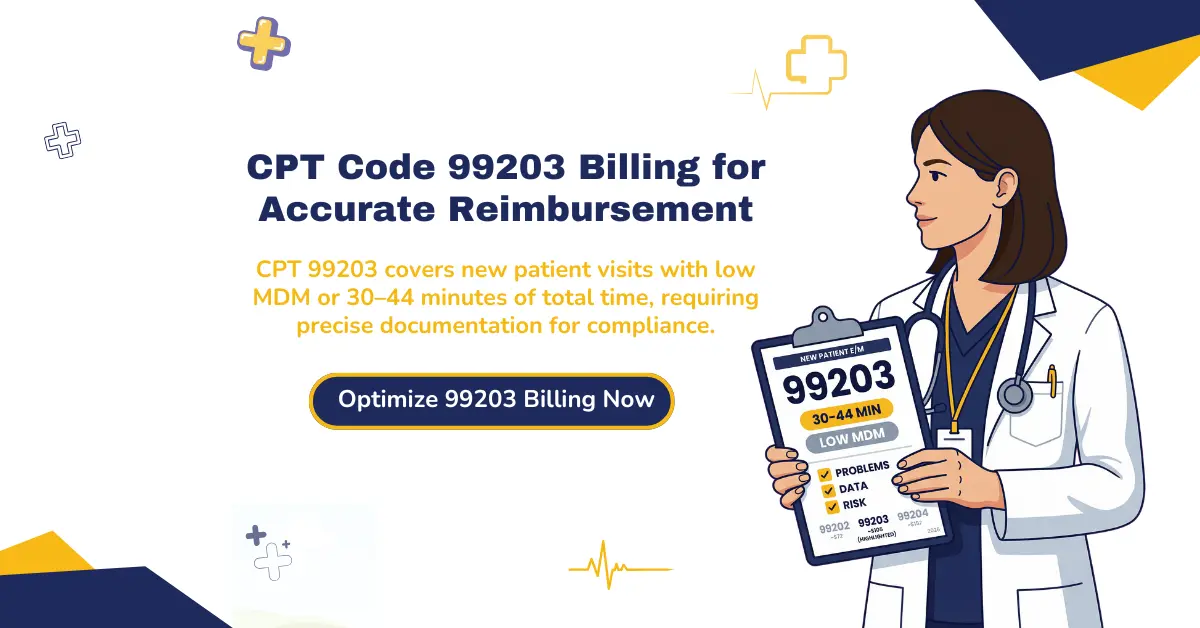
CPT code 99203 is an evaluation and management (E/M) code used for new patient office or outpatient visits requiring a medically appropriate history and/or examination and low medical decision making complexity, with a total encounter time of 30 to 44 minutes. It’s also among the most frequently audited new patient E/M codes by CMS Recovery Audit Contractors, making documentation precision a first-line financial protection measure.
The code belongs to the E/M family for new patients, maintained by the American Medical Association. It sits within the office and other outpatient services range, codes 99202 through 99205. Since the AMA and CMS overhauled E/M guidelines effective January 1, 2021, code selection is based on either MDM level or total time. The old three key component structure doesn’t apply in 2026, and the deleted 99201 has no relevance to current billing.
A new patient, for this code’s purposes, is someone who hasn’t received any professional services from the same physician, or another physician of the same specialty and subspecialty in the same group practice, within the previous three years. Professional services means face-to-face encounters reported with a specific CPT code. Phone calls, portal messages, and administrative contacts don’t count toward that three-year window.
The HHS Office of Inspector General has consistently identified evaluation and management coding, and new patient cpt code visits specifically, as a payment integrity priority. Practices that understand 99203’s audit profile protect their revenue proactively. Those that treat documentation as an afterthought face claim recoupment demands, pre-payment review periods, and payer contract scrutiny. The difference is almost always documentation.
How to Select CPT Code 99203: MDM or Time
Two paths support code selection for 99203. You pick one and document accordingly. Mixing signals from both methods on the same claim creates confusion during review and can weaken your audit position.
Time Requirements: 30 to 44 Minutes
When selecting CPT code 99203 based on time, the provider must spend at least 30 minutes but less than 45 minutes of total time on the date of the encounter. Time below 30 minutes doesn’t support 99203, so consider 99202. Time at or above 45 minutes crosses into 99204 territory, provided the documentation supports that level.
Per AMA guidance on total time, referenced at the CMS E/M Visits Hub, the count includes face-to-face time plus non-face-to-face activities performed personally by the billing provider on the same calendar date. Pre-visit chart review, documentation, ordering tests, reviewing results, care coordination, and post-visit communications all count. Time spent by nurses, medical assistants, or other support staff does not.
Here’s where practices get into trouble. Recording total time without describing the contributing activities is insufficient for audit defense. A bare entry of “30 minutes” fails the scrutiny of a RAC reviewer because it can’t be independently verified. The compliant format names the total and lists the specific activities.
A documentation entry that holds up looks like this: “Total clinician time on date of service: 34 minutes. Activities: pre-visit review of outside records from prior specialist, face-to-face evaluation and history, counseling on treatment options, ordering and review of lab panel, and EHR documentation.”
One more thing worth knowing. If MDM is chosen as the code selection method, time doesn’t need to be documented at all. The two methods are independent. Don’t document both and then try to blend them.
Medical Decision Making: Low Complexity
When selecting CPT code 99203 based on medical decision making, the MDM must be classified as low complexity. The AMA defines MDM using three elements, and the provider must meet or exceed the low complexity threshold in at least two of the three to support this code.
The table below maps each element to its low complexity threshold and the documentation standard that satisfies an audit reviewer. The third column is the one that matters most when a claim is pulled for review.
| MDM Element | Low Complexity Threshold | Audit Documentation Standard |
| Number and complexity of problems addressed | Two or more self-limited or minor problems, or one stable chronic illness, or one acute uncomplicated illness or injury | Name the specific problem(s) addressed. State that the chronic illness is stable or the injury is uncomplicated. Don’t leave those conclusions implied in the note. |
| Amount and complexity of data reviewed | Limited: review of prior external notes from a unique source, or ordering and reviewing a basic test | Identify the specific data source by name. If no data was reviewed, write “no outside records reviewed” explicitly. An empty data field triggers reviewer inquiry. |
| Risk of complications, morbidity, or mortality | Low risk: OTC drug management, minor surgery without identified risk factors, or physical therapy referral | State the treatment selected and why it represents low risk. “Low risk” must be evidenced in the plan, not assumed from the diagnosis. |
The AMA “2 of 3” rule means that if two elements meet low complexity criteria, the MDM supports 99203, even if the third element sits at a higher level. Auditors apply this rule as a floor, not a ceiling. Meeting two of three in the documentation is different from meeting it clinically. The chart note carries the burden.
One confusion keeps coming up in billing departments. Some sources incorrectly state that 99203 requires moderate MDM. Per AMA CPT 2026 and CMS, 99203 requires low complexity MDM. CPT 99204 requires moderate complexity. Getting this wrong in the other direction creates systematic upcoding errors that attract payer audits.
99203 vs 99202 vs 99204: Key Differences and Payer Audit Implications
Code selection errors in the new patient E/M range are one of the most consistent findings in RAC audits. Understanding where 99203 sits relative to 99202 and 99204 isn’t just a coding question. It’s a compliance question with a dollar value attached to every visit.
Comparison Table: New Patient E/M Codes 99202 Through 99205 with Payer Audit Trigger Column
| Code | MDM Level | Total Time | 2026 Medicare (Non-Facility) | Work RVU | Payer Audit Trigger |
| 99202 | Straightforward | 15 to 29 minutes | Approximately $72 | 0.93 | Single-provider practices billing all new patients at 99202 regardless of problem count |
| 99203 | Low | 30 to 44 minutes | Approximately $105 | 1.60 | Time entries clustered at exactly 30 minutes across high claim volumes; absent MDM elements |
| 99204 | Moderate | 45 to 59 minutes | Approximately $157 | 2.60 | Upcoding from 99203: documentation doesn’t reflect moderate MDM; all new patients billed at this level |
| 99205 | High | 60 to 74 minutes | Approximately $212 | 3.50 | Statistical outlier when used for the majority of new patient visits in a non-specialist practice |
99202 vs 99203: When to Use Each
CPT 99202 applies when a new patient presents with a single self-limited or minor problem, no data review is required, and risk is minimal. CPT 99203 applies when the provider manages two or more minor problems, or one stable chronic illness, reviews at least one external data source, and treatment involves low risk such as a prescription drug. The revenue difference is approximately $33 per visit.
That $33 gap cuts both ways. Consistently coding 99202 when 99203 is supported is a revenue problem. A practice losing $33 per eligible visit at volume forfeits meaningful revenue without ever triggering an audit. Consistently coding 99203 when 99202 is supported is a compliance problem, one that triggers payer downcode review and potential audit.
99203 vs 99204: The $52 Difference and Its Audit Profile
Low complexity MDM, which supports 99203, involves managing a stable chronic illness or an acute uncomplicated illness with limited data review and low risk such as an OTC or new prescription drug. Moderate complexity MDM, which supports 99204, involves managing a chronic illness with exacerbation, prescribing a controlled substance, or making decisions that carry moderate risk factors. Time range: 30 to 44 minutes for 99203 versus 45 to 59 minutes for 99204.
The revenue difference is approximately $52 per visit. A practice correctly coding 99204 instead of 99203 at 15 new patients per week captures more than $40,000 annually in legitimate additional reimbursement. That’s real money left on the table when providers default to 99203 out of habit.
Here’s the compliance side. The jump from 99203 to 99204 increases reimbursement by approximately 50%, which makes payers highly sensitive to upcoding in this range. Documentation must explicitly support moderate MDM. It can’t be inferred from the visit duration or the diagnosis alone. Payer reviewers are trained to look for exactly that gap.
99203 vs 99213: New Patient vs Established Patient
CPT 99203 applies when the patient hasn’t been seen by the same physician or same specialty in the same group within three years. CPT 99213 applies to established patients with low MDM for visits of 20 to 29 minutes. Billing 99203 for an established patient is one of the most common new patient E/M code violations, and it’s one that RAC contractors flag through automated cross-reference of patient visit history against billed codes.
Accurate code selection at every encounter level is the foundation of a sustainable revenue cycle management strategy.
When to Bill CPT Code 99203: Clinical Scenarios with Audit Rationale
Real audit defense starts with knowing exactly which clinical situations support 99203 and why. The five scenarios below cover orthopedics, ophthalmology, rheumatology, neurology, and cardiology. Each one maps the MDM rationale to the documentation language an auditor actually reads.
Scenario 1: Orthopedics — New Patient Knee Pain
Patient: 48-year-old male | Chief Complaint: Left knee pain for three weeks, worsening with stair climbing | ICD-10: M25.362 (pain in left knee) | Time: Approximately 32 minutes
MDM Rationale: One acute musculoskeletal complaint (limited data: X-ray ordered; low risk: NSAID prescription initiated).
CPT code 99203 is the correct and defensible code here. The X-ray order satisfies the limited data element of low MDM, and the prescription NSAID elevates risk above the minimal threshold that would support 99202. The complaint is uncomplicated without systemic features, exacerbation of chronic disease, or any moderate risk decision, so 99204 isn’t supported.
Audit documentation note: Document the X-ray order by name. Record the prescription drug and a brief rationale for low risk classification. Write “one acute musculoskeletal problem” explicitly in the MDM section. Don’t leave complexity conclusions for a reviewer to infer.
Scenario 2: Ophthalmology — New Patient Blurred Vision
Patient: 61-year-old female | Chief Complaint: Gradual blurred vision in both eyes over six months | ICD-10: H53.8 (other visual disturbances) | Time: Approximately 36 minutes
MDM Rationale: One undiagnosed new problem with uncertain prognosis, review of outside primary care records (limited data), specialist imaging referral considered (low risk at this stage).
An undiagnosed new problem with uncertain prognosis satisfies the low complexity MDM threshold under the problems element, even when the acuity appears low. Straightforward MDM applies to self-limited or minor problems. An undiagnosed visual complaint doesn’t meet that definition, which is why 99202 isn’t defensible here.
Audit documentation note: Write “new problem with uncertain prognosis, not yet diagnosed” explicitly in the note. Don’t leave the problem complexity to inference. Reviewers won’t give credit for conclusions that aren’t written down.
Scenario 3: Rheumatology — New Patient Joint Pain
Patient: 39-year-old female | Chief Complaint: Symmetric finger joint stiffness and pain for two months, worse in the mornings | ICD-10: M06.9 (rheumatoid arthritis, unspecified) | Time: Approximately 40 minutes
MDM Rationale: One chronic condition under initial evaluation, rheumatoid factor and CRP ordered (limited data), NSAID management initiated (low risk).
One chronic condition under initial evaluation with limited lab data and low-risk prescription management satisfies low complexity MDM. No exacerbation is present, no drug requiring toxicity monitoring was prescribed, and no moderate risk element applies. That’s why 99204 isn’t supported.
Audit documentation note: Identify the specific labs ordered by name. State that the chronic illness is “under initial evaluation” to distinguish this visit from ongoing management. Document the prescription type and a brief risk rationale. Specific language protects the claim.
Scenario 4: Neurology — New Patient Migraine Evaluation
Patient: 33-year-old male | Chief Complaint: Recurrent migraines, three to four per month for six months, no prior neurology evaluation | ICD-10: G43.909 (migraine, unspecified, without status migrainosus) | Time: Approximately 35 minutes
MDM Rationale: One stable chronic condition at initial evaluation, review of outside primary care notes (limited data), prophylactic medication initiated (low risk prescription).
This is a classic low complexity MDM profile for a new patient visit: stable chronic condition, limited outside record review, and prescription management without moderate risk features. No imaging was ordered, no acute exacerbation is present, and no moderate risk decision was required, so 99204 isn’t defensible.
Audit documentation note: Write “reviewed outside primary care records” and include the date and provider name. Vague references to “prior records” don’t satisfy CMS data source identification requirements. The source must be specifically named.
Scenario 5: Cardiology — New Patient Palpitations
Patient: 55-year-old female | Chief Complaint: Intermittent palpitations for four weeks, not associated with chest pain or syncope | ICD-10: R00.2 (palpitations) | Time: Approximately 33 minutes
MDM Rationale: One undiagnosed new problem, ECG ordered (limited data), monitoring only with no pharmacological intervention (low risk).
An undiagnosed new problem with a limited diagnostic workup and a low risk monitoring plan supports 99203. No prescription was initiated, no moderate risk assessment was required, and no systemic symptoms were present. Those absences matter for the audit defense record.
Audit documentation note: State “ECG ordered” by name. Record that no medications were initiated and explain why the monitoring plan represents low risk. Monitoring without intervention must be documented as an intentional clinical decision. A reviewer who sees no medication and no explanation may treat the absence as an omission rather than a plan.
Selecting the right E/M code for every new patient encounter requires precise medical decision making mapping and documentation that survives payer scrutiny. ClaimMax RCM’s billing team reviews every claim for code accuracy and documentation completeness before submission. Learn how our medical billing service protects your E/M revenue.
Documentation Requirements for CPT Code 99203: The Audit Defense Standard
When a 99203 claim gets pulled for review, the auditor reads the chart note. Not the encounter. Not the provider’s intent. Just the written record. Incomplete documentation isn’t treated as partial credit under Medicare’s standard. It’s treated as absent.
The 10-Point Audit Defense Documentation Checklist
Every 99203 claim needs to clear all 10 of these before it leaves the practice. Most documentation checklists stop at nine items. This one includes the prior authorization confirmation step that payers check but most checklists skip entirely.
| # | Documentation Element |
| 1 | Patient status confirmed as new: no professional services from the same provider, same specialty, or same group within the previous three years. |
| 2 | Code selection method specified: state whether the code was selected based on time or MDM. Both methods can’t be mixed in the same claim. |
| 3 | If time-based: total minutes recorded with a description of the specific activities contributing to that total. |
| 4 | If MDM-based: all three MDM elements explicitly addressed, including problems by name and complexity, data source identified specifically or noted as none, and risk level stated with supporting treatment rationale. |
| 5 | Medically appropriate history and/or examination documented, proportionate to the presenting complaint and recorded in enough detail for an independent reviewer to confirm relevance. |
| 6 | Assessment with a specific ICD-10-CM code: not a symptom code where a definitive diagnosis is available and documented. |
| 7 | Treatment plan with specific management decisions: medications named, tests identified, referrals specified, follow-up timeframe stated. |
| 8 | Provider attestation: the billing provider personally performed the service or directly supervised it in compliance with applicable supervisory rules. |
| 9 | If a same-day procedure was also performed: Modifier 25 appended to 99203, and the E/M note stands independently with its own chief complaint, history, assessment, and plan separate from the procedure note. |
| 10 | Prior authorization confirmed and authorization number documented on the claim, applicable when the payer, plan, or location requires authorization for new patient visits. |
Time Documentation vs MDM Documentation
The method you choose determines what you document. Pick one and document only what that method requires.
Coding by MDM means no time documentation is needed. Document the problems, data, and risk elements. That’s it. Coding by time means you record total time on the date of service, which must fall between 30 and 44 minutes for 99203, and describe the specific activities performed. Per AMA guidance: “If time is used to determine the E/M level, physicians should include the total amount of time spent on the date of service.” Nothing more is required for code support.
Three Audit-Triggering Documentation Failures
These aren’t generic mistakes. Each one maps to a specific audit consequence that results in the MDM element being treated as unmet.
Failure 1: Missing Problem Classification. Writing “patient with knee pain” rather than “one acute musculoskeletal problem, no systemic features, no prior workup.” The first describes a symptom. The second documents MDM complexity. Auditors review the second format. When it’s absent, the MDM element fails.
Failure 2: Unidentified Data Source. Writing “reviewed prior records” without identifying the source by provider, date, or institution. CMS requires each unique data source to be individually identified. Vague references to “records” satisfy no reviewer examining the claim.
Failure 3: Implied Risk Level. Recommending an NSAID without stating it represents low risk prescription management. The prescription appears in the plan. The risk classification doesn’t. Documentation that requires a reviewer to infer MDM elements from clinical actions rather than reading them directly fails the audit standard.
Incomplete documentation is one of the primary drivers of 99203 claim denials. ClaimMax RCM’s denial management services include pre-submission documentation review to catch compliance gaps before they reach the payer.
CPT Code 99203 Reimbursement Rates and RVU Breakdown (2026)
Understanding what 99203 should pay isn’t just useful for budgeting. It’s the first step in catching underpayments before they age into revenue you can’t recover.
2026 Medicare Payment Calculation
The 2026 Medicare national non-facility reimbursement rate for CPT code 99203 is approximately $105, based on a total relative value unit of approximately 3.13 and the CMS Physician Fee Schedule. Facility-based payment is approximately $70.
Knowing the correct expected rate is step one of underpayment detection. Practices that don’t systematically verify posted payments against expected amounts allow payer remittance errors to accumulate silently. Payment posting accuracy is how those discrepancies get caught before they become uncollectable.
CMS finalized two separate conversion factors for 2026: $33.4009 for non-QP clinicians and $33.5675 for Qualifying APM Participants. The payment formula, documented at the CMS PFS Documentation and Formulas page, works as follows: Medicare payment equals (Work RVU times Work GPCI plus PE RVU times PE GPCI plus MP RVU times MP GPCI) times the applicable conversion factor. National non-facility output is approximately $105 before GPCI adjustment.
RVU Component Breakdown
| RVU Component | Value |
| Work RVU | 1.60 |
| Non-Facility Practice Expense RVU | 1.38 |
| Facility Practice Expense RVU | 0.60 |
| Malpractice RVU | 0.15 |
| Total RVU (Non-Facility) | Approximately 3.13 |
| Total RVU (Facility) | Approximately 2.35 |
The non-facility total RVU of approximately 3.13 multiplied by the applicable conversion factor produces the expected Medicare payment before GPCI adjustment. A payment posting specialist uses this calculation to flag remittances that fall below the expected amount. Systematic gaps between expected and received payments are where underpayment recovery begins, but only when someone is running this calculation against every posted payment.
Estimated Commercial Payer Rates
Commercial rates are negotiated and vary by contract, specialty, and region. The figures below represent typical reimbursement ranges based on standard market benchmarks.
| Payer | Estimated Reimbursement Range |
| Blue Cross Blue Shield | Approximately $125 to $145 |
| UnitedHealthcare | Approximately $120 to $140 |
| Aetna | Approximately $118 to $138 |
| Cigna | Approximately $130 to $160 |
| Medicare | Approximately $105 (national average, non-facility) |
| Medicaid | Approximately $65 to $85 (varies by state) |
Practices without systematic payment verification against contracted rates can’t know whether they’re being paid correctly. Underpayment isn’t always intentional. It is always financial exposure.
Geographic Payment Variation
CMS applies Geographic Practice Cost Indices to each RVU component individually. A practice in a high-cost metro receives a higher payment than one in a lower-cost region for the same code and the same documentation. Use the CMS PFS Look-Up Tool to verify locality-specific rates for your practice location before assuming the national average applies.
Year-Over-Year Rate Trend
| Year | Non-Facility Medicare Rate | Conversion Factor |
| 2023 | Approximately $113 | $33.06 |
| 2024 | Approximately $112 | $32.74 |
| 2025 | Approximately $112 | $32.35 |
| 2026 | Approximately $105 | $33.40 (non-QP) |
The 2026 rate reflects practice expense methodology changes: non-facility PE increased while facility PE decreased. The efficiency adjustment exemption also applies to time-based E/M codes. Verify current rates using the CMS PFS Look-Up Tool, since locality adjustments produce figures that differ from the national average.
Accurate 99203 CPT code reimbursement depends on correct RVU configuration, clean claim submission, and systematic payment verification against contracted rates. ClaimMax RCM’s revenue cycle management services and payment posting service are built to catch underpayments before they age out of the collection window.
G2211 Add-On Code with 99203: 2026 Billing Rules and Audit Compliance
G2211 is among the most misapplied add-on codes in new patient E/M billing. Its additional payment, approximately $16 to $17 per eligible encounter under the 2026 Medicare fee schedule, makes it attractive. But incorrect application attracts audit attention. Understanding exactly when G2211 is appropriate with 99203 CPT code, and when it isn’t, is the difference between legitimate additional reimbursement and a compliance exposure.
What Is G2211 and When Does It Apply to 99203?
G2211 became separately payable effective January 1, 2024, recognizing office and outpatient visits where the provider serves as the focal point for ongoing care coordination or manages a serious or complex condition over time. It attaches to base E/M codes 99202 through 99215. Beginning January 1, 2026, it also applies to home visit codes 99341 through 99350. The code isn’t specialty-restricted — any qualifying provider can report it when the visit context supports a longitudinal care relationship.
Not every new patient visit qualifies. A new patient presenting for a one-time evaluation, such as a worker’s compensation exam, a pre-operative clearance, or a single-episode acute illness, does not support G2211. The documentation must reflect that the provider intends to serve as the ongoing focal point for this patient’s care, not just the clinician who handled a discrete episode.
At a volume of 20 eligible new patient visits per week, correct G2211 application represents more than $17,000 in additional annual revenue. That is legitimate revenue only if the documentation supports it every time.
G2211 and Modifier 25: The 2025 to 2026 Rule Change
The interaction between G2211 and Modifier 25 changed significantly in 2025 and carries compliance implications into 2026. Here’s the timeline:
2024 rule: CMS implemented claim edits that prevented payment of G2211 when the associated E/M code was billed with Modifier 25. The two could not appear together on the same claim.
2025 exception, continuing into 2026: CMS created a specific carve-out. G2211 is now payable alongside an E/M code billed with Modifier 25 when the same-day service is an Annual Wellness Visit, a vaccine administration, or any Medicare Part B preventive service.
The practical implication for 99203 is this: a new patient visit for a chronic condition evaluation billed with Modifier 25 on the same day as a vaccine or Part B preventive service can now include G2211. Both the E/M service and the preventive service must be independently documented. The authorization documentation requirements haven’t changed.
Billing G2211 with Modifier 25 on a 99203 claim where the same-day service is a minor procedure that doesn’t qualify as an AWV, vaccine, or Part B preventive service produces a claim that fails CMS claim edits. The edit denial is not appealable on medical necessity grounds. The rule is administrative and categorical.
G2211 Audit Risk: What RAC Contractors Are Reviewing in 2026
RAC contractors have identified three specific G2211 billing patterns for 2026 review. Practices should check their own claim data against all three before an external reviewer does it first.
Pattern 1: G2211 appended to 99203 for new patient encounters where the clinical note describes a one-time or acute-only visit without any reference to ongoing care coordination. The add-on code appears on the claim. The documentation doesn’t support it.
Pattern 2: G2211 billed with Modifier 25 for same-day minor procedures that are not an Annual Wellness Visit, vaccine administration, or Part B preventive service. This is the combination that CMS claim edits specifically reject, and the denial rate on these claims is consistent.
Pattern 3: Systematic G2211 application to every new patient visit regardless of clinical context, particularly when the practice’s G2211 billing rate significantly exceeds the specialty benchmark rate for the same region. Statistical outliers in G2211 volume are a documented RAC selection criterion.
What Modifier Is Used for 99203? Modifiers, Prior Authorization Compliance, and Audit Standards
The most commonly used modifier with CPT 99203 is Modifier 25. For telehealth, Modifier 95 or Modifier 93 applies depending on the delivery method. Some encounters require prior authorization documentation before submission, a compliance step that most modifier guides omit entirely. All three areas carry specific documentation requirements that determine whether the claim survives review.
| Modifier | Description | When to Use with 99203 | Audit Compliance Requirement |
| 25 | Significant, separately identifiable E/M service on the same date as a procedure | When a minor procedure or preventive service is performed on the same date and a distinct E/M service was also provided | E/M note must stand independently with a separate chief complaint, history, assessment, and plan from the procedure note |
| 95 | Synchronous audio and video telemedicine | Telehealth visits via HIPAA-compliant real-time audio and video | POS 02 or POS 10 required; document patient consent and platform name |
| 93 | Audio-only telemedicine | When the patient cannot access video technology | Not accepted by all payers; verify coverage before submitting; document reason video was unavailable |
| 57 | Decision for surgery | When the E/M results in a decision for major surgery within the 90-day global period | Rarely used with 99203 given low MDM requirement; document the surgical decision explicitly if applied |
| GC | Service by a resident under a teaching physician | Teaching hospital settings where a resident performs the evaluation | Attending attestation must be present in the note; residents’ time does not count toward the billing provider’s total time |
Modifier 25 with CPT 99203: Documentation Requirements
Modifier 25 is the most scrutinized modifier in E/M billing. The AMA states that different diagnoses are not required to justify reporting both an E/M and a procedure on the same day. CMS emphasizes, though, that the E/M documentation must clearly demonstrate the evaluation was significant and separately identifiable from the procedure’s inherent pre-service, intra-service, and post-service work.
The documentation standard is specific. The E/M note must include its own chief complaint, history, assessment, and plan, entirely separate from the procedure note. A single merged note describing both the evaluation and the procedure without distinguishing the two is one of the most common Modifier 25 audit failures. Some payers also require a separate diagnosis for the E/M service when Modifier 25 is appended, so verify each payer’s policy before submitting.
Telehealth Modifiers for 99203
CMS prefers Modifier 95 for synchronous audio and video telehealth encounters. Modifier 93 is available for audio-only encounters when the patient can’t access video. Some commercial payers and Medicaid programs still require Modifier GT instead of 95, so verify each payer’s current modifier preference before submitting. For audio-only encounters, confirm the payer covers audio-only telehealth services for new patient E/M codes. Not all plans do.
Prior Authorization Compliance for 99203 Encounters
Certain payers require prior authorization for new patient visits, particularly Medicare Advantage plans, commercial payers with specialty referral networks, and some Medicaid managed care organizations. When prior authorization is required, the authorization number must appear on the claim in the correct field before submission. Submitting without the authorization number in the required field produces an administrative denial that typically can’t be reversed on appeal.
The pre-service workflow matters here. Confirm prior authorization before scheduling the new patient encounter, document the authorization number in the EHR at the time of approval, and ensure the billing system carries the authorization number to the claim automatically. Authorization obtained after the date of service is retroactive authorization. Most payers decline it.
Prior Authorization Action Item: Review all active payer contracts for any plan that requires prior authorization for new patient office visits at your specialty or location. A missing authorization number on a 99203 claim is a preventable administrative denial. It must be caught before the date of service, not during billing.
ClaimMax RCM’s prior authorization services manage the authorization request, confirmation, and documentation workflow for new patient encounters across all payer types.
Other Situational Modifiers
Modifier 59 is rarely appropriate with E/M codes and shouldn’t be appended to 99203 without specific payer guidance. Modifier AT applies to chiropractic manipulation codes, not E/M codes. Modifier GT was the CMS standard for telemedicine before Modifier 95 replaced it, and it now functions primarily as a commercial payer and Medicaid legacy requirement in plans that haven’t updated their billing specifications.
Who Can Bill CPT Code 99203? Provider Eligibility and Enrollment Requirements
CPT code 99203 can be billed by physicians (MD and DO), nurse practitioners, and physician assistants. Some payers also recognize clinical psychologists and licensed clinical social workers for specific E/M code types within their licensed scope of practice. Proper payer credentialing is a prerequisite in every case. An unenrolled provider’s claims face full recoupment, and the timely filing window won’t wait for credentialing to catch up.
Provider Eligibility Table
| Provider Type | Can Bill 99203? | Compliance Notes |
| Physician (MD, DO) | Yes | Must be enrolled and credentialed with each payer before billing |
| Nurse Practitioner (NP) | Yes | Bills under own NPI; Medicare pays at 85% of the physician rate |
| Physician Assistant (PA) | Yes | Bills under own NPI; Medicare pays at 85% of the physician rate |
| Clinical Psychologist | Payer-specific | Some payers allow E/M codes within scope; verify before billing |
| Licensed Clinical Social Worker | Payer-specific, some states | Varies significantly by state and payer contract |
| Registered Nurse | No | Cannot bill E/M codes independently |
| Medical Assistant | No | Cannot bill E/M codes independently |
Incident-To Billing and CPT 99203
Incident-to billing allows non-physician practitioners to bill under the supervising physician’s NPI, but the arrangement applies only to established patients. CPT code 99203 is a new patient cpt code. It cannot be billed incident-to under any circumstances.
RAC contractors specifically cross-reference new patient code claims against the NPI under which they were billed. When a new patient code appears under a physician NPI but the documentation reveals the encounter was performed entirely by a non-physician practitioner without direct physician involvement, the claim fails the incident-to standard. The financial consequence is recoupment, plus possible referral for further review.
Provider enrollment and credentialing with each payer is a prerequisite before the first claim goes out. Delays in credentialing produce denials that can’t be retroactively corrected once the timely filing window closes.
ClaimMax RCM’s credentialing services manage the full payer enrollment process so providers are authorized to bill before the first new patient claim is submitted.
For practices billing 99203 for telehealth new patient visits across multiple payers, ClaimMax RCM’s telehealth medical billing services manage modifier accuracy, POS code assignment, and payer-specific policy compliance.
CPT 99203 Audit Risk, Denial Patterns, and How to Defend Every Claim
New patient E/M codes are consistently among the top code families flagged in CMS post-payment reviews. CPT 99203, as the midpoint code in the new patient E/M range, draws audit attention because it sits at the boundary between straightforward and moderate complexity. Billing it correctly every time isn’t a paperwork issue. It’s the primary financial protection measure for practices that see high volumes of new patients.
The Nine Audit Triggers for 99203 Claims
These aren’t theoretical risks. Each one appears in RAC audit findings and payer denial patterns with enough consistency that a billing team should treat them as active exposure points, not edge cases.
Item 1: New Patient Status Misclassification
Trigger: Billing 99203 for a patient seen by the same provider, same specialty, or same group within the previous three years.
Resolution: Build a patient status verification step into the EHR scheduling workflow. The check must run before code assignment, not at billing review.
Item 2: Time Entry Without Activity Description
Trigger: Recording “35 minutes” without describing contributing activities. A bare time entry can’t be independently verified by a reviewer.
Resolution: Document total time and briefly identify the specific activities: record review, face-to-face evaluation, counseling, ordering, and documentation.
Item 3: Absent or Implied MDM Elements
Trigger: Not explicitly naming all three MDM elements when billing by medical decision making. An auditor treats an undocumented element as unmet, not as assumed.
Resolution: Use an EHR template that prompts the provider to address problem complexity, data source, and risk level for every new patient encounter.
Item 4: Modifier 25 Without Standalone E/M
Trigger: Appending Modifier 25 to 99203 when the E/M note doesn’t stand independently of the procedure documentation.
Resolution: The E/M note must include its own chief complaint, history, assessment, and plan. A merged note for the evaluation and the procedure fails the audit standard every time.
Item 5: Established Patient Billed as New
Trigger: Systematic misclassification of established patients as new, often caused by patient demographic changes, EHR system resets, or new provider assignments within the same group.
Resolution: Run a quarterly claims analysis cross-referencing new patient code billing against prior visit history in the EHR.
Item 6: Time Entries Clustered at the Code Threshold
Trigger: Time entries that consistently land at exactly 30 minutes across a high percentage of new patient encounters. This pattern flags as threshold-targeting rather than genuine time documentation.
Resolution: Document contributing activities alongside total time. Entries that cluster at code thresholds without activity context are a statistical red flag in RAC analytics.
Item 7: Templated Documentation Pattern
Trigger: Clinical notes that appear structurally identical across multiple patients, suggesting auto-populated history, examination, and assessment fields rather than individually documented encounters.
Resolution: EHR templates must prompt the clinician, not pre-fill content. Identical notes across different patients indicate documentation that doesn’t reflect individual encounters.
Item 8: G2211 Without Longitudinal Care Documentation
Trigger: Appending G2211 to 99203 for encounters where the note describes a one-time or acute-only visit without any reference to ongoing care management or the provider’s role as care coordinator.
Resolution: Only append G2211 when the documentation explicitly reflects the longitudinal care relationship context. The intent to provide ongoing management must be stated in the note.
Item 9: Data Source Not Identified
Trigger: Writing “reviewed prior records” or “records reviewed” without identifying the source by provider name, date, or institution. CMS requires each unique external data source to be individually documented.
Resolution: Name the specific data source: “reviewed outside records from Dr. [Name], [Practice Name], dated [Date].” A general reference to “records” satisfies no one reviewing the MDM data element.
RAC and MAC Enforcement Patterns in 2026
Recovery Audit Contractors focus E/M reviews on statistical outliers: providers whose coding patterns diverge from specialty peers in the same region. Three patterns attract RAC attention specifically for 99203 in 2026.
Pattern 1: Practices where the majority of new patient visits are billed at exactly 99203 regardless of presenting problem complexity, particularly in specialties where the complexity distribution would predict a wider spread across 99202 through 99204.
Pattern 2: High volumes of 99203 with Modifier 25 alongside minor procedures, particularly where the E/M to procedure ratio exceeds the specialty benchmark. Payers cross-reference the separately billed E/M against the procedure’s global package to confirm the evaluation was genuinely distinct.
Pattern 3: G2211 billed at rates significantly higher than the specialty-level benchmark, combined with 99203 claims that lack longitudinal care context in the documentation.
Medicare Administrative Contractors run pre-payment reviews on providers flagged through their claims analytics systems. A provider placed under pre-payment review must supply supporting documentation for every affected claim before payment releases. That workflow burden makes proactive compliance far less costly than reactive claim defense.
Denial Prevention Best Practices
- Conduct quarterly internal chart audits on a random sample of at least 20 new patient E/M claims per quarter. Review for patient status accuracy, MDM completeness, time documentation format, and Modifier 25 compliance.
- Train all providers and billing staff on the 2021 AMA E/M guidelines and any 2026 payer-specific updates affecting new patient visit coding.
- Implement structured EHR documentation templates that prompt providers to address all three MDM elements explicitly. Templates must guide clinical documentation, not pre-fill it.
- Review denial and adjustment reports monthly. Any denial that recurs more than twice carries a systemic root cause that requires a workflow correction, not just claim rework.
- Confirm prior authorization before each new patient encounter for every payer that requires it. A missing authorization number produces an administrative denial that most payers won’t reverse retroactively.
Audit risk and claim denials share a common root cause: a billing workflow that hasn’t been built around the compliance requirements of each payer in your portfolio. ClaimMax RCM’s denial management services and AR follow-up team identify coding and configuration errors before they accumulate into aged, unrecoverable revenue. Learn how our denial management services protect your 99203 collections.
ICD-10 Codes Commonly Paired with CPT Code 99203
Every CPT claim requires an ICD-10-CM diagnosis code to establish medical necessity. A diagnosis code that doesn’t support the level of service billed, or that uses an unspecified code when a more specific one is available and documented, is a common trigger for medical necessity review. Below are ICD-10 codes frequently associated with the clinical scenarios that support CPT 99203 billing.
| ICD-10 Code | Description | Audit Documentation Note |
| M25.362 | Pain in left knee | Laterality required; “knee pain” without laterality uses an unspecified code when a more specific code is available and documented |
| H53.8 | Other visual disturbances | Document “new problem with uncertain prognosis” explicitly; don’t leave problem complexity to inference |
| M06.9 | Rheumatoid arthritis, unspecified | Note “under initial evaluation” to distinguish initial workup from ongoing management visits |
| G43.909 | Migraine, unspecified, without status migrainosus | Document specific migraine frequency and whether this is the first neurology evaluation |
| R00.2 | Palpitations | Document ECG order by name; record absence of pharmacological intervention as an intentional clinical decision |
| L40.0 | Psoriasis vulgaris | Document body surface area affected and prior treatment history; psoriasis without documented extent may trigger review |
| M54.2 | Cervicalgia | Document duration, onset, and absence of neurological features to support low complexity classification |
| F32.1 | Major depressive disorder, single episode, moderate | If prescription initiated, document risk level explicitly; moderate MDD with a new prescription may escalate MDM to 99204 |
| E11.9 | Type 2 diabetes mellitus without complications | State “stable chronic illness” explicitly; document absence of complications to support low rather than moderate complexity |
| Z13.89 | Encounter for screening for other disorder | Document the specific disorder screened for; a generic screening code without specificity triggers medical necessity review |
When documentation supports a more specific ICD-10 code than the unspecified version, use it. An auditor reviewing a 99203 claim paired with an unspecified code will ask one question: did the biller review the chart, or just default to a generic code? When the chart clearly documents enough detail for a specific code and the claim uses an unspecified one, that gap raises the question every time.
ICD-10 accuracy at the claim level is one of the most preventable sources of medical necessity denials. ClaimMax RCM’s medical billing service includes ICD-10 code review and documentation matching on every claim before it reaches the payer.
Frequently Asked Questions About CPT Code 99203
What is CPT code 99203 used for?
CPT code 99203 is used to report an office or other outpatient visit for the evaluation and management of a new patient. It applies when the visit involves low complexity medical decision making or when the total provider time on the date of service is 30 to 44 minutes. It’s used across primary care, orthopedics, neurology, ophthalmology, cardiology, rheumatology, and other specialties for initial evaluations of low-complexity conditions. It’s also one of the most frequently audited new patient E/M codes by CMS Recovery Audit Contractors.
How long should a 99203 visit last?
A visit billed under CPT code 99203 requires a minimum of 30 minutes of total provider time on the date of service. The maximum before advancing to 99204 is 44 minutes. Total time includes both face-to-face time and non-face-to-face activities personally performed by the billing provider: record review, documentation, care coordination, and ordering tests all count. Staff time can’t be included. Document the total time and briefly describe the contributing activities.
What is the difference between CPT 99203 and 99204?
CPT 99203 requires low complexity medical decision making and covers visits of 30 to 44 minutes, while 99204 requires moderate complexity MDM and covers 45 to 59 minutes. The MDM distinction matters significantly: 99203 addresses a stable chronic illness or an acute uncomplicated condition with limited data review and low risk, while 99204 involves a chronic illness with exacerbation, a controlled substance prescription, or decisions carrying moderate risk. The 2026 Medicare reimbursement difference is approximately $52 per visit.
What is the difference between 99202 and 99203?
CPT 99202 requires straightforward MDM and covers visits of 15 to 29 minutes. CPT 99203 requires low complexity MDM and covers 30 to 44 minutes. The MDM distinction: 99202 handles one self-limited problem with no data review and minimal risk, while 99203 involves two or more minor problems or one stable chronic illness with limited data review and low risk. The 2026 Medicare reimbursement difference is approximately $33 per visit.
What is the difference between 99203 and 99213?
CPT 99203 is for new patients not seen by the same provider or same specialty within the same group over the past three years. CPT 99213 is for established patients with low complexity medical decision making covering visits of 20 to 29 minutes. Both require low MDM, but they differ in patient status, time range, and reimbursement. Under 2026 Medicare, 99203 pays approximately $105 versus approximately $93 for 99213 at the non-facility rate.
How much does Medicare pay for 99203 in 2026?
The 2026 Medicare national non-facility reimbursement rate for CPT 99203 is approximately $105, based on a total RVU of approximately 3.13 and the CMS Physician Fee Schedule. Facility payment is approximately $70. Geographic variation produces a range of approximately $93 to $125 across Medicare Administrative Contractor regions. CMS finalized two conversion factors for 2026: $33.4009 for non-QP clinicians and $33.5675 for qualifying APM participants. Commercial payers typically reimburse between $118 and $160 depending on the contract and region.
What is the RVU for CPT 99203?
The total non-facility RVU for CPT 99203 is approximately 3.13, composed of 1.60 work RVUs, 1.38 practice expense RVUs, and 0.15 malpractice RVUs. The facility total RVU is approximately 2.35 due to a reduced practice expense allocation. Medicare payment is calculated by multiplying total RVUs by the 2026 conversion factor ($33.4009 for non-QP clinicians), then adjusted by the Geographic Practice Cost Index for the provider’s locality.
What is the MDM requirement for CPT 99203?
CPT 99203 requires low complexity medical decision making when billing by MDM rather than time. The AMA defines low complexity MDM using three elements, and the provider must meet the threshold in at least two of the three: problems (two or more self-limited problems, or one stable chronic illness), data (limited, meaning at least one external data source reviewed), and risk (low, such as prescription drug management or minor surgery without identified risk factors).
Who can bill CPT code 99203?
CPT code 99203 can be billed by physicians (MD and DO), nurse practitioners, and physician assistants. Clinical psychologists and licensed clinical social workers may also bill under specific payer contracts within their licensed scope of practice. Only time personally spent by the billing provider counts toward the 30-minute threshold. CPT 99203 is a new patient code and can’t be billed incident-to, since incident-to billing applies to established patients only.
Can 99203 be used for telehealth?
Yes. CMS and most commercial payers allow CPT 99203 for qualifying telehealth visits in 2026. The same time and MDM requirements apply as for in-person encounters. Use Modifier 95 for synchronous audio and video visits and Modifier 93 for audio-only encounters where the patient can’t access video. Use Place of Service 02 or 10 depending on the patient’s location. Document patient consent and the HIPAA-compliant platform used. Verify each payer’s modifier preference before submitting.
What modifier is used with CPT 99203?
The most commonly used modifier with CPT 99203 is Modifier 25, which indicates a significant, separately identifiable E/M service performed on the same date as a procedure. For telehealth encounters, Modifier 95 (audio and video) or Modifier 93 (audio-only) applies depending on the delivery method. When prior authorization is required by the payer, the authorization number must appear on the claim in the correct field before submission. Always verify individual payer modifier requirements before submitting.
Does CPT 99203 require prior authorization?
CPT 99203 itself doesn’t universally require prior authorization. Specific payers do, though, particularly Medicare Advantage plans, commercial payers with specialty referral requirements, and some Medicaid managed care organizations. When prior authorization is required, the number must be confirmed before the date of service and documented on the claim. A missing authorization number produces an administrative denial that most payers won’t reverse retroactively.
Can G2211 be billed with CPT 99203?
Yes. G2211 can be billed alongside 99203 when the encounter establishes or reflects an ongoing care relationship and the provider serves as the focal point for care coordination. G2211 became separately payable January 1, 2024 and adds approximately $16 to $17 to eligible encounter reimbursement. It can’t be billed with Modifier 25 on 99203 unless the same-day service is an Annual Wellness Visit, a vaccine administration, or a Medicare Part B preventive service.
What is the CPT code 99203 description?
The official AMA CPT descriptor for 99203 is: “Office or other outpatient visit for the evaluation and management of a new patient, which requires a medically appropriate history and/or examination and low level of medical decision making. When using total time on the date of the encounter for code selection, 30 minutes must be met or exceeded.” This descriptor has been in effect since the January 1, 2021 AMA E/M guideline overhaul and remains current for 2026.
What should I look for in a medical billing service for audit compliance?
A billing service built for audit compliance should offer documentation review before claim submission, prior authorization management, payer-specific compliance verification, and systematic denial tracking across Medicare, Medicare Advantage, Medicaid, and commercial contracts. ClaimMax RCM provides a full-service medical billing service that includes coding accuracy review, prior authorization services, denial management, AR follow-up, and credentialing support. Practices with recurring 99203 audit findings or new patient code denials benefit most from a billing partner whose workflow is designed around first-submission claim defense. Contact ClaimMax RCM to review your current 99203 billing configuration.