The HHS Office of Inspector General has flagged evaluation and management coding as a persistent payment integrity concern for years. Recovery Audit Contractors recovered more than $900 million in improper E/M payments across the most recent three-year audit cycle. CPT code 99202 sits near the top of that review list every single cycle.
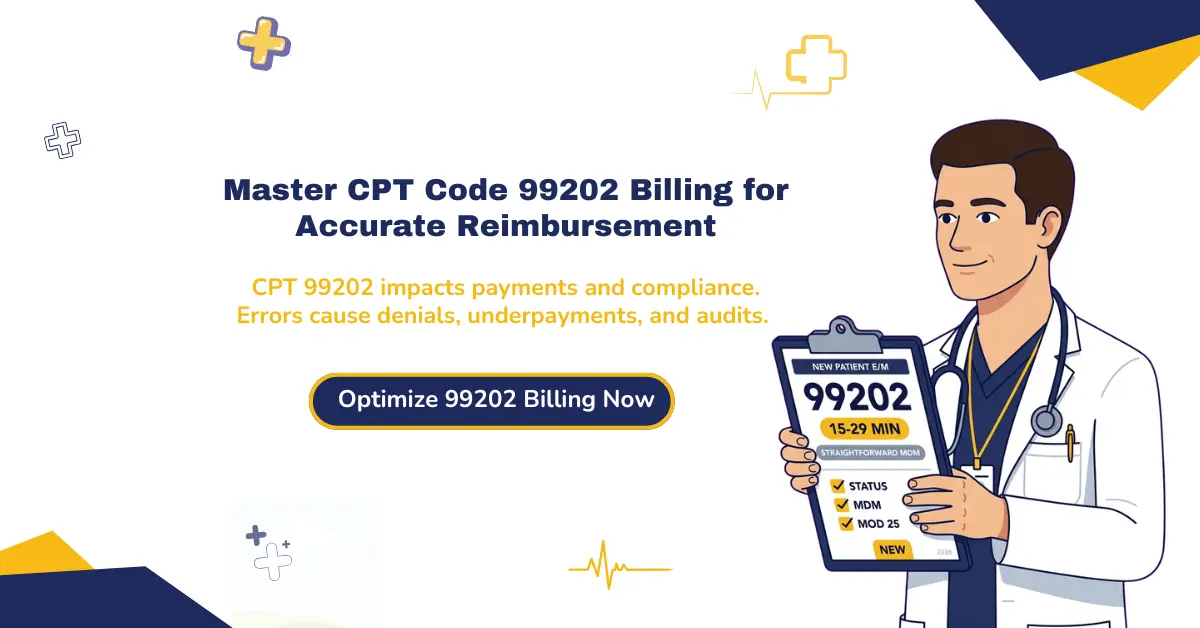
CPT code 99202 is an evaluation and management code for a new patient office or other outpatient visit that requires straightforward medical decision making, or a minimum of 15 to 29 minutes of total provider time on the date of the encounter.
That’s the definition. Here’s the reality: getting paid for this code isn’t the hard part. Keeping that payment when a Recovery Audit Contractor or Medicare Administrative Contractor decides to take a closer look, that’s where practices run into trouble.
This guide covers everything you need for 2026: the CMS definition and documentation requirements, audit defense strategies for both time-based and MDM-based coding, denial root causes and prevention frameworks, G2211 interaction rules, prior authorization compliance, and how ClaimMax RCM’s revenue cycle management services protect practices from E/M audit exposure.
ClaimMax RCM is a full-service revenue cycle management company built around one goal: helping providers bill 99202 accurately, defend claims under payer scrutiny, and recover revenue when denials happen.
What Is CPT Code 99202?
CPT code 99202 is an evaluation and management billing code used for new patient visits in an office or other outpatient setting, requiring either straightforward medical decision making or 15 to 29 minutes of total provider time on the date of the encounter.
It belongs to the Office or Other Outpatient Services family within the Current Procedural Terminology system, maintained by the American Medical Association. That family runs from 99202 through 99215 and covers both new and established patient visits. CPT code 99202 is specifically designated for new patients, and the distinction matters more than most providers realize.
The AAPC classifies this code within the E/M category as one of the most frequently billed new patient office visit codes in the country. High volume means high scrutiny. That’s not speculation; it’s how audit contractor prioritization works.
Key Facts at a Glance
| Field | Detail |
| Code | 99202 |
| Category | Evaluation and Management (E/M) |
| Subcategory | Office or Other Outpatient Services |
| Patient Status | New patient only |
| MDM Level | Straightforward |
| Time Range | 15 to 29 minutes |
| Medicare Reimbursement 2026 | Approximately $72 (non-facility) |
| Place of Service | Office (POS 11), outpatient settings |
| Effective Date | Active since January 1, 2021 revision |
Since the 2021 E/M guideline overhaul by the AMA and CMS, providers have two legitimate pathways for selecting this code. You can choose based on the level of medical decision making, which must meet the straightforward complexity threshold, or based on total time spent on the encounter date, which must reach 15 minutes and stay below 30. Only one method needs to be documented. You don’t need both.
Here’s the compliance reality: because 99202 CPT code billing volume is among the highest in the new patient E/M family, it draws heightened scrutiny from Medicare Administrative Contractors, Recovery Audit Contractors, and commercial payer special investigation units. Accurate code selection and complete documentation aren’t optional steps. They’re the only defense available when a claim gets pulled for review.
99202 CPT Code Description
The official AMA CPT descriptor for this code reads as follows:
“Office or other outpatient visit for the evaluation and management of a new patient, which requires a medically appropriate history and/or examination and straightforward medical decision making. When using total time on the date of the encounter for code selection, 15 minutes must be met or exceeded.”
Source: AMA CPT Professional Edition
That language is precise for a reason. Every word in it carries audit weight.
“Medically appropriate” is where a lot of providers and auditors end up on opposite sides of a recoupment decision. A clinician might consider a thorough systems review appropriate out of professional habit. An auditor reviewing the same note asks a different question: was the documented history and examination proportionate to the presenting complaint? A detailed multi-system review for a minor tension headache that resolves with OTC medication doesn’t pass that test. Matching your documentation to the actual complaint is the audit defense principle, not matching it to your clinical instincts.
Prior to January 1, 2021, codes 99202 through 99205 required three distinct key components: history, examination, and medical decision making. All three had to meet specific complexity thresholds. The 2021 revision eliminated that rigid three-component structure entirely. CPT code 99201 was deleted effective January 1, 2021 because it shared the same straightforward MDM level as 99202, making it redundant. CPT 99202 is now the lowest-level active new patient E/M code in the office visit family.
Is CPT Code 99202 Still Valid in 2026?
Yes. CPT code 99202 is a valid, active code in 2026. It wasn’t affected by the 2021 deletion of CPT 99201, and no changes to its descriptor or requirements are scheduled for upcoming code cycles. CMS continues to recognize it for Medicare reimbursement under the Physician Fee Schedule. It remains the starting point for new patient office visit coding across all specialties.
Who Is a New Patient for CPT Code 99202? The 3-Year Rule and Audit Exposure
CMS and the AMA define a new patient as someone who has not received any professional services from the same physician, or from another physician of the same specialty and subspecialty within the same group practice, within the previous three years. “Professional services” means face-to-face encounters reported with a specific CPT code. Phone calls, patient portal messages, and administrative contacts don’t count.
The group practice and specialty nuances matter more than most billing teams realize. In a multi-specialty group, a patient can be new to one specialty even if they’ve visited a different specialty within the same group. Single-specialty groups work differently: any visit to any provider in the group within three years makes that patient established, regardless of which specific provider they saw.
Here’s a real-world example of how this plays out:
A patient visited your practice’s dermatologist in February 2023 for a minor skin check. In April 2026, they schedule a first visit with your practice’s primary care provider. Because the specialties differ, this patient qualifies as a new patient under the CPT definition, even within the same group practice.
Misclassifying an established patient as a new patient is one of the top RAC audit triggers for E/M codes. RAC contractors query billing histories specifically to find patients who appear in the same group’s records within three years but are billed at the new patient rate. The financial exposure goes beyond individual claim recoupment.
Audit Consequence Note: Repeat misclassification of established patients as new patients can trigger a pre-payment review period, where the practice must submit supporting documentation for every affected claim before any payment is released. That’s a workflow burden that compounds quickly across high-volume practices.
The audit defense for CPT code 99202 starts before the provider walks into the room. Patient status verification has to happen at scheduling, not at billing.
CPT Code 99202 Time Requirements: What Counts and What Auditors Check
When selecting CPT code 99202 based on time, the provider must spend at least 15 minutes of total time on the date of the encounter. The 99202 time requirement has a ceiling too: once documented time reaches 30 minutes, the visit crosses into 99203 territory. Staying between 15 and 29 minutes is what supports this code.
“Total time” under the AMA E/M guidelines includes both face-to-face and non-face-to-face activities personally performed by the billing provider on the same calendar date. Staff time doesn’t factor in. Only what the billing provider personally did counts.
What Activities Count Toward Total Time?
These activities are billable toward the 99202 time requirement when performed by the billing provider:
- Reviewing patient records, test results, and imaging before or after the encounter
- Performing a medically appropriate history and physical examination
- Counseling and educating the patient, caregiver, or family member
- Ordering medications, tests, or referral procedures
- Documenting the clinical encounter in the EHR
- Communicating with other healthcare professionals about this patient, when not separately reported
- Independently interpreting test results and communicating findings, when not separately reported
What Does Not Count Toward Time?
Auditors check these exclusions specifically because providers frequently include them:
- Nursing staff, medical assistant, or clinical support personnel time
- Travel time between locations
- Services billed separately under their own CPT codes on the same date
- Administrative and scheduling tasks unrelated to clinical decision-making
- General teaching not directly related to this patient’s care
How to Document Time for CPT Code 99202 in an Audit-Ready Format
Here’s where practices create real vulnerability without realizing it. The AMA clarifies that providers aren’t required to document time per individual activity, but they must record total time with enough context for a reviewer to verify it independently. That distinction matters when a claim gets pulled.
Compliant documentation example:
“Total clinician time on date of service: 20 minutes. Activities included review of outside records brought by patient, face-to-face evaluation and physical examination, counseling patient on diagnosis and treatment options, and EHR documentation.”
Non-compliant documentation example:
“Time: 20 minutes.”
That bare entry fails the audit defense standard. A reviewer can’t verify what the 20 minutes covered, whether staff time was included, or whether separately billed services inflated the count. It’s not a documentation technicality. It’s the difference between a defensible claim and a recoupment demand.
New Patient E/M Time Thresholds at a Glance
| CPT Code | Minimum Time | Maximum Time | MDM Level |
| 99202 | 15 minutes | 29 minutes | Straightforward |
| 99203 | 30 minutes | 44 minutes | Low Complexity |
| 99204 | 45 minutes | 59 minutes | Moderate Complexity |
| 99205 | 60 minutes | 74 minutes | High Complexity |
The 99202 CPT code description time threshold is the narrowest in the new patient range. At 15 minutes, you’re in. At 30 minutes, you’ve crossed into the next code. Document accurately and document specifically.
What Is the Criteria for CPT Code 99202? MDM Requirements and Audit Standards
When selecting CPT code 99202 based on medical decision making, the MDM must be classified as straightforward. AMA CPT guidelines define medical decision making using three elements, and the provider must meet or exceed the straightforward threshold in at least two of the three to support this code. MDM-based coding requires each contributing element to be explicitly documented, not implied, because auditors evaluate what’s written, not what the clinician remembers doing.
That last point is where audit exposure lives. A provider can perform a textbook straightforward visit and lose a recoupment dispute because the note doesn’t show it.
The Three MDM Elements for Straightforward Complexity
MLN E/M booklet defines MDM complexity using the same three-element framework the AMA established. Here’s how each element maps to audit documentation requirements for CPT code 99202 requirements:
| MDM Element | Straightforward Threshold | Audit Documentation Requirement |
| Number and complexity of problems addressed | One self-limited or minor problem | Document the specific problem, its self-limited nature, and the clinical basis for that classification |
| Amount and/or complexity of data reviewed | Minimal or none | If no data was reviewed, state it explicitly: “no outside records reviewed, no diagnostic results interpreted” |
| Risk of complications, morbidity, or mortality | Minimal risk | Document the treatment type selected and why it represents minimal risk, such as an OTC recommendation rather than a new prescription |
The AMA’s “2 of 3” rule means that if two elements meet straightforward criteria, the MDM supports 99202 even if the third element sits at a higher complexity level. Auditors apply this rule as a floor, not a ceiling. Meeting it in documentation is a different thing from meeting it clinically. You need both.
Applying MDM in a Clinical Audit Scenario
Walk through this example and map the documentation language directly.
Clinical scenario: A new patient presents with a mild tension headache lasting two days. No neurological symptoms. No current medications. The provider takes a focused history, examines the head, neck, and eyes briefly, and recommends OTC acetaminophen with a return visit if symptoms persist beyond five days.
Here’s how each MDM element maps to audit-ready language:
- Problem complexity: “Tension headache, self-limited, no neurological features documented.”
- Data reviewed: “No outside records reviewed, no lab or imaging ordered.”
- Risk level: “OTC analgesic recommended; minimal risk level.”
That visit meets straightforward MDM across all three elements with documentation that can survive scrutiny. Each element is explicitly stated. Nothing is implied or left for an auditor to interpret favorably.
The escalation trigger matters too. If that same patient has a documented history of migraines requiring prescription management, or if the provider orders imaging during the visit, the MDM likely exceeds straightforward. Don’t force 99202 when 99203 is what the documentation actually supports.
How to Select CPT Code 99202: Time-Based vs MDM-Based Coding
CPT 99202 can be selected based on either total time (15 to 29 minutes) or straightforward medical decision making. It is not exclusively a timed code. Since the 2021 evaluation and management guideline overhaul by the AMA and CMS, providers choose whichever method best supports the encounter. Only one method needs to be documented.
That flexibility is genuinely useful. What catches practices off guard is the compliance implication that comes with it.
Choosing a selection method isn’t just a documentation preference. It’s a compliance decision. A claim defended by time must show documented total time with activity context. A claim defended by MDM must show all three MDM elements explicitly addressed. Whichever method you select, the documentation has to fully support it.
When to Use Time-Based Selection
Time-based selection works best when the encounter involves significant non-face-to-face work that MDM alone wouldn’t capture. Extensive pre-visit record review, care coordination after a new patient transfers from another practice, or lengthy post-visit EHR documentation for a complex presenting complaint in an otherwise straightforward patient: these are situations where time-based coding reflects what actually happened. Time-based selection can legitimately support 99202 even when the MDM elements are sparse.
When to Use MDM-Based Selection
MDM-based selection makes more sense when the visit is efficient and the clinical complexity clearly supports straightforward complexity without requiring detailed time tracking. Focused, low-acuity new patient encounters fit this pattern well. Tracking time in those visits adds administrative burden without improving code accuracy.
Time-Based vs MDM-Based: Side-by-Side Comparison
| Factor | Time-Based Selection | MDM-Based Selection |
| What to document | Total minutes with a brief description of contributing activities | All three MDM elements addressed explicitly in the note |
| Audit vulnerability | Bare time entries without activity context; staff time included in the count | Undocumented MDM elements; implied rather than stated complexity |
| Best suited for | Encounters with significant pre-visit or post-visit provider work | Focused, low-acuity visits with clear straightforward complexity |
| Common compliance failure | Documenting only “Time: 20 minutes” with no activity description | Leaving the data element blank when no data was reviewed |
Consistency Note: Whichever method your practice adopts for similar visit types, document it the same way every time. Inconsistency in selection method across providers treating comparable patients is an audit flag. RAC contractors look for patterns, and a practice that alternates between time and MDM documentation on similar encounters draws the kind of statistical attention you don’t want.
CPT Code 99202 Documentation Requirements and Audit Defense Checklist
When a 99202 claim gets pulled for review, the clinical note is the only thing standing between your practice and a recoupment demand. A payer or RAC auditor can’t observe the encounter. They can only evaluate what the note records. Under Medicare’s standard, if it’s not documented, it wasn’t done. That’s not an interpretation. It’s the enforcement principle applied in every audit.
The checklist and sample note below represent the documentation floor for audit survivability, not a ceiling for clinical thoroughness.
The 10-Point Audit Defense Documentation Checklist
Documentation Element1Patient status confirmed as new: No professional services from the same provider, group, or same specialty within the previous three years2Setting confirmed as office or other outpatient: 99202 is not valid for inpatient, observation, or emergency department encounters3Code selection method specified: State clearly whether the code was selected by time or by MDM4If time-based: Total minutes recorded with a brief description of the specific activities the billing provider performed on the date of service5If MDM-based: All three MDM elements addressed explicitly: problem complexity, data reviewed or explicitly noted as none, and risk level stated6Medically appropriate history and examination documented: Proportionate to the presenting complaint, not a generic template fill7Assessment includes a specific ICD-10-CM diagnosis code: Not a symptom code where a definitive diagnosis is available and documented8Treatment plan with follow-up instructions documented: Plan must be distinct from the assessment and include next steps9Provider attestation present: The billing provider personally performed or directly supervised the service10If a procedure was also performed: Modifier 25 is applied to 99202 and the E/M note stands completely independently of the procedure documentation
Sample Audit-Ready Documentation for a 99202 Visit
The following note uses a musculoskeletal scenario. It’s structured to survive line-by-line audit review.
Chief Complaint: Low back pain, one week duration.
History: New patient presents with mild low back pain beginning after minor physical exertion one week ago. No radiation to the lower extremities. No neurological symptoms including numbness, tingling, or weakness. No bowel or bladder changes. No prior episodes. No current medications. No prior treatment for this complaint.
Examination: Focused examination of the lumbar spine. Mild tenderness to palpation at L4 to L5 paraspinal muscles bilaterally. Full range of motion with mild discomfort at end range flexion. Negative straight leg raise bilaterally. No neurological deficits on gross assessment.
Assessment: Acute musculoskeletal strain, lumbar region (ICD-10: M54.5).
Plan: OTC ibuprofen 400 mg every six hours as needed with food. Activity modification: avoid heavy lifting for one week. Return visit in one week if no improvement or sooner if symptoms worsen or neurological symptoms develop.
MDM Statement: Straightforward complexity. One self-limited musculoskeletal problem addressed. No outside records reviewed, no diagnostic data ordered or interpreted. Minimal risk: OTC analgesic recommended.
Code Selection Basis: MDM.
Three audit-triggering documentation failures show up consistently in 99202 CPT code reviews and are worth calling out specifically:
- Generic chief complaints that don’t match the ICD-10 code assigned. A chief complaint of “pain” paired with a diagnosis of acute musculoskeletal strain creates a documentation gap auditors flag immediately.
- MDM statements copied from prior encounter templates without modification. Identical MDM language across multiple patient notes signals auto-population, not clinical documentation. Denial management teams see this pattern frequently in pre-payment review findings.
- Missing attestation language when a resident or midlevel provider participated. If anyone other than the billing provider performed part of the service, the note must include a teaching physician attestation or the medical billing claim fails the provider participation standard.
Documentation-driven denials are preventable when the right review process is built into the billing workflow. ClaimMax RCM’s medical billing service includes coding accuracy review and documentation compliance checks on every E/M claim before submission. Learn how our medical billing service reduces documentation-related denial rates.
Who Can Bill CPT Code 99202?
CPT code 99202 can be billed by physicians (MD and DO), nurse practitioners (NP), and physician assistants (PA). Some payers also recognize clinical psychologists as eligible billers for E/M codes within their licensed scope of practice. Eligibility varies by payer and state, so verifying before submitting is always the right call.
| Provider Type | Can Bill 99202? | Compliance Notes |
| Physician (MD, DO) | Yes | Full E/M billing rights under Medicare and most commercial payers |
| Nurse Practitioner (NP) | Yes | Bills under own NPI at 85% of the physician rate under Medicare |
| Physician Assistant (PA) | Yes | Bills under own NPI at 85% of the physician rate under Medicare |
| Clinical Psychologist | Yes, with limitations | Payer-specific; verify scope-of-practice alignment before submitting |
| Licensed Clinical Social Worker | Varies | Some payers allow E/M billing within licensed scope; confirm by payer and state |
| Registered Nurse (RN) | No | Not eligible to bill procedure code 99202 independently |
| Medical Assistant (MA) | No | Not a recognized billing provider for any E/M code |
One rule applies to every provider type without exception: only time personally spent by the billing provider counts toward the 15-minute threshold. Staff time can’t be included in time calculations under any circumstances.
Incident-To Billing and CPT 99202
Incident-to billing allows non-physician practitioners to bill under the supervising physician’s NPI, typically at the full physician rate rather than the reduced 85% rate. Here’s the problem: incident-to applies only to established patients. It never applies to new patients.
CPT code 99202 is a new patient code. It cannot be billed incident-to. Practices that submit 99202 claims incident-to for new patient encounters are creating a systematic audit exposure that compounds with every claim submitted that way.
RAC Compliance Alert: Recovery Audit Contractors specifically query for incident-to claims submitted on the same date as new patient codes. This is a known extraction pattern in RAC audit programs. A handful of these claims in your billing history won’t go unnoticed during a data review.
Enrollment matters here too. Providers must be enrolled and credentialed with each payer before billing any E/M code. An unenrolled provider’s claims are subject to full recoupment regardless of how strong the documentation is. Clean notes don’t protect an unverified provider relationship.
Provider enrollment and credentialing is the prerequisite for every billable E/M service. ClaimMax RCM’s credentialing services manage the full payer enrollment process so that providers are authorized to bill before the first claim goes out. Learn more about our credentialing services.
CPT Code 99202 Reimbursement Rates and Payment Accuracy in 2026
The 2026 Medicare national non-facility reimbursement rate for the 99202 CPT code is approximately $72, based on the CMS Physician Fee Schedule. The facility rate is approximately $46. Geographic variation across Medicare Administrative Contractor regions produces a range of approximately $63 to $88 depending on locality adjustments.
Knowing the correct rate is the first line of defense against systematic underpayment. Practices that don’t verify reimbursement against expected amounts allow payer payment errors to compound silently across hundreds of claims. Payment posting accuracy is how those discrepancies get caught before they become uncollectable.
Medicare Reimbursement for 99202 (2026 Rates)
| Setting | Medicare Rate 2026 |
| Non-Facility (Office) | Approximately $72 |
| Facility (Hospital Outpatient) | Approximately $46 |
The 2026 99202 CPT code reimbursement calculation uses this formula:
Payment = [(Work RVU x Work GPCI) + (PE RVU x PE GPCI) + (MP RVU x MP GPCI)] x Conversion Factor
CMS finalized two separate conversion factors for 2026: $33.57 for qualifying APM participants (QPs) and $33.40 for non-QP physicians. That dual conversion factor structure is new for 2026 and affects how expected payment amounts are calculated at the payment posting stage.
Commercial Payer Average Reimbursement
| Payer | Average Reimbursement |
| Blue Cross Blue Shield | Approximately $83 |
| UnitedHealthcare | Approximately $82 |
| Aetna | Approximately $81 |
| Cigna | Approximately $109 |
| Medicare | Approximately $72 |
| Medicaid | Approximately $55 to $65 (varies by state) |
Payment Integrity Note: Commercial payers frequently pay at rates below their contracted amounts for E/M codes due to automated claims processing edits. Practices without systematic payment posting review and contract rate verification won’t catch these underpayments until the revenue is too old to recover. That’s a silent revenue leak that doesn’t show up in denial reports because the claim technically paid.
2026 CMS Policy Changes Affecting 99202 Payment
Three policy changes from the 2026 CMS Physician Fee Schedule Final Rule affect how 99202 reimbursement is calculated and paid:
- Efficiency adjustment exemption for E/M codes. CMS applied a 2.5% efficiency adjustment to work RVUs for nearly all non-time-based services. E/M codes including 99202 are exempt because they are time-based services. That exemption protects 99202 reimbursement from the broader 2026 rate compression affecting other code families.
- Practice expense methodology change. CMS finalized an update to indirect practice expense RVUs: non-facility settings saw a 4% increase, while facility settings saw a 7% decrease. Office-based 99202 billing may reflect a slight payment improvement in 2026. Hospital-employed providers billing at the facility rate may see a reduction.
- Dual conversion factor verification requirement. The split between the QP and non-QP conversion factors means billing entities need to confirm which factor applies to their providers before calculating expected reimbursement. Configuring payment posting verification against the wrong conversion factor produces systematic discrepancy errors that are difficult to unwind retroactively.
Accurate 99202 CPT code reimbursement depends on correct rate configuration, clean claim submission, and systematic payment verification against contracted rates. ClaimMax RCM’s revenue cycle management services and payment posting service are built to catch underpayments before they age out of the collection window. Learn about our revenue cycle management and how payment accuracy protects your E/M collections.
What Is the Difference Between 99202 and 99203?
The primary difference between 99202 and 99203 is the level of medical decision making and the time threshold. CPT 99202 requires straightforward MDM and covers visits of 15 to 29 minutes, while 99203 requires low complexity MDM and covers visits of 30 to 44 minutes. Both are new patient office visit codes. The distinction between them carries real reimbursement and audit consequences.
Time Comparison
At 29 minutes, you’re billing 99202. At 30 minutes, you’ve crossed into 99203 territory, provided the documentation supports it. That one-minute difference isn’t just a threshold. It’s a compliance line.
Here’s the audit angle that catches practices off guard. RAC contractors specifically look for providers whose documented encounter times cluster just below the code threshold across multiple claims. A pattern of visits consistently documented at 28 or 29 minutes by the provider’s own time entries triggers a coding pattern review. It doesn’t look like careful documentation. It looks like systematic threshold management.
Medical Decision Making Comparison
| MDM Element | 99202 (Straightforward) | 99203 (Low Complexity) |
| Problems Addressed | One self-limited or minor problem | Two or more self-limited problems, or one stable chronic illness requiring ongoing management |
| Data Reviewed | Minimal or none | Limited: ordering and reviewing a basic diagnostic test |
| Risk | Minimal: OTC medication recommendation | Low: new prescription drug |
The MDM distinction becomes clearest in a clinical scenario. Consider a new patient presenting with a mild anxiety complaint.
If the visit involves a focused discussion and a recommendation to try a structured breathing technique, that encounter may support 99202. The problem is self-limited, no data is reviewed, and the intervention carries minimal risk. But if the provider initiates a prescription anxiolytic during the same visit, the risk element escalates to low complexity. That’s a 99203, not a 99202. The clinical decision changed the code.
Reimbursement and Audit Implications
The 2026 Medicare non-facility rates tell the financial story directly. The 99202 CPT code reimburses approximately $72. CPT 99203 reimburses approximately $107. That’s roughly $35 per visit.
A practice consistently undercoding 99203 visits as 99202, at a volume of 15 new patients per week, could forfeit more than $27,000 annually in legitimate reimbursement. That’s not a rounding error. It’s a systematic revenue problem caused by conservative coding habits.
The risk runs in both directions. Undercoding 99202 when 99203 is supported is a revenue problem. Overcoding 99202 when the documentation doesn’t hold up to scrutiny is a compliance problem. Both carry real financial consequences, and neither is acceptable when a billing workflow is built correctly.
99202 vs 99212: New Patient vs Established Patient Billing
The 99202 CPT code is used for new patient visits, while 99212 is used for established patient visits. Both codes require straightforward medical decision making, but they differ in patient status, time range, and reimbursement.
| Factor | 99202 (New Patient) | 99212 (Established Patient) |
| Patient Status | New: not seen in three or more years | Established: seen within three years |
| MDM Level | Straightforward | Straightforward |
| Time Range | 15 to 29 minutes | 10 to 19 minutes |
| Medicare Reimbursement 2026 | Approximately $72 | Approximately $52 |
| Audit Risk Pattern | New patient misclassification | Established patient billed at new patient rate |
The reimbursement gap exists for a practical reason. New patient visits require the provider to build a clinical baseline from scratch: prior medical history, current medications, allergies, surgical history, and social context. That additional work is reflected in higher relative value unit assignments. Established patient visits start with existing documentation, so the provider workload is lower.
The evaluation and management compliance warning here is direct. Billing 99202 for an established patient is a coding violation. It can trigger claim denials, recoupment demands, and payer audits. Practices need a patient status verification step built into EHR intake workflows before any E/M code is assigned.
Compliance Warning: By the time a claim reaches the billing team, the code has typically already been assigned by the provider. A billing review process can catch some errors, but patient status misclassification usually happens at the point of care, not at the billing desk. Fix the intake workflow. That’s where this problem starts.
What Is the Difference Between 99202 and 99213?
CPT 99202 is used for new patient visits with straightforward medical decision making, while 99213 is used for established patient visits with low complexity MDM. They differ in patient status, MDM level, and time range.
| Factor | 99202 | 99213 |
| Patient Status | New patient | Established patient |
| MDM Level | Straightforward | Low Complexity |
| Time Range | 15 to 29 minutes | 20 to 29 minutes |
| Medicare Reimbursement 2026 | Approximately $72 | Approximately $80 |
Billing errors in this comparison run in both directions, and the audit detection mechanism differs for each. Selecting 99202 for an established patient typically surfaces through claims data analysis when a reviewer cross-references the patient’s prior visit history against the billed code. That’s a straightforward RAC query. Billing 99213 for a new patient is less common, but it creates the inverse problem: underpayment. CPT 99202 would have been the correct code and, at approximately $72 versus approximately $80 for 99213, the new patient code actually pays more in this specific comparison. Getting it wrong costs revenue either way.
CPT Codes 99202 to 99205: The Complete New Patient E/M Code Range
CPT 99202 is the lowest-level code in the new patient office visit E/M range. Understanding the full range from 99202 through 99205 helps providers select the most accurate code for each encounter and prevents the systematic coding patterns that draw payer audit attention.
| Code | MDM Level | Time Range | Medicare Rate 2026 (Non-Facility) | Typical Clinical Scenario |
| 99202 | Straightforward | 15 to 29 minutes | Approximately $72 | Minor rash, mild tension headache, low back pain without neurological features |
| 99203 | Low Complexity | 30 to 44 minutes | Approximately $107 | UTI requiring labs, controlled hypertension initial workup |
| 99204 | Moderate Complexity | 45 to 59 minutes | Approximately $168 | New diabetes diagnosis, anxiety requiring prescription management |
| 99205 | High Complexity | 60 to 74 minutes | Approximately $212 | Complex multi-system illness, uncontrolled chronic disease, psychiatric emergency evaluation |
Choosing the Right Code and Avoiding Systematic Coding Patterns
Code selection must reflect the highest complexity level the documentation actually supports. Provider habit, visit type assumptions, and scheduling slot duration don’t factor in. The decision framework is straightforward: confirm patient status as new or established, then assess MDM complexity or record total time, then select the code that matches what’s documented.
One historical note worth knowing: CPT code 99201 was deleted effective January 1, 2021 because it shared the same straightforward MDM level as 99202, making it redundant. The 99202 CPT code is now the lowest active new patient E/M code for office visits in the current code set.
The 99202 to 99205 code range also has an add-on code for extended visits. If a new patient office visit exceeds 74 minutes, report 99205 plus add-on code 99417 for each additional 15-minute increment beyond the base code.
Audit Pattern Warning: Practices where more than 70% of new patient visits are billed at 99202, regardless of specialty or patient complexity, create a statistical outlier pattern that MAC medical review programs flag for pre-payment or post-payment audit. A primary care practice seeing genuinely straightforward new patients may legitimately cluster at 99202. A specialty practice with a complex patient population billing predominantly at 99202 looks different to a claims analyst. Know your specialty benchmark and code accordingly. Both the CPT code for new patient encounters and the documentation behind it need to reflect actual clinical complexity.
99202 CPT Code RVU Breakdown and Payment Calculation (2026)
Understanding the relative value unit structure behind CPT 99202 does three practical things: it helps you predict expected reimbursement before a claim posts, it gives you a benchmark to identify underpayments at the payment posting stage, and it lets you evaluate commercial payer contract rates against Medicare as a baseline. The total RVU determines the Medicare payment when multiplied by the CMS conversion factor and adjusted for geographic location.
| RVU Component | Value | Description |
| Work RVU (wRVU) | 0.93 | Reflects the physician’s time, skill, and clinical effort |
| Practice Expense RVU (PE RVU, Non-Facility) | 0.85 | Covers overhead costs in an office setting |
| Malpractice RVU (MP RVU) | 0.05 | Covers professional liability insurance allocation |
| Total RVU (Non-Facility) | 1.83 | Sum of all three components |
The facility PE RVU is lower, approximately 0.38, because the hospital absorbs practice expense costs. That produces a lower total relative value unit and a lower payment for facility-based billing. Office-based providers billing CPT 99202 always receive the more favorable non-facility rate.
How Medicare Calculates the 99202 Payment
The Medicare payment formula for the 99202 CPT code RVU applies geographic cost adjustments to each component before multiplying by the conversion factor:
Payment = [(Work RVU x Work GPCI) + (PE RVU x PE GPCI) + (MP RVU x MP GPCI)] x Conversion Factor
The GPCI, or Geographic Practice Cost Index, adjusts each relative value unit component for regional cost differences. High-cost localities produce higher GPCI values and higher payments. Rural or lower-cost areas produce lower adjustments.
For 2026, CMS finalized two conversion factors: $33.57 for qualifying APM participants (QPs) and $33.40 for non-QP physicians. That dual structure results from statutory requirements under MACRA and is new for 2026.
At a national average GPCI of 1.0, the sample calculation looks like this:
(0.93 + 0.85 + 0.05) x $33.40 = approximately $61.12 before geographic adjustment
In higher-cost localities, the GPCI-adjusted total reaches $72 to $88. That range explains why the same code pays differently in Manhattan versus rural Mississippi.
Here’s the payment posting application that most practices miss. The RVU-based expected payment calculation is the tool a payment posting specialist uses to verify whether a payer remittance actually matches the contracted rate. A systematic gap between what you expected and what was received, identified only when someone runs this calculation against every posted payment, is exactly where underpayment recovery begins. Without that check, short payments compound silently across hundreds of claims.
What Modifier Is Used for 99202? Common Modifiers and Prior Authorization Rules
The most commonly used modifier with CPT code 99202 is Modifier 25, which indicates a significant, separately identifiable E/M service performed on the same day as a procedure. For telehealth visits, Modifier 95 (synchronous audio and video) or Modifier 93 (audio-only) is required. Some payers also require prior authorization documentation to be confirmed before specific 99202 encounters are submitted.
| Modifier | Description | When to Use with 99202 | Compliance Risk |
| 25 | Significant, separately identifiable E/M service | When a separate procedure is performed on the same day | High audit scrutiny; E/M note must stand independently of the procedure documentation |
| 95 | Synchronous telemedicine via real-time audio and video | Telehealth visits using a HIPAA-compliant video platform | Place of service code must match (POS 02 or POS 10) |
| 93 | Audio-only telemedicine | When patient cannot access video technology | Not accepted by all commercial payers; verify before submitting |
| 57 | Decision for surgery | When E/M results in decision for major surgery within a 90-day global period | Rarely used with 99202 given the straightforward MDM requirement |
| GC | Resident performed service under teaching physician supervision | Teaching hospital settings | Resident evaluation with attending attestation must be documented |
Modifier 25 with CPT Code 99202
Modifier 25 is the most scrutinized modifier in E/M medical billing. The AMA’s Modifier 25 reporting guide states that different diagnoses are not required to justify reporting both an E/M and a procedure on the same day. What is required is that the E/M documentation clearly demonstrates a significant, separately identifiable evaluation, beyond the procedure’s inherent pre-service, intra-service, and post-service work.
The CPT code 99202 Modifier 25 documentation standard is specific. The E/M note must stand independently with its own chief complaint, history, assessment, and plan that are separate from the procedure note.
Documentation Guidance: A single combined note that describes both the evaluation and the procedure without clearly distinguishing the two is one of the most common Modifier 25 audit failures. If a reviewer can’t tell where the E/M ends and the procedure begins, the modifier won’t survive scrutiny.
Telehealth Modifiers (95 and 93)
CMS prefers Modifier 95 for synchronous audio and video telehealth services. Modifier 93 covers audio-only encounters when the patient can’t access video. Here’s where payer variation creates real submission risk: some commercial payers and Medicaid programs still require Modifier GT instead of 95. Don’t assume your Medicare modifier requirement applies everywhere. Verify individual payer modifier requirements before submitting the 99202 CPT code telehealth claim.
Prior Authorization Compliance and Modifier Documentation
This is where procedure code 99202 billing gets more complicated than most providers expect. Certain payers require prior authorization for new patient visits at specific facilities or under specific plan types, particularly Medicare Advantage plans and commercial payers with specialty referral requirements.
When prior authorization is required, the authorization number must appear on the claim before submission. Some payers require it in a specific field within the 837P transaction. Others accept it in the notes field. Submitting without the number in the required field is treated as an unverified claim, not a documentation error. That distinction matters because the resulting denial typically can’t be overturned on appeal.
The practical workflow is straightforward. Before scheduling any new patient encounter at a facility where prior authorization is contractually required, confirm the authorization is in place, document the number in the EHR, and verify that it carries through to the claim automatically through billing system configuration.
Prior Authorization Action Item: Review your active payer contracts for any plans that require prior authorization for new patient office visits at your specific location or specialty. A missing authorization number on a 99202 claim is a preventable denial, but only if the workflow catches it before the date of service, not after.
ClaimMax RCM’s prior authorization services manage the authorization request, tracking, and documentation workflow for new patient encounters across all payer types.
Other Situational Modifiers
Modifier 57 applies when an E/M results in the decision for major surgery within a 90-day global period. It’s rarely appropriate with 99202 because straightforward MDM and a surgical decision for major surgery don’t typically align. Modifier GC applies in teaching settings where a resident performed the service under attending supervision; the attending’s attestation must be documented separately. Modifier 59 is rarely appropriate with E/M codes and shouldn’t be appended to 99202 in most circumstances. Modifier AT covers chiropractic acute treatment and applies only to manipulation codes, never to E/M codes.
G2211 Add-On Code with 99202: 2026 Billing Rules and Compliance Requirements
One of the most significant Medicare billing developments affecting 99202 CPT code reimbursement in recent years is the activation of HCPCS add-on code G2211. G2211 became separately payable on January 1, 2024 and provides additional Medicare reimbursement for office and outpatient visits that reflect the inherent complexity of a longitudinal clinician-patient relationship. It carries its own documentation requirements and payer compliance rules that providers need to understand before billing it alongside any E/M code.
What Is G2211?
G2211 is a Medicare add-on code that recognizes visits where the provider serves as the focal point for ongoing care coordination or manages a serious or complex condition over time. It attaches to base E/M codes 99202 through 99215. Beginning January 1, 2026, per the CMS 2026 Physician Fee Schedule Final Rule, G2211 also applies to home visit codes 99341 through 99350. G2211 is not specialty-restricted. Any qualifying provider may report it when the visit context supports a longitudinal care relationship.
When Can G2211 Be Billed with 99202?
G2211 may be reported alongside 99202 when a new patient encounter establishes a care relationship intended for ongoing management. A new patient presenting for an initial evaluation of a condition requiring continued monitoring and follow-up treatment qualifies. The encounter must reflect the provider’s role as the primary point of care coordination, not a one-time consultation or an acute-only visit.
G2211 adds approximately $16 to $17 per eligible visit under the 2026 Medicare fee schedule. That’s meaningful revenue across a high-volume practice.
RAC Compliance Alert: G2211 documentation must explicitly support the longitudinal relationship context. Appending G2211 to routine 99202 visits where the note describes a one-time acute encounter, without any reference to ongoing care coordination, is a miscoding pattern that RAC contractors have flagged as a 2026 review target. The add-on code and the documentation must match.
The G2211 and Modifier 25 Interaction: The 2025 to 2026 Rule Update
The billing rules for G2211 used alongside Modifier 25 changed on a specific timeline, and understanding the sequence matters for correct claim submission.
2024: CMS implemented edits that prevented payment of G2211 when the associated E/M code was billed with Modifier 25. Practices that appended G2211 to a 99202-25 claim received denials on the add-on code.
January 1, 2025: CMS created a specific exception. G2211 is payable alongside an E/M code billed with Modifier 25 when the same-day service is an Annual Wellness Visit, a vaccine administration, or any Medicare Part B preventive service. That exception carries forward into 2026.
Practical implication for 2026: If a new patient visits for a problem-oriented evaluation (99202-25) plus a preventive service or vaccine on the same calendar date, the practice can report 99202-25, G2211, and the preventive service code together. That combination maximizes legitimate reimbursement for same-day complex encounters without creating the duplicate payment exposure that existed before the 2025 exception took effect.
Can 99202 Be Used for Telehealth? 2026 Billing Requirements and Payer Rules
Yes. CMS and most commercial payers allow CPT 99202 for qualifying telehealth visits in 2026. The same time and MDM requirements apply as for in-person encounters. Medicare doesn’t use the CPT telemedicine-specific codes (98000 to 98015) but covers telehealth E/M services when billed with routine office visit codes (99202 through 99215) plus the appropriate modifier.
| Element | Requirement |
| Modifier (Audio and Video) | Modifier 95 (CMS preferred) or Modifier GT (required by some commercial payers and Medicaid programs) |
| Modifier (Audio-Only) | Modifier 93 when patient cannot access video technology |
| Place of Service | POS 02 (Telehealth, Other Than Home) or POS 10 (Telehealth, Patient Home) |
| Technology Platform | Real-time interactive audio and video through a HIPAA-compliant platform |
| Documentation Requirements | Note that the visit was conducted via telemedicine, specify the platform used, and document patient consent |
| Time Requirements | Same as in-person: 15 to 29 minutes of total provider time |
Audio-only visits have their own compliance layer. Modifier 93 applies when the patient genuinely can’t access video technology. Not all payers reimburse audio-only encounters at the same rate as audio-video visits. Some don’t reimburse them at all. Verify payer policy before submitting audio-only claims, because a denial on audio-only is often not appealable when the payer’s published policy excludes it.
Commercial payer telehealth policies vary more than most billing teams account for. Some plans have specific documentation checklists, originating site requirements, or geographic restrictions that apply in 2026. Don’t assume commercial payer rules mirror Medicare. Each active payer contract needs to be verified independently.
State consent requirements add another layer. Telehealth new patient visits carry specific consent documentation obligations in many states. The consent form must confirm that the patient agrees to receive care via telehealth and that the provider has explained the limitations of remote evaluation. A missing consent notation in the clinical record is a compliance gap that survives the initial claim submission, but surfaces during a payer audit.
For practices billing the 99202 CPT code telehealth across multiple payers, ClaimMax RCM’s telehealth medical billing services manage modifier accuracy, POS code assignment, and payer-specific policy compliance across your full payer mix.
ICD-10 Codes Commonly Paired with CPT Code 99202
Every CPT 99202 claim must be paired with an appropriate ICD-10-CM diagnosis code to establish medical necessity. Claims submitted without a valid diagnosis code, or with a code that doesn’t support the level of service billed, are subject to denial. Using an unspecified ICD-10 code where a more specific code is available and documented can also trigger a medical necessity review. Below are ICD-10 codes frequently associated with the clinical scenarios that support this code.
| ICD-10 Code | Description | Audit Documentation Note |
| M79.3 | Panniculitis | Minor soft tissue complaint; document the specific location and duration of symptoms |
| H52.4 | Presbyopia | New patient vision-related complaint; document corrective lens status and onset |
| G43.909 | Migraine, unspecified, without status migrainosus | New headache evaluation; specify migraine type if clinically documented |
| F32.0 | Major depressive disorder, single episode, mild | Initial mental health evaluation; MDM must support straightforward complexity |
| N39.0 | Urinary tract infection, site not specified | Acute UTI without labs may support 99202; ordering labs crosses into 99203 territory |
| K21.0 | Gastroesophageal reflux disease with esophagitis | New GI complaint at straightforward complexity; document symptom duration and severity |
| M25.511 | Pain in right shoulder | Musculoskeletal complaint; document laterality explicitly in the clinical note |
| L57.0 | Actinic keratosis | Dermatology new patient, minor skin lesion evaluation; document lesion characteristics |
| Z13.88 | Encounter for screening for disorder due to exposure to contaminants | Occupational health new patient encounter; document exposure history and screening rationale |
The “Audit Documentation Note” column reflects what auditors specifically look for when a claim with that ICD-10 code gets pulled for review. Matching the diagnosis to the documented complaint and clinical findings, rather than selecting a code from memory or habit, is the practice that survives scrutiny. A diagnosis code that doesn’t align with the documented chief complaint and assessment creates an immediate credibility problem during any payer review.
CPT Code 99202 Audit Risk, Denial Patterns, and How to Defend Every Claim
Despite being one of the most frequently billed E/M codes, the 99202 CPT code description triggers a disproportionate share of audit findings and claim denials. CMS audit findings and Recovery Audit Contractor data consistently place new patient E/M codes among the top 10 code families targeted for post-payment review. Understanding the specific triggers and building a proactive defense is what separates practices that keep their revenue from those that face recoupment demands.
The Nine Audit Triggers for 99202 Claims
1. New Patient Status Error
Trigger: Billing 99202 for a patient seen by the same provider, same specialty, or same group within the previous three years.
Resolution: Implement an EHR-level patient status verification query that runs before any new patient code is assigned. This check must happen at scheduling, not at billing. By the time it reaches the billing team, the code is already on the encounter.
2. Vague or Missing Time Documentation
Trigger: Using generic time entries such as “spent 20 minutes with patient” without describing the contributing activities.
Resolution: Document total time with a brief description of the specific activities the billing provider performed on the date of service. A bare time entry can’t be independently verified by a reviewer.
3. Absent MDM Documentation
Trigger: Not explicitly addressing all three MDM elements when MDM is the code selection method. Auditors treat an undocumented element as one that doesn’t exist.
Resolution: Use an EHR template with a structured MDM section that prompts the provider to address problem complexity, data reviewed, and risk level for every new patient encounter. Prompts are acceptable. Pre-filled content that doesn’t reflect the individual encounter is not.
4. Modifier 25 Without Standalone E/M
Trigger: Appending Modifier 25 to 99202 when the E/M note doesn’t stand independently of the procedure documentation.
Resolution: The E/M note must include its own chief complaint, history, assessment, and separate treatment plan. One merged note for both the evaluation and the procedure fails the audit standard every time.
5. Established Patient Billed at New Patient Rate
Trigger: Systematic misclassification of established patients as new in the EHR, often caused by demographic changes, new provider assignments, or EHR implementation errors that reset patient history.
Resolution: Run a quarterly claims data analysis comparing new patient code billing against the EHR patient visit history. Catching the pattern before a payer does is the only way to avoid a pre-payment review period.
6. Upcoding Based on Visit Duration Alone
Trigger: Assuming a longer visit automatically justifies a higher code without documenting the activities that make up the time.
Resolution: Document the specific activities contributing to total time. Duration without supporting activity documentation won’t hold up during a time-based code defense.
7. Templated Documentation Pattern
Trigger: Clinical notes that appear structurally identical across multiple patients, suggesting history, examination, and assessment were auto-populated rather than individually documented.
Resolution: EHR documentation must reflect the actual findings for each patient. Template prompts guide the clinician. Template-filled content that doesn’t reflect the individual encounter is a compliance risk that compounds across high-volume practices.
8. Incident-To New Patient Billing
Trigger: Billing 99202 incident-to for a new patient encounter. Incident-to applies only to established patients, never to new patients. In a teaching or group practice setting, this can constitute a false billing pattern.
Resolution: Audit incident-to claim patterns quarterly. New patient codes billed incident-to are a per-claim compliance violation, not a billing preference.
9. G2211 Without Longitudinal Documentation
Trigger: Appending G2211 to 99202 for encounters where the documentation describes a one-time acute visit without any reference to ongoing care coordination or chronic condition management.
Resolution: Only append G2211 when the encounter documentation specifically reflects the provider’s role as the focal point for ongoing care management. The documentation must support the longitudinal relationship claim, not just the E/M service itself.
RAC and MAC Enforcement Patterns in 2026
Recovery Audit Contractors focus E/M reviews on statistical outliers: providers whose coding patterns diverge significantly from their specialty peers in the same region. Three specific patterns draw RAC attention in 2026.
Pattern 1: Practices where new patient codes are billed at 99202 for more than 70% of new patient encounters, regardless of the specialty’s typical complexity level. A primary care practice with genuinely low-acuity new patients may legitimately cluster here. A specialty practice with complex referrals billing predominantly at 99202 looks different to a claims analyst running peer comparisons.
Pattern 2: High volumes of 99202 billed with Modifier 25 alongside minor procedures, particularly in practices where the E/M to procedure ratio exceeds the specialty benchmark by more than one standard deviation. That ratio is one of the first things a RAC data query isolates.
Pattern 3: Significant mismatches between documented visit durations in EHR records and the time-based codes submitted on claims. When a provider’s EHR timestamps consistently show shorter visit times than the billed code supports, the discrepancy becomes an extraction target.
The MAC enforcement layer adds a different kind of pressure. Medicare Administrative Contractors conduct pre-payment review for providers flagged through their claims analytics systems. A provider placed on pre-payment review for E/M codes must submit supporting documentation for every affected claim before payment releases. That’s not a one-time inconvenience. It’s a workflow burden that accumulates fast across a busy practice, and it makes proactive compliance significantly less costly than reactive defense.
Denial Prevention Best Practices
These five actions address the root causes behind the most common 99202 denial patterns:
- Conduct quarterly internal chart audits on a random sample of at least 20 new patient E/M claims per quarter. Review specifically for patient status accuracy, documentation completeness, and code selection support. Don’t wait for a payer to find the pattern.
- Train all providers and billing staff on the 2021 AMA E/M guidelines and any 2026 payer-specific updates affecting new patient visit coding. Annual training isn’t enough when guidelines and payer policies shift mid-year.
- Implement EHR-level documentation templates with structured prompts for MDM element coverage and time activity description. Templates must guide the clinician through the documentation requirements, not pre-fill the content.
- Review denial and adjustment reports monthly to identify recurring patterns. A denial that surfaces more than twice isn’t a one-off error. It’s a systemic root cause that needs a workflow fix, not a resubmission.
- Build a prior authorization pre-check into the scheduling workflow for any payer that requires authorization for new patient specialty visits. A missing authorization number on a 99202 claim is a denial that typically can’t be recovered retroactively, and it won’t show up in your documentation review after the fact.
Audit risk and claim denials share a common root cause: a billing configuration that hasn’t been built to match the compliance requirements of each payer in your portfolio. ClaimMax RCM’s denial management services and AR follow-up team identify coding and configuration errors before they accumulate into aged, uncollectable revenue. Learn how our denial management services protect your 99202 collections.
Frequently Asked Questions About CPT Code 99202
What is CPT code 99202 used for?
CPT code 99202 is used to report an office or other outpatient visit for the evaluation and management of a new patient. It applies when the visit involves straightforward medical decision making or when total provider time on the date of the encounter is 15 to 29 minutes. It’s used across primary care, mental health, dermatology, musculoskeletal medicine, and specialty practices for initial evaluations of low-complexity conditions. Because it’s one of the highest-volume new patient E/M codes, it’s also one of the most frequently audited.
How long should a 99202 visit last?
A visit billed under CPT code 99202 requires a minimum of 15 minutes of total provider time on the date of service. The maximum before advancing to 99203 is 29 minutes. Total time includes both face-to-face and non-face-to-face activities personally performed by the billing provider: reviewing records, documentation, patient counseling, and care coordination all count. Staff time and separately billed services do not count. The provider doesn’t need to document time per task, but must record total minutes with a brief description of the contributing activities.
How much does Medicare pay for 99202 in 2026?
The 2026 Medicare national non-facility reimbursement rate for CPT 99202 is approximately $72, based on the CMS Physician Fee Schedule. The facility rate is approximately $46. Geographic variation produces a range of approximately $63 to $88 across Medicare Administrative Contractor regions. CMS finalized two conversion factors for 2026: $33.57 for qualifying APM participants and $33.40 for non-QP physicians. Commercial payers typically reimburse between $80 and $110 depending on the contract and region.
What is the difference between 99202 and 99203?
CPT 99202 requires straightforward medical decision making and covers visits of 15 to 29 minutes. CPT 99203 requires low complexity MDM and covers 30 to 44 minutes. The MDM distinction means 99202 addresses one self-limited problem with minimal data and minimal risk, while 99203 involves two or more minor problems, or one stable chronic condition, with limited data review and low risk such as a new prescription. The 2026 Medicare reimbursement difference is approximately $35 per visit.
What is the difference between 99202 and 99212?
CPT 99202 is for new patients not seen by the same provider or same-specialty group within three years. CPT 99212 is for established patients seen within that timeframe. Both require straightforward MDM, but they differ in time range (99202 requires 15 to 29 minutes; 99212 requires 10 to 19 minutes) and Medicare reimbursement (99202 pays approximately $72 versus approximately $52 for 99212 in 2026). Billing 99202 for an established patient is a coding violation that triggers claim recoupment.
Who can bill CPT code 99202?
CPT code 99202 can be billed by physicians (MD and DO), nurse practitioners (NP), and physician assistants (PA). Some payers allow clinical psychologists to bill E/M codes within their scope of practice. Only time personally spent by the billing provider counts toward the 15-minute threshold. CPT 99202 is a new patient code and can’t be billed under incident-to arrangements, which apply to established patients only. Billing 99202 incident-to is a per-claim compliance violation.
Is CPT code 99202 still valid in 2026?
Yes. CPT code 99202 remains an active, valid code in 2026. It wasn’t affected by the 2021 deletion of CPT 99201, and no changes to its descriptor or requirements have been announced for future code cycles. CMS continues to recognize it for Medicare reimbursement. It’s currently the lowest-level active new patient E/M code for office or outpatient visits, and the 99202 CPT code description has remained unchanged since the 2021 E/M guideline revision.
Does CPT code 99202 need a modifier?
CPT code 99202 doesn’t require a modifier when billed as a standalone E/M service. Modifier 25 is required when a separate procedure is performed on the same day and a significant, independently documentable E/M service was also provided. For telehealth visits, Modifier 95 (audio and video) or Modifier 93 (audio-only) is required. If the encounter required prior authorization, the authorization number must also appear on the claim in the required field before submission. Missing that number in the correct field is treated as an unverified claim, not a documentation error.
Can 99202 be used for telehealth?
Yes. CMS and most commercial payers allow CPT 99202 for qualifying telehealth visits in 2026. The same time and MDM requirements apply as for in-person visits. Use Modifier 95 for synchronous audio and video and Modifier 93 for audio-only encounters. Use POS 02 or POS 10 depending on whether the patient is in a non-home or home location. Document patient consent and the HIPAA-compliant platform used. Commercial payer telehealth policies vary significantly, so verify each payer’s requirements before submitting.
What is the RVU value for CPT code 99202?
The total non-facility RVU for CPT 99202 is approximately 1.83, composed of 0.93 work RVUs, 0.85 practice expense RVUs, and 0.05 malpractice RVUs. The facility RVU is lower due to a reduced practice expense allocation. Medicare payment is calculated by multiplying total RVUs by the 2026 conversion factor ($33.40 for non-QP physicians), adjusted by the GPCI for the provider’s locality. That figure is the baseline a payment posting specialist uses to verify whether posted payments match contracted rates.
What is a common audit trigger for CPT 99202 claims?
The most common audit trigger for 99202 claims is billing the new patient code for an established patient, someone seen by the same provider or same-specialty group within the previous three years. Other frequent triggers include vague time documentation, absent MDM element coverage, Modifier 25 without a standalone E/M note, and G2211 billed without documentation supporting an ongoing care relationship. Recovery Audit Contractors specifically query for statistical outliers in new patient code billing patterns, and practices clustered at 99202 across high volumes of encounters draw that review.
What should I look for in a medical billing service for audit compliance?
A medical billing service built for audit compliance should offer documentation review before claim submission, systematic denial tracking, and payer-specific compliance verification across Medicare, Medicare Advantage, Medicaid, and commercial contracts. ClaimMax RCM provides a full-service medical billing service with coding accuracy review, prior authorization management, denial management, AR follow-up, and credentialing support. Practices that struggle with 99202 audit findings or recurring new patient code denials benefit most from a billing partner whose workflow is designed around first-submission claim defense, not post-denial recovery. Practices ready to review their current 99202 billing configuration can contact ClaimMax RCM directly for an initial consultation.